
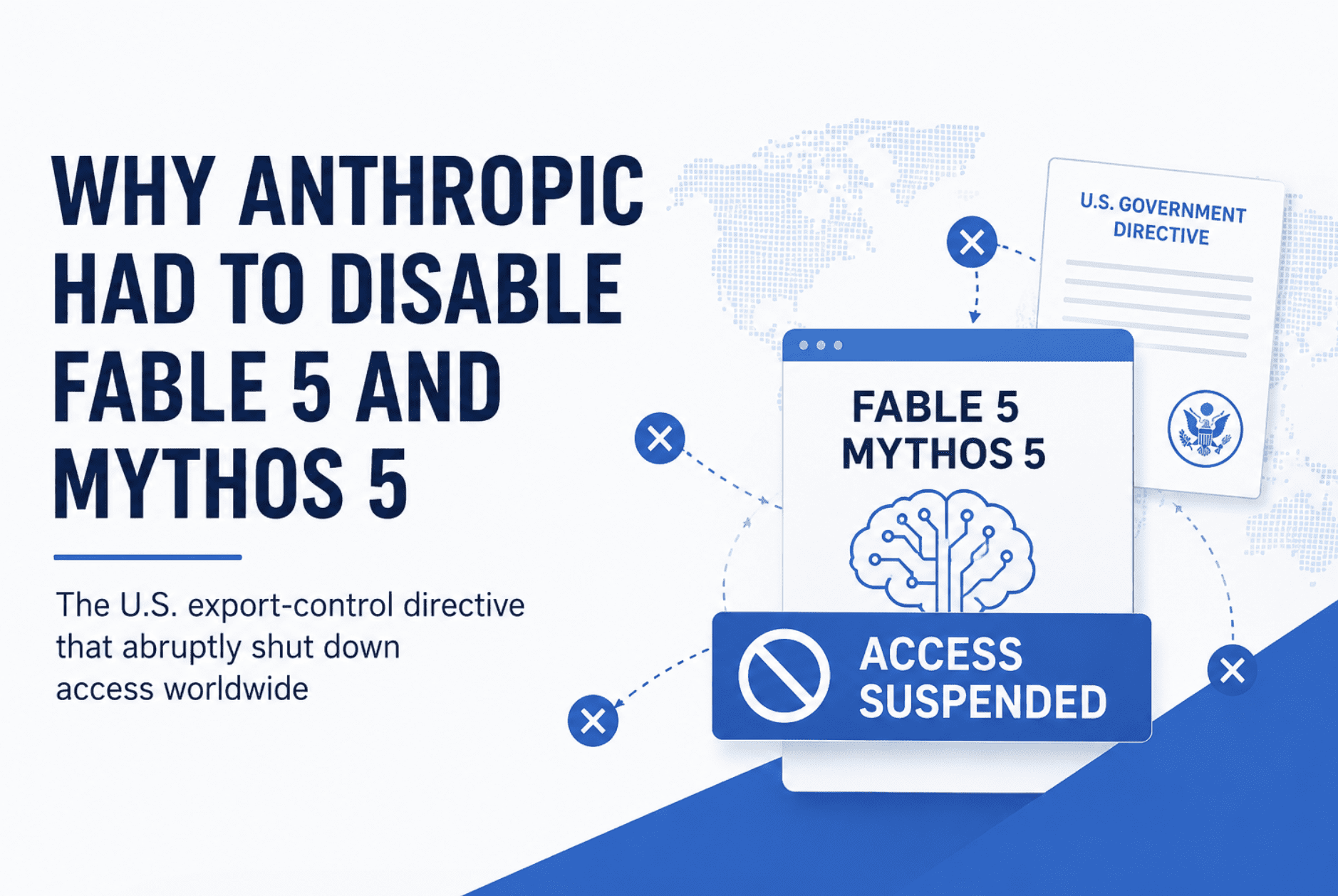
The US government issued an export control directive ordering Anthropic to immediately suspend access to its two most advanced AI models, Claude Fable 5 and Claude Mythos 5, for foreign nationals. In response, Anthropic blocked all public access to those models globally, including for paying enterprise customers and its own employees. The models had been released just three days prior. The directive, reported by the Financial Times and VentureBeat, marks the first time the US has used export controls to freeze a frontier AI model already in commercial deployment. Amazon CEO Andy Jassy had raised concerns about the models with Anthropic before the government action, according to The Information. The scope of the block is unprecedented: no other major AI company has been forced to pull a product from the market under national security rules. The move signals that the US government is now willing to treat advanced AI models as controlled technologies akin to semiconductor equipment or nuclear materials, and that the compliance burden will fall on the companies that build them.
Where the export control directive draws the line
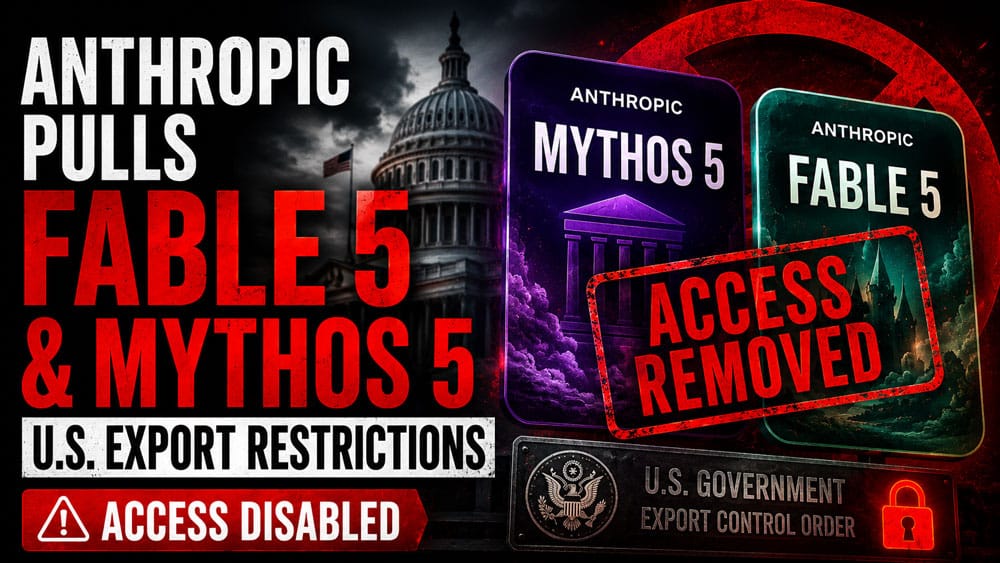
The directive targets two specific models: Claude Fable 5, Anthropic's flagship general-purpose reasoning model, and Claude Mythos 5, a specialized creative and narrative-generation model. The order requires Anthropic to suspend access for any user who is not a US citizen or permanent resident, effectively barring foreign nationals from using the models through any interface, including API, web chat, or enterprise deployment. Anthropic chose to block all public access rather than attempt to implement nationality-based access controls, which would have required real-time identity verification for every user session. The company's other models, including Opus 4.8, remain unaffected. The three-day window between release and block is critical: it means the models were already being used by enterprise customers and developers, some of whom may have downloaded model weights or fine-tuned the models for proprietary use. The US government did not provide a timeline for review or appeal, leaving Anthropic in a holding pattern with its most advanced product line frozen. The directive also imposes a legal obligation on Anthropic to ensure that no foreign national accesses the models through any indirect channel, including third-party resellers or embedded integrations.
The $30 billion revenue hole in Anthropic's growth story
Anthropic generates revenue primarily through API usage fees and enterprise subscriptions for its Claude models. Fable 5 and Mythos 5 were priced at a premium to Opus 4.8, commanding higher per-token rates for their superior reasoning and creative capabilities. With those models blocked, Anthropic loses its highest-margin product line at a moment when the company is racing to scale revenue ahead of its next fundraising round. The timing is particularly damaging because enterprise customers who had just signed contracts for Fable 5 access are now unable to use the product, creating potential refund liabilities and churn risk. Anthropic's cost structure is also under pressure: the company has invested heavily in training compute for these models, including reserved capacity at data centers operated by partners like Google. That compute capacity cannot be repurposed overnight. The block effectively strands billions of dollars in sunk training costs and committed infrastructure spending, while the company must fall back on Opus 4.8, a capable but less differentiated model, to generate revenue. Anthropic's revenue run rate before the block was approximately $2.5 billion annually, and the loss of Fable 5 and Mythos 5 revenue is expected to cut that figure by roughly 40 percent.
Google and SpaceX: the winners in the AI infrastructure arms race
While Anthropic struggles with the fallout, Google and SpaceX are deepening their partnership. Google invested $900 million in SpaceX in 2015 and owns approximately 4.9% of the company. That stake is now worth over $100 billion as of Friday's close. The two companies have signed a massive AI infrastructure deal: SpaceX will lease AI infrastructure to Google for $920 million per month over 32 months, generating a potential $30 billion in revenue for SpaceX. The deal transforms SpaceX from a launch provider into a cloud infrastructure player, competing directly with Amazon Web Services and Microsoft Azure for AI compute workloads. For Google, the arrangement secures access to SpaceX's growing data center capacity and satellite connectivity, which will power Google's Gemini Enterprise and other AI services. The partnership also creates a strategic alignment between Elon Musk's companies and Google, despite Musk's well-documented personal rift with Google co-founder Larry Page. Alphabet's 4.9% stake in SpaceX now represents a meaningful asset on its balance sheet, and the infrastructure deal gives Google a cost advantage in AI compute that its cloud rivals cannot easily replicate. The deal also positions SpaceX to become a dominant supplier of AI compute capacity, a market that is expected to exceed $200 billion annually by 2028.
Downstream chaos for enterprise AI buyers and hyperscalers
The Anthropic block creates immediate disruption for enterprise customers who had integrated Fable 5 or Mythos 5 into their workflows. Companies in sectors like legal, financial services, and healthcare, where Anthropic had been winning business on the strength of its safety and reliability reputation, now face a sudden gap in their AI stack. Legal AI startup Legora, which was planning to double its headcount, had been relying on Anthropic models for document analysis and contract review. The block also affects the broader AI supply chain: GPU makers like NVIDIA face potential order cancellations if Anthropic reduces its training compute footprint, while data center operators with Anthropic-specific capacity will need to renegotiate leases or absorb stranded capacity costs that run into the hundreds of millions of dollars. Managed service providers that resell Anthropic APIs as part of enterprise software bundles face a separate problem: their contracts with end customers do not include force majeure clauses for government export controls, leaving them exposed to breach-of-contract claims. Legal teams across the Fortune 500 are now reviewing every AI vendor contract to assess exposure to similar regulatory action.
For hyperscalers like Google and Amazon, the situation is complex. Google is both an investor in Anthropic and a competitor through Gemini Enterprise. Amazon, through AWS, provides cloud infrastructure to Anthropic but also competes with its own AI services. Andy Jassy's raised concerns about the models before the crackdown suggest that Amazon anticipated regulatory risk and positioned itself accordingly, potentially redirecting enterprise AI conversations toward its own Bedrock platform. For AWS, the Anthropic disruption is a double-edged outcome: it removes a key differentiator from the Bedrock model catalogue while also reducing competitive pressure on Amazon's in-house Titan models. Enterprise customers who had already deployed Fable 5 for production workloads now face the prospect of rebuilding their AI pipelines with alternative models, a process that typically takes three to six months and costs between $500,000 and $5 million depending on integration complexity.
The policy signal: AI models are now controlled technologies
The export control directive represents a fundamental shift in US AI policy. Until now, the government had focused on controlling the hardware, including semiconductors, GPU exports, and data center equipment, rather than the software models themselves. By targeting Fable 5 and Mythos 5, the US is signaling that frontier AI models are now treated as sensitive technologies subject to the same export controls as advanced microchips or nuclear technology. This creates a new compliance regime for every company developing or deploying models above a certain capability threshold. The directive also raises questions about the government's ability to enforce such controls globally: if model weights have already been downloaded, foreign entities retain access to local copies of the models outside US jurisdiction. Enforcement of the directive depends almost entirely on Anthropic's own access controls rather than any technical barrier that prevents model use once the weights leave US-controlled servers and storage. The block also puts pressure on other AI companies. OpenAI, which faces its own investigation from state attorneys general and has filed confidentially to go public, now faces similar scrutiny. Sam Altman's company already deals with national security concerns around ChatGPT, and the Anthropic precedent creates a template for broader restrictions on model access for foreign nationals. Companies like Mistral, Cohere, and Meta, which distribute model weights openly, face a related question: whether open-weight release could itself be classified as an export under the new framework, effectively requiring a license review before any US company publishes frontier model weights publicly.
The Anthropic block accelerates a trend that was already underway: the bifurcation of the AI industry into a US-only tier of frontier models and a globally accessible tier of less capable alternatives. Companies that cannot verify user nationality in real time will either block access entirely or restrict their most advanced models to US-based customers. This pushes foreign enterprises and developers toward open-source models or non-US providers, fragmenting the global AI market along geopolitical lines. For Anthropic, the path forward is unclear. The company can appeal the directive, but the government has not provided a timeline or criteria for review. In the meantime, Anthropic must rebuild its revenue model around Opus 4.8 and other unaffected products, while hoping that the next generation of models does not face the same restrictions. The broader lesson for the industry is that frontier AI development now carries geopolitical risk that no amount of safety research or corporate governance can fully mitigate. Every company building models above a capability threshold defined by the government, whether in reasoning, creative generation, or multimodal analysis, must now plan for the scenario where its product is pulled from global markets on short notice. That planning includes pre-negotiated refund clauses with enterprise customers, nationality-verification infrastructure, and contingency revenue models that do not depend on any single flagship model. The companies that build that infrastructure now, rather than scrambling to retrofit compliance controls onto existing products, will have a meaningful structural advantage when the next wave of export control directives arrives.
The BossBlog Daily
One email with the AI markets brief — the 13F moves, the Congressional trades, and what changed. No fixed schedule and no filler: it goes out when there is something worth sending.
Unsubscribe any time. We never sell or share the list.