
Anthropic pulled its two most advanced AI models, Claude Fable 5 and Claude Mythos 5, from global availability just three days after their launch, bowing to a US government export control order that blocks foreign nationals from accessing the technology. The San Francisco-based company suspended all public and enterprise access to the models, including for paying customers and employees, making it the first instance of a major AI lab taking a frontier model offline worldwide to comply with national security directives. The order, issued by the US government, targets the export of AI capabilities deemed sensitive, and Anthropic's compliance has left enterprises that had already begun integrating Fable 5 and Mythos 5 scrambling for alternatives. The move comes as the AI industry faces a cascade of structural shifts: a $30 billion AI infrastructure deal between SpaceX and Google is rewriting the cloud computing landscape, OpenAI is navigating legal investigations and a confidential IPO filing, and employees at both Anthropic and OpenAI have cashed out approximately $14 billion in shares. This export control action signals that the US government is now willing to enforce hard boundaries on AI model distribution, with immediate consequences for global enterprise customers and the competitive dynamics of the AI market.
Blanket shutdown of Fable 5 and Mythos 5
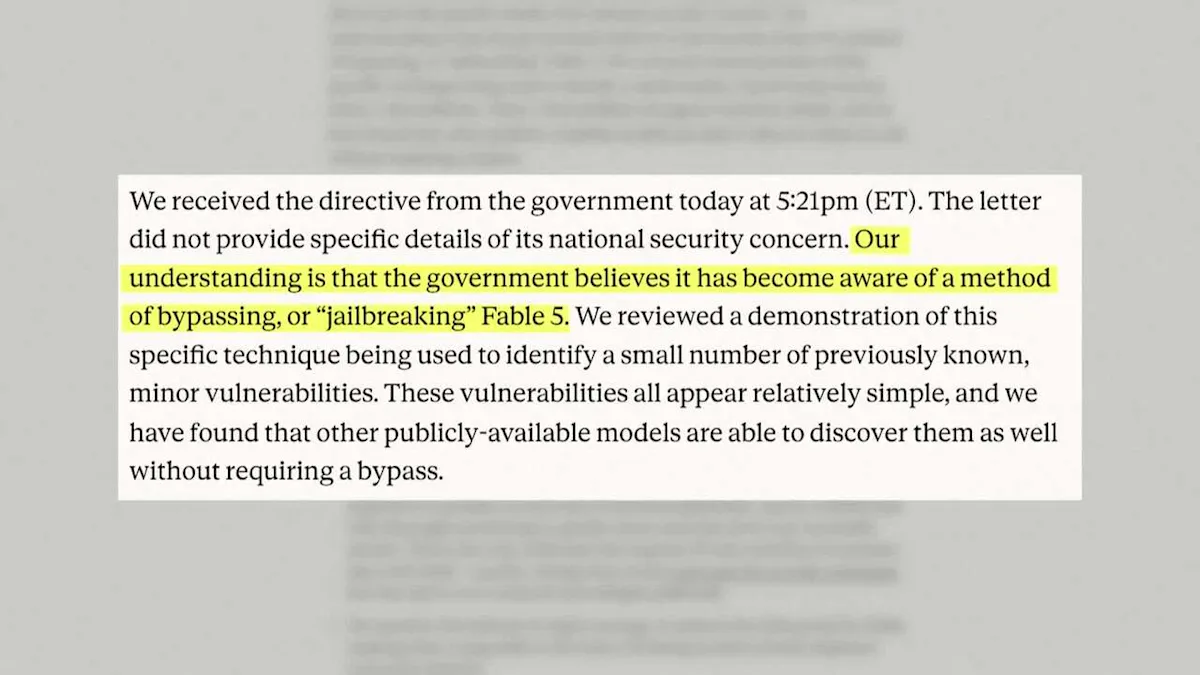
The US government ordered Anthropic to suspend access to Claude Fable 5 and Mythos 5 for foreign nationals, but the company went further by blocking global access entirely, including for its own employees and paying customers. This blanket shutdown, reported by VentureBeat, reflects the difficulty of enforcing nationality-based access restrictions on cloud-deployed AI models. Anthropic determined that the only way to comply with the order was to take the models offline everywhere, rather than risk inadvertent access by prohibited users. The models had been released only three days prior, meaning the government acted swiftly after their launch. Other Anthropic models, such as Opus 4.8, remain unaffected, indicating that the order targeted specific capabilities in Fable 5 and Mythos 5 rather than Anthropic's entire product line. The speed of the government's intervention shows that the US has developed a classification framework for AI model capabilities, and that Fable 5 and Mythos 5 crossed a threshold that triggered export controls. This is a significant departure from previous US AI policy, which relied on voluntary commitments from companies. The order also creates a precedent: any AI lab that releases a model with certain capabilities will now face immediate government action, forcing companies to pre-clear their most advanced models before launch. The order was backed by significant legal authority, and Anthropic's compliance was immediate and total.
Financial impact on Anthropic
The financial impact on Anthropic is immediate and severe. Fable 5 and Mythos 5 were likely the company's highest-margin products, commanding premium API pricing for enterprise customers. With those revenue streams cut off, Anthropic must now rely on Opus 4.8 and older models to generate income, compressing its average revenue per user and slowing its path to profitability. The timing is particularly painful because Anthropic and OpenAI employees have already cashed out approximately $14 billion in shares, with OpenAI alone facilitating over $9 billion in employee share sales via tender offers. This shows that both companies have been under pressure to provide liquidity to early employees, and the loss of Fable 5 and Mythos 5 revenue will make future fundraising or secondary sales more difficult. Meanwhile, the $30 billion AI infrastructure deal between SpaceX and Google, where SpaceX leases AI infrastructure to Google for $920 million per month over 32 months, demonstrates the scale of capital flowing into AI compute. Google invested $900 million in SpaceX in 2015, owning roughly 4.9% of the company, and that stake is now worth over $100 billion. This deal positions SpaceX as Google's cloud provider, a stunning reversal from the days when Elon Musk and Larry Page had a falling out over AI safety. The infrastructure spending underscores that while Anthropic faces a regulatory bottleneck, the compute arms race continues unabated.
Competitive reshuffle
The export control order creates a clear winner in OpenAI, which now has a direct path to capture Anthropic's enterprise customers. OpenAI is facing its own headwinds: it is under investigation by state attorneys general, and CEO Sam Altman apologized for failing to alert law enforcement about a mass shooting suspect's ChatGPT account. However, its models remain fully available globally. OpenAI also filed confidentially to go public, giving it a capital markets advantage that Anthropic lacks. Snowflake CEO Sridhar Ramaswamy, whose company partners with multiple AI providers, will likely see increased demand for multi-model orchestration as enterprises seek to diversify away from Anthropic. The SpaceX-Google deal also reshapes the cloud AI market: Google, through its partnership with SpaceX, gains access to Colossus data centers and becomes a more formidable competitor to AWS and Azure. Alphabet's stake in SpaceX, now worth over $100 billion, gives Google both a financial incentive and a strategic imperative to push SpaceX's AI infrastructure. This creates a three-way battle: Google-SpaceX vs. Microsoft-OpenAI vs. Amazon-Anthropic. With Anthropic's top models offline, Amazon's investment in Anthropic looks less valuable in the short term, potentially pushing AWS to accelerate its own model development or seek alternative AI partners. Google DeepMind, whose Gemini Enterprise tier remained unaffected by the export order, stands to absorb enterprise workloads that Fable 5 and Mythos 5 once dominated, particularly in regulated verticals like legal research and financial modeling. The competitive window is narrow: enterprises do not switch AI providers lightly, but a forced outage lasting more than two weeks typically triggers a formal vendor review.
Downstream effects on hyperscalers and enterprise buyers
Enterprise customers that had already deployed Claude Fable 5 and Mythos 5 face a sudden gap in their AI pipelines. These models were used for complex reasoning tasks, code generation, and financial analysis, and switching to Opus 4.8 or a competitor's model will require retesting, retraining, and potentially lower performance. The disruption will accelerate enterprise adoption of multi-model strategies, where companies maintain access to multiple AI providers to avoid single points of failure. This benefits platforms like Snowflake that offer model-agnostic AI services. For hyperscalers, the impact is mixed: Google gains from the SpaceX deal but loses if Anthropic customers migrate to OpenAI, which runs on Microsoft Azure. Microsoft benefits from OpenAI's IPO and the potential influx of Anthropic refugees, but faces regulatory risk if the US government expands export controls to other models. The $30 billion SpaceX-Google deal also has implications for data center construction: SpaceX's Colossus data centers will need to scale rapidly to meet Google's demand, driving capex for Nvidia's H100 and B200 GPUs, as well as networking equipment from Broadcom and Marvell. The deal's 32-month timeline suggests that both companies are betting on sustained AI demand through at least 2029. Canadian Prime Minister Mark Carney commented on the need for diversification after Anthropic's action, signaling that foreign governments are now factoring US export controls into their AI strategies.
Policy signal
The export control order against Anthropic represents a hardening of US AI policy under the Trump administration, which signed an AI initiative in December 2025. The order targets not just the models themselves but the underlying capabilities, showing that the US government has developed a classification system for AI model performance. This is a shift from the Biden-era approach of voluntary safety commitments and industry self-regulation. The involvement of figures like Howard Lutnick and David Sacks in the broader AI policy conversation indicates that the administration is taking a hands-on approach to AI governance. For Anthropic, the order creates a strategic dilemma: it can either comply and lose its most advanced product, or challenge the order in court and risk alienating the US government. The company's decision to comply fully, rather than seek a narrow exemption, shows that the order was backed by significant legal authority. The precedent set here will affect every AI lab: future model releases will require pre-approval from US export control authorities, slowing the pace of AI advancement. This is a net positive for OpenAI, which has already navigated the regulatory landscape and filed for IPO, and a net negative for smaller labs and open-source projects that lack the resources to engage with export control bureaucracy. The US government has signaled that it will use export controls as a primary tool for AI governance, and the global AI market must now operate within these constraints. The Bureau of Industry and Security, which oversees export controls, is expected to publish updated AI-specific regulations by the end of the third quarter, giving companies a clearer framework for pre-clearance.
The next six months will determine whether this export control action is an isolated incident or the beginning of a broader regulatory regime. If the US government extends similar restrictions to other models, the AI industry will face a structural slowdown in capability deployment, with enterprises forced to operate on older, less capable models. This would create a two-tier market: US-based customers with access to frontier models, and international customers limited to older or less capable alternatives. The SpaceX-Google deal, meanwhile, will accelerate the concentration of AI compute infrastructure in a small number of hands, making it harder for new entrants to compete. For Anthropic, the path forward involves either developing models that fall below the export control threshold, or investing heavily in compliance infrastructure to win approval for future releases. The company's ability to retain talent will be tested, especially after employees have already cashed out significant equity. OpenAI's IPO will provide a benchmark for how the public markets value AI companies, and the outcome will influence whether Anthropic pursues its own public offering. The $14 billion in employee cash-outs at both companies suggests that insiders are betting that current valuations are near a peak, and the export control order only reinforces that caution. The global AI race is entering a new phase where regulatory risk is as important as technical capability.
The BossBlog Daily
One email with the AI markets brief — the 13F moves, the Congressional trades, and what changed. No fixed schedule and no filler: it goes out when there is something worth sending.
Unsubscribe any time. We never sell or share the list.