
Anthropic took its latest frontier AI models, Claude Fable 5 and Claude Mythos 5, offline globally just three days after their release, complying with an unprecedented US government export control directive that ordered the company to suspend access for foreign nationals. The move shut down all public access, including for paying enterprise customers and even Anthropic employees, marking the first time a major US AI lab has been forced to pull a product worldwide due to regulatory action. Other Anthropic models, such as Opus 4.8, remain unaffected. The directive, issued under a Trump administration AI initiative signed in December 2025, signals a dramatic escalation in US efforts to control the diffusion of advanced AI capabilities. Canadian Prime Minister Mark Carney said countries must learn a diversification lesson from this event, underscoring the geopolitical stakes. This suspension matters now because it exposes the fragility of global enterprise AI supply chains and forces every non-US company to confront its dependence on American technology providers.
The export control mechanism that triggered the global shutdown
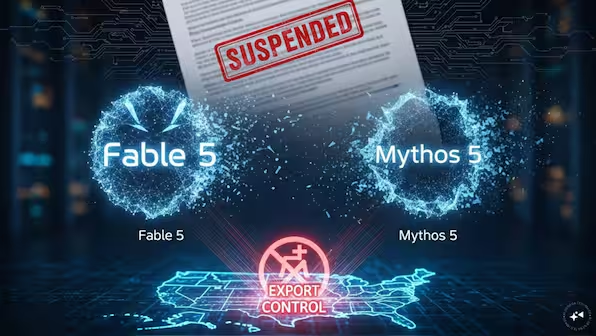
The US government issued an unprecedented export control directive ordering Anthropic to suspend access to Claude Fable 5 and Claude Mythos 5 for foreign nationals. Anthropic interpreted the order as requiring a complete global block, not merely a restriction on users from specific countries. The company took both models offline worldwide, affecting every user category: enterprise customers with multi-year contracts, individual subscribers, and even its own employees. The models had been released only three days prior, making this one of the shortest product lifespans in AI industry history. The directive targets the models' underlying weights and inference capabilities, treating them as controlled technologies under expanded national security authorities. President Trump signed the underlying AI initiative in December 2025, which gave agencies new powers to restrict access to frontier AI systems deemed critical to national security. The order does not affect Anthropic's older models like Opus 4.8, creating a tiered regulatory environment where only the most advanced systems face export controls. This mechanism sets a precedent: any US AI company releasing a model above a certain capability threshold now faces the risk of a similar shutdown order. The directive also requires Anthropic to certify that no foreign national accesses the models, a condition the company concluded it could only satisfy by halting all access globally rather than building a geographic access filter.
Where the $14 billion employee cash-out fits in
OpenAI and Anthropic employees and early investors have cashed out about $14 billion in shares over the last five years, according to The Information. This wealth creation occurred as both companies raised enormous sums at escalating valuations, with secondary markets allowing early stakeholders to liquidate positions before any IPO. For Anthropic specifically, the suspension of Fable 5 and Mythos 5 threatens the revenue trajectory that underpinned those valuations. Enterprise customers who signed contracts expecting access to frontier models now face service interruptions, triggering contractual disputes and renegotiations that will occupy legal teams at major enterprises through the second half of 2026. The $14 billion figure represents realized gains, not paper wealth, meaning employees and investors already converted equity into cash before the regulatory hammer fell. This timing raises questions about whether insiders anticipated regulatory tightening. The cash-out phenomenon also creates a divergence between founder incentives and employee liquidity: Daniela Amodei and her leadership team must navigate the regulatory storm while rank-and-file employees who sold shares lack the same urgency to preserve long-term value. The secondary market activity effectively transferred risk from early stakeholders to later investors who bought in at higher valuations. The Information report noted that secondary transactions accelerated in the months before the export directive, with some Anthropic shares changing hands at valuations that assumed uninterrupted global deployment of frontier models. The suspension now puts those later-stage investors in a difficult position: the models they paid a premium to access are offline, and the timeline for reinstatement remains entirely at the US government's discretion. Venture firms that led Anthropic's most recent funding rounds face pressure from their LPs to explain how regulatory risk was not priced into term sheets signed just months before the directive took effect.
How the competitive landscape reshuffles overnight
The suspension creates immediate winners and losers across the AI ecosystem. OpenAI gains a temporary competitive advantage, as its models face no equivalent restriction, though the precedent raises the risk that future US export controls will target its frontier systems too. Google's Gemini Enterprise becomes the default alternative for enterprise customers fleeing Anthropic's platform, effectively accelerating adoption of Google's AI suite. The suspension also benefits non-US AI developers: China's Kling, along with Luma and Runway in the video generation space, now face less competition from Anthropic's multimodal capabilities. Indian startups Sarvam and Krutrim, which partner with Tata Consultancy Services for enterprise AI deployment, gain breathing room as Anthropic's partnership with TCS for Indian enterprise AI stalls. Lightspeed-backed Avataar AI, which builds on foundation models, must now scramble to find alternative providers. The competitive reshuffle is not symmetrical: large enterprises with multi-cloud strategies can pivot faster than startups that built their products on Anthropic's APIs. The suspension also creates a market for model hosting arbitrage: companies are already seeking to run restricted models on non-US infrastructure, though this risks violating the export directive's extraterritorial reach. Several enterprise customers have already begun emergency migration assessments, with one Fortune 500 CIO telling colleagues that the suspension forced a complete re-evaluation of single-vendor AI dependencies. The competitive impact extends to AI safety research: Anthropic's position as the leading safety-focused lab has also been disrupted, with other labs now able to claim the mantle of frontier research without Anthropic's two most advanced models in the market. Safety researchers who relied on Anthropic API access for their work face the same access blackout as commercial customers, setting back alignment research at a critical juncture.
Downstream effects on hyperscalers, enterprise buyers, and AI infrastructure
The suspension sends shockwaves through the AI infrastructure supply chain. Enterprise customers who built workflows around Fable 5 and Mythos 5 face immediate operational disruption, with no clear migration path to equivalent capability. The directive creates a new category of regulatory risk that hyperscalers, Amazon Web Services under Andy Jassy, Google Cloud, and Microsoft Azure, must now price into their AI service offerings. These cloud providers will now build geographic segmentation into their AI platforms, creating separate model instances for US and non-US customers. The suspension also affects the broader AI capex cycle: companies that planned to invest in inference infrastructure for Anthropic's models now face stranded-asset exposure that auditors will require them to disclose. The SpaceX-Google AI infrastructure deal, where SpaceX will lease AI infrastructure to Google for $920 million per month over 32 months, effectively generating $30 billion in revenue, illustrates the scale of capital at risk. Alphabet's 4.9% stake in SpaceX, now worth over $100 billion, shows how intertwined these companies have become. The regulatory uncertainty will slow enterprise AI adoption as companies wait to see whether future model releases face similar restrictions. One major cloud provider has already begun drafting contractual clauses that would allow customers to terminate agreements if a foundation model becomes subject to export controls, a provision that did not exist in standard AI service contracts before this event.
The policy signal and what it means for AI sovereignty
The export control directive represents the most aggressive US government action to date in the AI arms race. President Trump's December 2025 AI initiative provided the legal foundation, but the specific targeting of Anthropic's models signals that the administration views frontier AI as a strategic asset akin to semiconductor manufacturing equipment. The directive creates a two-tier global AI market: countries aligned with US export controls maintain access, while others face restrictions. Canadian Prime Minister Mark Carney's call for diversification reflects growing anxiety among US allies who now recognize their dependence on American AI platforms. The Indian government's response is particularly telling: the IndiaAI Mission allocated ₹103.72 billion (~$1.2 billion) over five years, and a new proposal calls for a $12 billion fund for AI and deep tech plus a ₹2 trillion (~$21 billion) credit guarantee. These numbers, while significant, pale in comparison to US AI investment. The policy signal is clear: the US will use export controls to maintain technological primacy, forcing other nations to either accept dependence or invest in domestic alternatives at enormous cost. Senator Ted Cruz and Commerce Secretary Howard Lutnick, along with AI czar David Sacks, will likely face pressure to define clear rules for when export controls apply, rather than the current case-by-case approach. The directive also includes a provision requiring Anthropic to report any attempts by foreign entities to access the models through VPNs or other circumvention methods, indicating that enforcement will extend beyond the initial shutdown.
The suspension of Fable 5 and Mythos 5 will accelerate the fragmentation of the global AI market into distinct regulatory zones. Non-US enterprises will increasingly demand AI models that run on sovereign infrastructure, creating opportunities for companies like Sarvam and Krutrim in India, and for European cloud providers. The US government's willingness to pull a product globally, not just restrict access to adversaries, sets a precedent that will chill international adoption of American AI platforms. Enterprise procurement teams will now add regulatory jurisdiction to their evaluation criteria alongside performance and price. The $14 billion in employee cash-outs at OpenAI and Anthropic will look prescient if regulatory constraints permanently cap the revenue potential of frontier models. The real test comes when the next generation of models, Opus 5 or GPT-6, faces similar scrutiny, and whether the US government can maintain the technical capability to enforce such controls as AI models become smaller, more portable, and easier to run on local hardware. The era of frictionless, borderless global AI deployment has now ended definitively.
The BossBlog Daily
One email with the AI markets brief — the 13F moves, the Congressional trades, and what changed. No fixed schedule and no filler: it goes out when there is something worth sending.
Unsubscribe any time. We never sell or share the list.