
Goldman Sachs raised its 12-month target for the CSI 300 index to 5,500 from 5,300, signaling nearly 12% upside from current levels, as the bank pivots its China equity strategy toward mainland AI hardware plays. The revision comes with a downgrade of Hong Kong H-shares to market-weight, while the bank remains overweight on mainland A-shares. The call is anchored on a single statistic: AI hardware drove 85% of the $3.8 trillion in Chinese AI-related equity gains since January 2025. The Hang Seng Tech index is down more than 5.5% year to date, while the tech-heavy ChiNext board on the Shenzhen exchange has surged over 25% in the same period. The CSI 300 itself is up more than 6% year to date, compared with the Hang Seng Index's roughly 1.5% gain. Goldman's head of Asia equity research, Kinger Lau, is effectively telling investors that the real AI money in China is not in internet platforms listed in Hong Kong, but in the semiconductor and hardware supply chain on the mainland. This is a bet that the next leg of China's AI rally will be powered by physical infrastructure, not just software or services.
Where the $3.8 trillion AI rally concentrated

Goldman Sachs's $3.8 trillion figure for Chinese AI equity gains since January 2025 is the headline number, but the composition matters more than the total. The bank calculates that 85% of that gain (roughly $3.23 trillion) came from companies directly tied to AI hardware production, including chip design, advanced packaging, server assembly, and cooling equipment. Only 15% came from software, cloud services, and internet platforms. This concentration explains the bank's tactical shift out of Hong Kong-listed tech giants and into mainland-listed semiconductor names. The Hang Seng Tech index, which is heavy on Tencent, Alibaba, and Meituan, has underperformed dramatically, dropping more than 5.5% year to date. Meanwhile, the ChiNext index, which lists many smaller-cap hardware and chip companies, has gained over 25%. The CSI 300's 6% year-to-date advance sits between these extremes, reflecting its mix of financials, industrials, and consumer stocks alongside tech. Goldman's target implies the index will accelerate from here, driven by further hardware-led multiple expansion. The bank's analysts note that the hardware segment continues to attract the bulk of new capital inflows into Chinese equities, reinforcing the concentration trend. For portfolio managers running broad emerging-market mandates, this split creates a practical allocation problem: the benchmark exposure is concentrated in Hong Kong-listed names that have lagged, while the outperformers sit in onshore A-share indices that are harder to access via standard ETF wrappers. Goldman's rotation call is partly a product of this structural access gap closing, as more foreign capital gains direct market access to the STAR and ChiNext boards through Stock Connect channels.
ASPEED's new chip lineup targets data center security and management
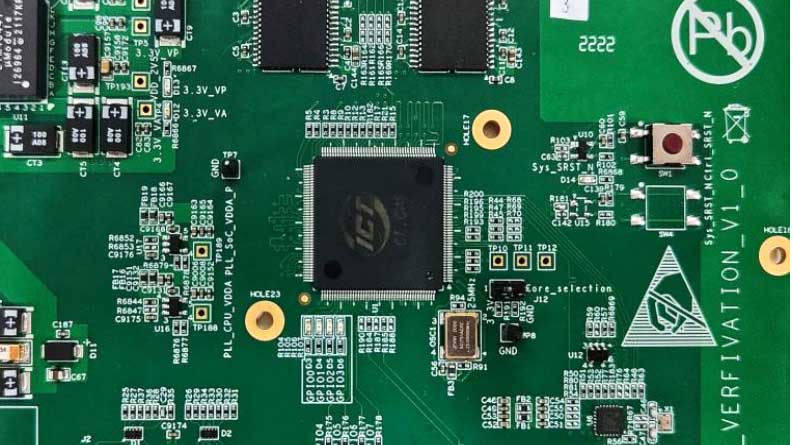
At COMPUTEX 2026, ASPEED Technology Inc. debuted a suite of server management chips that directly address the security and operational demands of AI data centers. The centerpiece is the AST1840 Satellite Management Controller (SMC) with embedded FPGA, developed in partnership with Lattice Semiconductor. This chip combines a baseboard management controller with programmable logic, allowing data center operators to customize security and management functions in hardware rather than software. ASPEED also introduced the AST1040 SMC and the AST1080 Platform Root of Trust (PRoT) SoC, both of which adopt the Caliptra 2.x SiRoT security architecture (an open-standard hardware root of trust developed by the Open Compute Project). The company's flagship AST2700 8th-generation BMC continues to serve as the primary management controller for high-end servers. ASPEED's subsidiary Cupola360 Inc. showcased its Reality Remote Management (RRM) platform, which combines hardware, software, AI, and IoT sensors to provide 360-degree remote monitoring of data center physical infrastructure. The message from ASPEED is clear: as AI clusters scale to tens of thousands of accelerators, the management and security plane must be hardened at the silicon level. These product launches position ASPEED to capture a larger share of the server management market as Chinese hyperscalers ramp up their AI data center deployments. The company's decision to partner with Lattice Semiconductor for the eFPGA core, rather than sourcing from a China-domestic FPGA supplier, reflects a pragmatic assessment of where best-in-class programmable logic comes from. That partnership also gives ASPEED access to Lattice's security toolchain, accelerating time-to-certification for data center buyers who require third-party audit trails before deploying new management silicon in production clusters.
Competitive reshuffle: who gains and who loses from the hardware pivot
Goldman's rotation out of Hong Kong H-shares and into mainland A-shares creates clear winners and losers among Chinese tech companies. The magnitude of that rotation signal matters: Goldman's downgrade of H-shares to market-weight from overweight affects how the bank's clients weight their allocations across China's dual-listed market structure, which spans hundreds of billions of dollars in aggregate active positioning. The losers are the Hong Kong-listed internet giants (Tencent, Alibaba, Meituan, and JD.com), which have dominated the Hang Seng Tech index and now face a downgrade in weighting. These companies benefited from the initial AI narrative around large language models and cloud integration, but their share prices have stagnated as investors question monetization timelines. The winners are mainland-listed semiconductor and hardware companies, including SMIC, Hua Hong Semiconductor, and a range of chip design houses and equipment makers listed on the ChiNext and STAR boards. ASPEED, though headquartered in Taiwan, supplies server management chips to every major Chinese server OEM and benefits indirectly from the mainland hardware buildout. The $3.8 trillion AI equity gain since January 2025 has been overwhelmingly captured by hardware names, and Goldman's call reinforces that capital will continue flowing into that segment. The Hang Seng Tech index's 5.5% year-to-date decline versus ChiNext's 25% gain is the market's verdict on which companies actually profit from AI infrastructure spending. Goldman's analysts expect this divergence to widen as more global funds rotate their China allocations toward hardware plays.
Downstream effects on hyperscalers, fabs, and enterprise buyers
The hardware-first AI thesis has direct implications for China's semiconductor supply chain and data center construction. Chinese hyperscalers (Alibaba Cloud, Baidu AI Cloud, Tencent Cloud, and Huawei Cloud) are all racing to deploy domestic AI accelerators, which requires massive investment in advanced packaging, high-bandwidth memory (HBM), and server management silicon. ASPEED's new chips, particularly the AST1840 with embedded FPGA, enable these hyperscalers to implement custom security and management policies without waiting for new ASIC tapeouts. The adoption of the Caliptra 2.x SiRoT architecture across ASPEED's product line signals that Chinese data center operators are prioritizing hardware-level security against supply chain attacks. For foundries like SMIC and Hua Hong, the AI hardware boom drives demand for mature-node chips used in power management, interface bridges, and server management (not just leading-edge processors). Enterprise buyers, including state-owned banks and telecom operators, are increasing their AI server procurement budgets, which flows directly to mainland-listed server manufacturers and component suppliers. The second-order effect is a capex cycle that benefits the entire Chinese semiconductor ecosystem, from EDA tools to packaging houses. Industry estimates suggest that Chinese hyperscalers will spend over $50 billion on AI infrastructure in 2026, with a significant portion allocated to domestic hardware suppliers.
Policy and strategy signal: Beijing's AI infrastructure playbook
Goldman's call is not just a stock-picking exercise; it is a read on where Chinese industrial policy is heading. Beijing has made AI hardware self-sufficiency a national priority, channeling state-backed funds into domestic chip design, advanced packaging, and equipment manufacturing. The CSI 300 target revision aligns with the government's push to channel capital into the real economy rather than speculative internet platforms. The Hang Seng Tech index's underperformance reflects the regulatory overhang on Hong Kong-listed tech companies, which face ongoing scrutiny over data security and antitrust compliance. By contrast, mainland-listed hardware companies benefit from subsidies, procurement preferences, and favorable IPO rules on the STAR and ChiNext boards. ASPEED's adoption of the open-standard Caliptra architecture, rather than a proprietary security solution, mirrors Beijing's preference for open, auditable hardware standards that reduce dependence on foreign IP. GoodVision AI's "7-Layer AI Cake" framework, which conceptualizes AI as a token industrial system spanning generation, distribution, orchestration, and optimization, provides a strategic vocabulary for this shift. The framework positions hardware as the foundational layer of a vertically integrated AI economy, exactly the model Beijing is building through state-directed investment. The National Integrated Circuit Industry Investment Fund (the "Big Fund") has allocated additional capital to domestic chip packaging and testing companies in recent months, further validating this policy direction.
The next phase of China's AI rally will test whether the hardware thesis can sustain its momentum. Goldman's 5,500 target on the CSI 300 implies that the index has room to run, but the composition of gains will matter more than the headline number. If AI hardware names continue to outperform, the ChiNext and STAR boards will attract increasing allocations from global funds rotating out of Hong Kong. The broader implication is that the AI hardware super-cycle is no longer just a US and Taiwan story; China's mainland market has become a parallel epicenter for infrastructure-layer equity gains, with Goldman's call marking a formal acknowledgment of that shift in global capital allocation. ASPEED's COMPUTEX product launches demonstrate that the server management silicon layer is evolving rapidly to meet the scale and security demands of AI clusters. The Caliptra 2.x architecture adoption across the industry creates a de facto standard that benefits ecosystem players like Lattice Semiconductor and ASPEED. GoodVision AI's framework provides a conceptual map for investors trying to understand which layers of the AI stack capture value. The risk is that hardware spending peaks before software monetization materializes, leaving semiconductor stocks with stretched valuations. For now, Goldman's call is a bet that China's AI infrastructure buildout has years of runway, and that the hardware companies supplying it will continue to capture the lion's share of equity gains.
The BossBlog Daily
Essential insights on AI, Finance, and Tech. Delivered every morning at 06:00 Asia/Shanghai. No noise.
Unsubscribe anytime. No spam.