
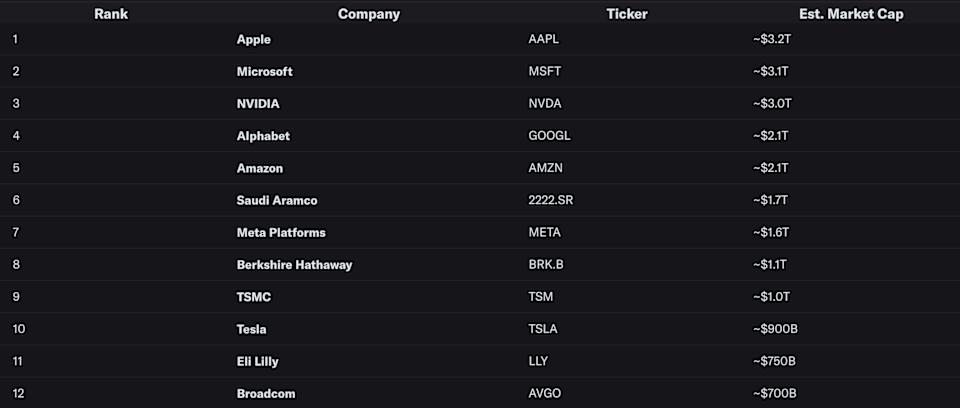
SpaceX plans to price its initial public offering as early as June 11 and list on Nasdaq under ticker SPCX, with a prospectus expected to go public as soon as May 20, 2026. The company targets raising approximately $75 billion at a valuation of roughly $1.75 trillion, making it the largest IPO in history. It is more than double Alibaba's $25 billion listing in 2014 and triple the $26 billion raised by Saudi Aramco. Goldman Sachs has secured the coveted lead left position on the prospectus, with Morgan Stanley, Bank of America, Citigroup, and JPMorgan Chase rounding out the top five lead bookrunners. The IPO timeline has been accelerated significantly: the roadshow kicks off June 4, pricing occurs June 11, and shares begin trading June 12. A total of 23 investment banks are involved, including a wider syndicate of Barclays, Deutsche Bank, UBS, Royal Bank of Canada, Mizuho Financial Group, and Macquarie Group. The Securities and Exchange Commission's faster-than-expected review contributed to the compressed schedule, signaling regulatory efficiency for high-profile offerings. This IPO matters now because it sets a new benchmark for tech listings and arrives amid a wave of mega IPOs from AI companies, with OpenAI and Anthropic also preparing to go public.
$75 Billion Primary Capital and the 3.5%–3.75% Float
SpaceX's IPO structure targets raising roughly $75 billion in primary capital, a figure that dwarfs every previous tech listing. The company merged with xAI in February 2026, valuing the combined entity at $1.25 trillion, but the IPO valuation is expected to reach north of $2 trillion based on the offering price. This implied valuation jump reflects investor appetite for SpaceX's dominant position in launch services and Starlink's growing revenue base. The deal is structured to bring up to $75 billion at a valuation above $2 trillion, meaning the offering represents roughly 3.5%–3.75% of the post-IPO company. This is a relatively small float for a listing of this magnitude. The underwriting fee pool is estimated between $800 million and over $1 billion, with some estimates pegging the fees at more than $500 million. For context, Goldman Sachs earned $535 million in fees from the Alibaba IPO in 2014, which raised $25 billion. The fee rate for SpaceX, approximately 1.2% of the total raise, is consistent with mega-deal economics where absolute dollar amounts compensate for lower percentage rates. The 23-bank syndicate structure ensures global distribution capacity, with Barclays covering UK investors, Deutsche Bank and UBS handling European demand, RBC serving Canadian accounts, Mizuho targeting Asian institutions, and Macquarie addressing Australian funds. The sheer size of the raise will absorb significant liquidity from the equity capital markets, potentially crowding out smaller IPOs scheduled for the same window.
How Underwriting Fees Flow Through Bank P&Ls
Goldman Sachs's lead left position on the SpaceX prospectus generates outsized economics for the firm. As lead left underwriter, Goldman will command the largest share of the fee pool, likely 15%–20% of total fees, or $120 million to $200 million based on the $800 million to $1 billion estimated range. Morgan Stanley serves as stabilization agent and handles retail allocation, a dual role that generates additional compensation beyond standard underwriting fees. The retail allocation piece is particularly lucrative: SpaceX may allocate up to 30% of the offering to retail investors through platforms including E-Trade, Charles Schwab, Fidelity, Robinhood, and SoFi. This retail tranche commands higher fee rates because of the operational complexity of managing millions of individual orders. For Goldman, the SpaceX mandate reinforces its dominance in mega-deal underwriting and positions the firm for future AI IPOs from OpenAI and Anthropic, both of which are preparing to go public. Goldman shares rose nearly 6% on the news of the lead left selection, reflecting investor recognition that this mandate signals continued franchise strength. The fee economics also benefit the broader syndicate: the 16 additional banks beyond the top five will split the remaining fees, with each earning $10 million to $30 million depending on allocation and distribution performance. For banks like Mizuho and Macquarie, participation in the SpaceX syndicate provides marquee deal credentials that justify future mandates from other tech unicorns.
Competitive Reshuffle Among Underwriters and Exchanges
Goldman Sachs's selection as lead left underwriter reshapes the competitive dynamics among bulge-bracket banks. The mandate is a direct win over Morgan Stanley, which had been widely expected to lead given its strong relationships with Elon Musk's other ventures. Morgan Stanley did secure the stabilization agent role and retail allocation mandate, but the lead left position carries the most prestige and the largest fee share. Bank of America, Citigroup, and JPMorgan Chase round out the top five, each securing meaningful but secondary roles. The wider syndicate includes regional champions: Barclays represents UK investors, Deutsche Bank and UBS cover Europe, RBC handles Canada, Mizuho serves Asia, and Macquarie addresses Australia. This geographic distribution ensures global demand coverage and prevents any single region from dominating the book. For Nasdaq, winning the SpaceX listing is a strategic victory over the New York Stock Exchange. The ticker SPCX will become one of the most actively traded symbols on the exchange, driving listing fees, data revenue, and prestige. The IPO also pressures other exchanges globally to compete for mega-listings, particularly as AI companies like OpenAI and Anthropic prepare their own public offerings. For retail brokerage platforms, the 30% retail allocation creates a competitive battleground. Robinhood, SoFi, E-Trade, Charles Schwab, and Fidelity will each compete for order flow, potentially offering incentives like commission-free trading or priority allocation to attract SpaceX-hungry retail investors.
Downstream Effects on Hyperscalers, Fabs, and Enterprise Buyers
SpaceX's $75 billion IPO and its $1.75 trillion valuation will ripple through the broader technology and space ecosystem. The capital raise provides SpaceX with substantial dry powder to accelerate Starlink deployment, Starship development, and satellite manufacturing capacity. This directly impacts hyperscalers like Amazon, which competes with Starlink through its Project Kuiper satellite internet initiative. Amazon will need to increase its own capex to keep pace with Starlink's accelerated rollout, potentially pressuring its cloud margins. For semiconductor fabs and chip designers, SpaceX's expanded satellite production drives demand for radiation-hardened chips, RF components, and power management ICs. Companies like Cerebras, which supplies AI compute for space applications, could see increased orders as SpaceX integrates xAI's technology into satellite constellations. Enterprise buyers of satellite internet services, including oil and gas companies, maritime operators, and rural broadband providers, will benefit from increased capacity and potentially lower prices as Starlink scales. The IPO also pressures legacy satellite operators like Iridium and Globalstar, which face a well-capitalized competitor with superior technology and lower cost structure. For the broader IPO market, SpaceX's massive offering absorbs significant institutional capital, potentially pushing smaller IPOs to later windows. The SEC's fast review of SpaceX's filing sets a precedent for regulatory efficiency, which could encourage other high-profile companies to accelerate their own listing timelines. OpenAI and Anthropic, both preparing to go public, will watch SpaceX's debut closely as a signal of market appetite for AI-enabled mega-caps.
Policy and Strategy Signal for the IPO Market
The SpaceX IPO represents a strategic inflection point for US capital markets and regulatory policy. The SEC's faster-than-expected review of SpaceX's filing signals a shift toward accommodating mega-listings, potentially in response to concerns about US exchanges losing share to international competitors. This regulatory efficiency creates a template for other high-profile offerings, particularly from AI companies like OpenAI and Anthropic that are preparing to confidentially file IPO drafts. Goldman Sachs's lead role reinforces the firm's strategy of dominating mega-deal underwriting, a playbook that CEO David Solomon has prioritized since taking the helm. The bank's success with SpaceX positions it to lead future AI IPOs, potentially creating a virtuous cycle where lead left mandates beget more lead left mandates. For Elon Musk, the IPO represents a liquidity event of unprecedented scale, allowing him to monetize his SpaceX stake while maintaining control through a dual-class structure. The merger with xAI in February 2026, which valued the combined entity at $1.25 trillion, integrated Musk's AI ambitions with his space operations, creating a vertically integrated technology powerhouse. The IPO also tests investor appetite for founder-led companies with concentrated voting power, a structure that has drawn criticism from corporate governance advocates but remains popular with growth investors. Jim Cramer and other market commentators have noted that SpaceX's IPO could reignite the retail trading frenzy seen during the 2020–2021 meme stock era, particularly given the 30% retail allocation. The offering will serve as a bellwether for whether the IPO market can absorb mega-deals without disrupting broader market functioning.
The SpaceX IPO will reshape the equity capital markets for years to come. A successful debut at $75 billion would validate the mega-IPO structure and encourage other private companies to accelerate their listing timelines. OpenAI is preparing to confidentially file its IPO draft as soon as this week, with Goldman Sachs and Morgan Stanley already working on the mandate. Anthropic is expected to follow within months. The combined wave of SpaceX, OpenAI, and Anthropic IPOs could raise over $150 billion in 2026, absorbing institutional capital and potentially crowding out smaller offerings. For retail investors, the 30% allocation represents an unprecedented opportunity to access a high-profile stock at the IPO price, democratizing participation in a way that previous mega-IPOs did not. However, the concentration of underwriting fees among a handful of banks raises questions about competition in the IPO advisory market. The SEC's fast review of SpaceX's filing sets a precedent that could accelerate the listing process for other companies, reducing the traditional six-to-nine-month timeline to as little as three months. For Elon Musk, the IPO provides liquidity without requiring him to sell his Tesla stake, preserving his position as the electric vehicle maker's largest individual shareholder. The listing also gives SpaceX a public currency for acquisitions, potentially accelerating its consolidation of the space industry. Whether the $1.75 trillion valuation holds in aftermarket trading will depend on Starlink's subscriber growth and Starship's operational milestones, but the IPO itself is already a historic event that redefines what is possible in public markets.
The BossBlog Daily
Essential insights on AI, Finance, and Tech. Delivered every morning at 06:00 Asia/Shanghai. No noise.
Unsubscribe anytime. No spam.
Tools mentioned
AffiliateSelected partner tools related to this topic.
AI Copilot Suite
Content drafting, summarization, and workflow automation.
Try AI Copilot →
AI Model Monitoring
Track model quality, latency, and drift with alerts.
View Monitoring Tool →
Low-fee Global Broker
Multi-market access with transparent pricing.
Open Broker Account →
Some links above are affiliate links. We earn a commission if you sign up through them, at no extra cost to you. Affiliate revenue does not influence editorial coverage. See methodology.
The BossBlog Daily
Essential insights on AI, Finance, and Tech. Delivered every morning at 06:00 Asia/Shanghai. No noise.
Unsubscribe anytime. No spam.
Tools mentioned
AffiliateSelected partner tools related to this topic.
AI Copilot Suite
Content drafting, summarization, and workflow automation.
Try AI Copilot →
AI Model Monitoring
Track model quality, latency, and drift with alerts.
View Monitoring Tool →
Low-fee Global Broker
Multi-market access with transparent pricing.
Open Broker Account →
Some links above are affiliate links. We earn a commission if you sign up through them, at no extra cost to you. Affiliate revenue does not influence editorial coverage. See methodology.