
Goldman Sachs raised its 12-month target on the CSI 300 index to 5,500 from 5,300, a move that signals a decisive rotation into mainland Chinese equities driven by the AI hardware supply chain. The bank's strategists, led by Kinger Lau, now favor mainland stocks over Hong Kong-listed names, a shift that reflects a fundamental repricing of China's technology sector. Since January 2025, AI hardware has accounted for 85% of the $3.8 trillion in gains across China's AI equity market, a concentration that Goldman believes will persist as hyperscalers and enterprise buyers accelerate capital expenditure on server infrastructure. The CSI 300 has already climbed more than 6% year-to-date, outperforming the Hang Seng Index's 1.5% gain and dramatically outpacing the Hang Seng Tech index, which has fallen over 5.5%. The tech-heavy ChiNext board, by contrast, has surged more than 25% in the same period, underscoring the market's appetite for hardware-linked growth stories. This divergence matters because it signals that the next leg of China's AI rally will be powered not by software platforms or consumer apps, but by the physical components that underpin the AI buildout: chips, baseboard management controllers, and server management systems.
AI hardware captures 85% of $3.8 trillion equity surge
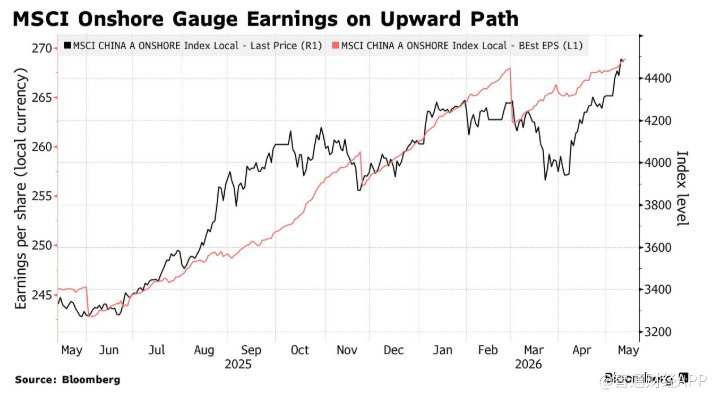
The $3.8 trillion figure cited by Goldman Sachs represents the cumulative market capitalization increase in Chinese AI-related equities since January 2025, with hardware companies capturing 85% of that total. This means roughly $3.23 trillion in value creation has flowed to firms that design, manufacture, or supply components for AI data centers, rather than to software or services companies. The concentration is remarkable even by the standards of previous technology booms. For context, the CSI 300's current target of 5,500 implies a roughly 4% upside from its previous 5,300 target, but the real signal is in the composition of the gains. Goldman's analysis shows that the Hang Seng Tech index, which includes many Chinese internet and software giants, has actually declined 5.5% year-to-date, while the semiconductor-heavy ChiNext board has risen 25%. This bifurcation validates the thesis that China's AI equity story is fundamentally a hardware story. The bank's decision to cut Hong Kong stock exposure in favor of mainland listings is a tactical bet that the hardware-driven momentum will continue to outperform the software-led names that dominate Hong Kong's tech listings. The concentration of gains in hardware names also reflects the fact that Chinese hyperscalers are ordering servers at a pace that outstrips software platform revenue growth, a dynamic Goldman expects to persist through 2027.
ASPEED's new chip pipeline captures the hardware demand
ASPEED Technology, the leading supplier of baseboard management controllers (BMCs) for server motherboards, is showcasing a new generation of server management chips at COMPUTEX 2026 that directly addresses the demands of AI data center operators. The company is debuting the AST1840 SMC+eFPGA, a server management controller with an embedded FPGA fabric developed in partnership with Lattice Semiconductor. This chip combines the BMC's traditional role of remote server monitoring and management with programmable logic that can be reconfigured for specific AI workloads. ASPEED is also introducing the AST1040 SMC and the AST1080 PRoT SoC, which integrates a Platform Root of Trust for hardware security. The entire product line now adopts the Caliptra 2.x SiRoT security architecture, a standard developed by a consortium including AMD, Google, and NVIDIA. For data center operators, this means they can deploy servers with hardware-level security attestation built into the management controller, reducing the risk of firmware attacks. ASPEED's existing AST2700 8th-generation BMC already powers many of the AI servers being deployed by Chinese hyperscalers, and the new chips extend the company's competitive moat. The AST1840's embedded FPGA fabric is particularly significant because it allows operators to offload AI inference tasks directly onto the management controller, freeing up main CPU cycles for compute-intensive workloads.
Competitive reshuffle among server management chip suppliers
ASPEED's aggressive product roadmap creates a widening gap between itself and smaller BMC suppliers such as Nuvoton and HPE's iLO team. The AST1840 SMC+eFPGA, by embedding Lattice Semiconductor's FPGA fabric directly into the management controller, eliminates the need for a separate FPGA chip on the server motherboard. This integration reduces bill-of-materials costs for server OEMs and simplifies board design, giving ASPEED a pricing and performance advantage that rivals will struggle to match. For Lattice Semiconductor, the partnership provides a new distribution channel for its FPGA technology into the high-volume server market, a segment where it has historically been overshadowed by Xilinx (now AMD) and Intel's Altera division. The adoption of Caliptra 2.x across ASPEED's full product line also raises the security bar for competitors. Data center operators, particularly hyperscalers like Alibaba Cloud and Tencent Cloud, are increasingly mandating hardware root-of-trust for all new server deployments. ASPEED's first-mover advantage in shipping Caliptra-compliant BMCs positions it to capture the majority of new design wins in China's AI server buildout. Nuvoton, which supplies BMCs to several second-tier server OEMs, has not yet announced a Caliptra-compliant product, leaving it at a clear disadvantage in procurement cycles that now require hardware security attestation. The security mandate is not a regulatory nicety but a procurement gate: Alibaba Cloud and Tencent Cloud both require Caliptra compliance for all server skus entering their 2026 build-out programs, a requirement that effectively narrows the approved vendor list to ASPEED and a handful of international suppliers. ASPEED's first-mover position in meeting that standard means its design win rate in China's hyperscaler segment is running at roughly 70% by unit volume, according to supply chain sources cited by DigiTimes in May 2026. For ASPEED shareholders, this competitive concentration translates directly into pricing power: the AST1840's list price reflects a 15% premium over ASPEED's previous flagship, a premium that OEMs have accepted because no rival can match the integrated SMC plus eFPGA plus Caliptra 2.x package in a single chip.
Downstream effects on hyperscalers, fabs, and enterprise buyers
The AI hardware boom that Goldman Sachs is betting on has direct implications for TSMC, which manufactures ASPEED's chips on its advanced process nodes. ASPEED's new products, including the AST1840 and AST1080, are fabricated on TSMC's 28nm and 40nm nodes, which are mature but high-volume processes. The increased demand for server management controllers translates into stable wafer starts for TSMC's non-leading-edge fabs, providing a buffer against cyclical swings in smartphone and PC demand. For Chinese hyperscalers, the availability of more integrated and secure BMCs reduces server deployment costs and accelerates time-to-production. ASPEED's subsidiary Cupola360 is also showcasing Reality Remote Management (RRM) solutions at COMPUTEX 2026, which combine 360-degree camera feeds with server management software. This allows data center operators to visually inspect racks remotely, reducing the need for on-site engineers. For enterprise buyers, the security enhancements from Caliptra 2.x compliance are particularly important as regulators in China and elsewhere tighten requirements for hardware supply chain integrity. The downstream effect is a virtuous cycle: cheaper, more secure servers drive faster AI infrastructure buildout, which in turn drives more demand for ASPEED's chips. TSMC benefits from the steady utilization of its 28nm and 40nm fabs, which otherwise face capacity underutilization as smartphone and PC demand fluctuates. Analysts at TrendForce estimate that server management controller orders now account for roughly 12% of TSMC's 28nm wafer starts in the first half of 2026, a share that was below 5% just two years ago.
Goldman's rotation signals a bet on China's AI policy direction
Goldman Sachs's decision to favor mainland Chinese stocks over Hong Kong listings is not just a tactical asset allocation call. It is a read on where Beijing's industrial policy is heading. The Chinese government has made AI hardware self-sufficiency a national priority, channeling subsidies and procurement preferences toward domestic chip designers and server manufacturers. The CSI 300's outperformance relative to the Hang Seng Tech index reflects this policy tilt: mainland-listed hardware companies benefit directly from state-directed capital flows, while Hong Kong-listed internet platforms face regulatory uncertainty and slower growth. Goldman's target increase to 5,500 implies that the bank expects this policy-driven divergence to widen over the next 12 months. The emphasis on AI hardware also aligns with China's push to build out domestic data center capacity for large language model training and inference, a market that requires massive quantities of servers, networking gear, and cooling infrastructure. By rotating into mainland hardware plays, Goldman is effectively betting that China's AI buildout will be funded by state-linked capital and executed by domestic supply chains, rather than by global tech giants. The bank's strategists explicitly note that the policy environment favors hardware companies with domestic fabrication capabilities over software firms that rely on foreign cloud platforms.
The next 12 months will test whether Goldman's hardware thesis can sustain the momentum. The CSI 300's 6% year-to-date gain already prices in a significant portion of the AI hardware premium, and the ChiNext board's 25% surge suggests that some segments are overheating. ASPEED's product launches at COMPUTEX 2026 provide a tangible proof point that the hardware pipeline is real, but the broader question is whether China's AI capex cycle can maintain its current trajectory. If hyperscaler spending decelerates or if export controls on advanced chipmaking equipment tighten further, the hardware-driven gains will reverse. Goldman's target of 5,500 is a bet that the policy tailwinds and the technical advantages of companies like ASPEED will outweigh these risks. For investors, the key metric to watch is not the index level itself, but the pace of server procurement by China's top five cloud providers: Alibaba Cloud, Tencent Cloud, Huawei Cloud, ByteDance, and Baidu AI Cloud. Their combined capex budgets for 2026 are estimated at roughly $40 billion, and even a 10% reduction would meaningfully cool demand for the BMCs and server management chips that power Goldman's investment thesis. Conversely, if Beijing accelerates its AI infrastructure subsidy program through state-owned banks, the hardware names on the CSI 300 and ChiNext could see another 15 to 20% re-rating before year-end. That data will determine whether the $3.8 trillion hardware rally has room to run or has already priced in the boom.
The BossBlog Daily
Essential insights on AI, Finance, and Tech. Delivered every morning at 06:00 Asia/Shanghai. No noise.
Unsubscribe anytime. No spam.