
For the first time in the current monetary policy cycle, financial markets now expect the Federal Reserve's next move to be a rate hike, not a cut. The CME Group's FedWatch tool, the benchmark for rate expectations, shows a 51% probability of a 25-basis-point hike at the December 2026 Federal Open Market Committee meeting. That probability rises to roughly 60% for the January 2027 meeting and exceeds 71% for March. The shift follows a string of hotter-than-expected inflation data, with consumer, wholesale, and import prices all exceeding forecasts. Meanwhile, the 30-year Treasury yield breached the psychologically critical 5% threshold, its highest level in over a year, sending shockwaves through equity markets. The 10-year yield also hit its highest point in roughly a year, casting a long shadow over stock valuations. This marks a complete reversal from just months ago, when traders were pricing in multiple rate cuts for 2026. Now, Kalshi traders assign a 68% probability of no cuts at all this year and a 50% chance of a hike before July 2027. The emerging narrative is one of stagflation, defined as high inflation combined with slowing growth, and incoming Fed Chair Kevin Warsh will inherit a central bank forced to tighten policy just as the economy shows cracks.
The Data Cascade That Flipped the FedWatch Tool
The market's flip from rate-cut expectations to rate-hike pricing is rooted in a series of data releases that have consistently surprised to the upside on inflation. Consumer price inflation in recent months hit its highest level since 2023, while wholesale and import price indices also ran above consensus forecasts. This data cascade forced traders to abandon the long-held view that the Fed's next move would be a cut. The FedWatch tool, which aggregates pricing in fed funds futures contracts, now shows the December 2026 meeting as a coin toss for a hike. The January 2027 meeting carries a roughly 60% probability of a 25-basis-point increase, and the March 2027 meeting shows a probability above 71%. These probabilities are derived from the pricing of CME-listed fed funds futures, which reflect the market's expectation for the average federal funds rate over each contract month. The shift is dramatic: futures markets now show below 1% odds of a June 2026 rate cut, a near-total collapse from earlier this year when cuts were the base case. The policy rate currently sits in the 3.50%??.75% range, where the Fed under Jerome Powell has held it since December 2025. Three FOMC officials dissented against the April 2026 policy statement over what they viewed as an easing bias, signaling internal pressure for a more hawkish posture well before the latest data. That dissent was prescient: the subsequent inflation prints have validated the minority view and forced the broader committee to acknowledge that the rate path has tilted decisively toward tightening. Fed watchers at Reuters noted that retail sales remained resilient through the same period, which complicates the picture further. A soft landing requires inflation to fall without the consumer cracking, and the data so far suggests the first condition is not being met.
How the 30-Year Yield at 5% Reshapes the P&L for Banks and Asset Managers
The 30-year Treasury yield crossing 5% is not just a headline number. It directly impacts the profitability and balance-sheet math for major financial institutions. For banks like Bank of America, a 5% long-end yield widens net interest margins on new loan origination but simultaneously crushes the market value of their existing bond portfolios. The unrealized losses on held-to-maturity securities, already a sore spot after the 2023 regional banking crisis, will deepen. For asset managers and pension funds, the 5% yield on the long bond resets the discount rate used for liability calculations. Corporate pension plans will see their funded status improve as higher discount rates lower the present value of future obligations, but insurers holding long-duration assets face mark-to-market losses. The yield surge also pressures equity valuations directly: the equity risk premium, which measures the excess return stocks offer over risk-free bonds, compresses as the risk-free rate rises. For growth stocks and high-duration assets like technology shares, a 5% 30-year yield is a direct headwind to valuation multiples. The sell-off in Treasury bonds is also raising funding costs for the U.S. government, with the Treasury Department facing higher interest expense on new issuance and upcoming refinancings. This dynamic feeds back into fiscal concerns, as higher debt-service costs constrain future spending and increase the deficit, creating a self-reinforcing cycle that bond vigilantes are already punishing.
The Competitive Reshuffle: Who Gains and Loses in a Hike Regime
A Fed that pivots to hiking reshuffles the competitive landscape across financial services and corporate borrowing. Regional banks, which rely on net interest income from floating-rate loans, stand to benefit from a higher rate environment if deposit costs remain sticky. However, the unrealized losses on their bond portfolios, a key vulnerability exposed in 2023, will worsen as yields rise further. Money-center banks like Bank of America have more diversified revenue streams but face the same balance-sheet pressure. On the other side, highly leveraged companies and private equity sponsors that loaded up on variable-rate debt during the low-rate era face a refinancing crunch. The leveraged loan and high-yield bond markets are already repricing, with spreads widening as default risk increases. For the housing market, the 30-year mortgage rate, which tracks the 10-year Treasury yield, will push higher, crushing affordability and reducing transaction volumes. This hurts mortgage originators and real estate brokers while benefiting large servicers that earn fee income regardless of volume. In the derivatives market, CME Group benefits from increased hedging activity as volatility spikes. The FedWatch tool itself becomes a more heavily trafficked product as traders scramble to position for the new regime. Kalshi, the prediction market platform, is also seeing elevated volume on its Fed rate contracts, with traders assigning a 50% chance of a hike before July 2027.
Downstream Effects on Hyperscalers, Fabs, and Enterprise Buyers
The rise in long-term yields and the prospect of Fed hikes will cascade through capital-intensive sectors, particularly technology infrastructure. The major hyperscalers, including Amazon Web Services, Microsoft Azure, and Google Cloud, are in the midst of a multi-year capital expenditure cycle, building data centers and purchasing AI chips. A 5% risk-free rate raises their cost of capital directly, as these companies finance a portion of their capex through debt issuance. The higher discount rate also reduces the net present value of long-duration AI and cloud investments, potentially slowing the pace of new data center construction. For semiconductor fabs, including TSMC's Arizona facility and Intel's Ohio project, the cost of financing multi-billion-dollar fabrication plants just got more expensive. The CHIPS Act subsidies provide some buffer, but private capital commitments will face a higher hurdle rate. Enterprise buyers of IT hardware and software, who often use leasing or vendor financing, will see higher implicit interest costs in their procurement contracts. This could delay refresh cycles for servers, networking gear, and enterprise software subscriptions. The bond market turmoil also affects corporate treasury departments, which manage short-term cash portfolios. With the 30-year yield at 5%, many treasurers will extend duration to lock in yields, pulling money from money market funds and short-term bank deposits. This shift in cash allocation reduces bank funding and tightens liquidity in the short-term credit markets, creating a second-order tightening effect that mirrors a de facto Fed hike.
What the Warsh Transition Signals About Fed Policy Direction
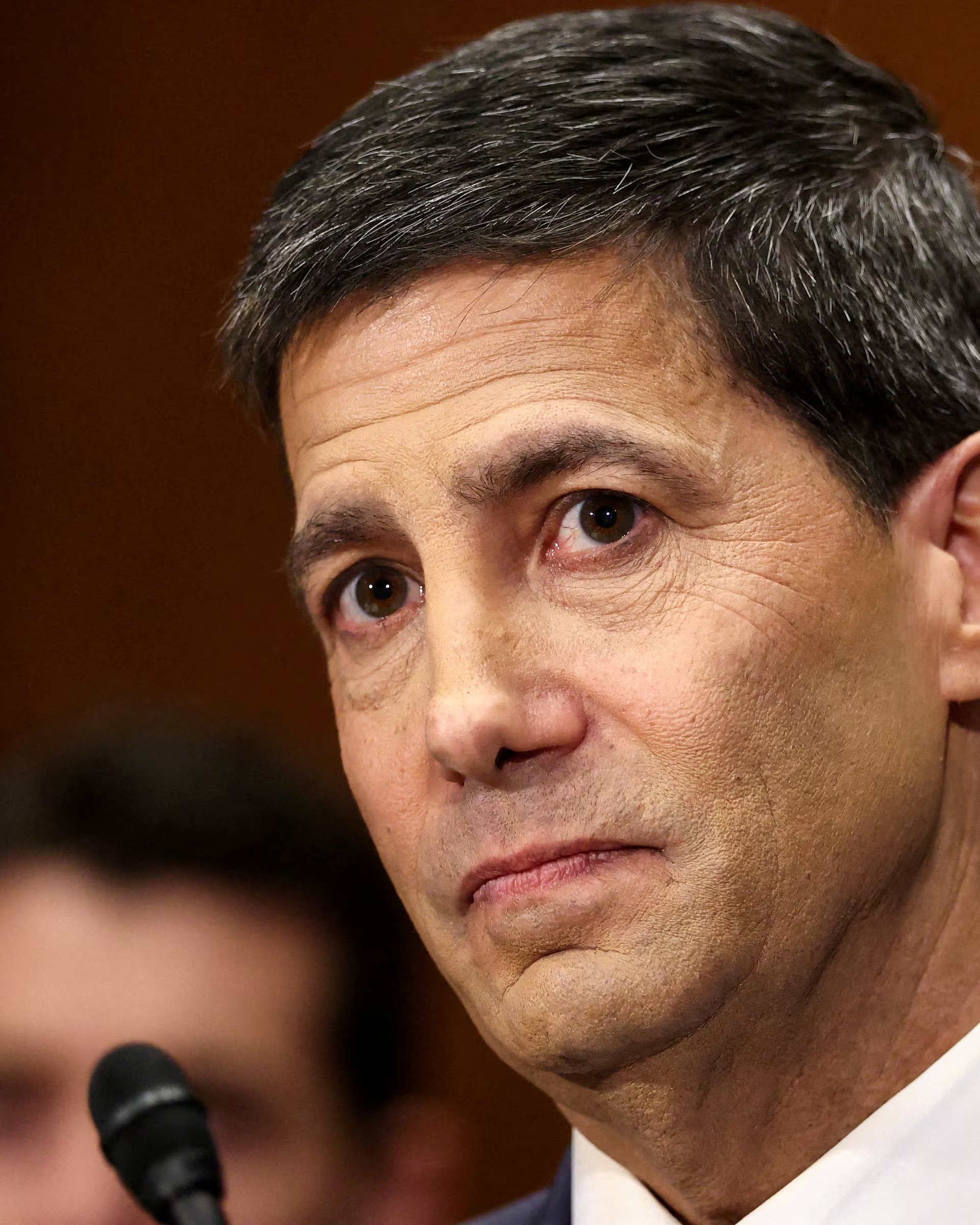
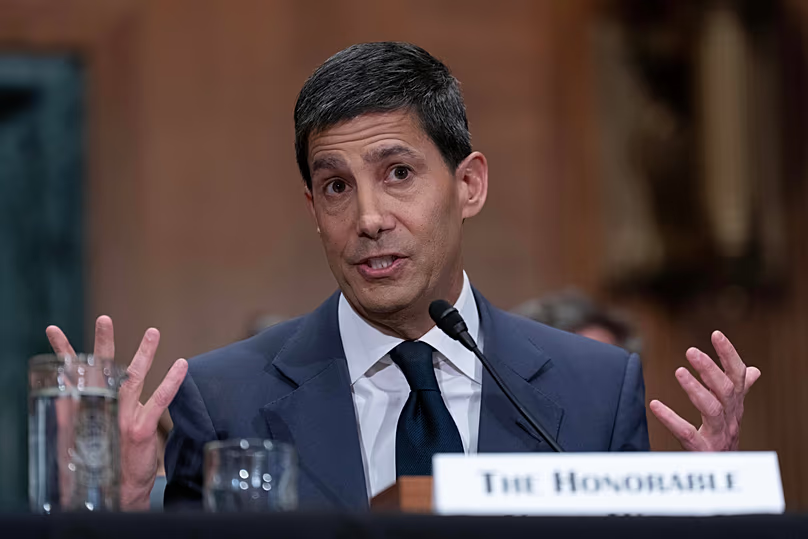
The market's repricing of rate expectations is unfolding against the backdrop of a leadership transition at the Federal Reserve. Kevin Warsh, a former Fed governor who served during the 2008 financial crisis, is set to take over as chair. Warsh inherits a central bank that is grappling with a policy error: the FOMC's April 2026 statement carried an easing bias that three officials publicly dissented against, and the subsequent data has proven the dissenters correct. The incoming chair's challenge is to re-anchor inflation expectations without triggering a recession. Warsh's public statements and past writings suggest a hawkish inclination. He has criticized the Fed's post-2020 framework for being too slow to tighten. Markets will parse his first FOMC statement and press conference for signals on the pace of normalization. The transition itself creates a period of uncertainty: Powell's final meetings are constrained by lame-duck dynamics, while Warsh's first meeting will be closely watched for a change in forward guidance. The probability of a hike before year-end, now at 51%, reflects the market's view that Warsh will move quickly to establish credibility. The risk is that the Fed overtightens into a slowing economy. Consumer confidence is at all-time lows, and labor market data is showing cracks. These are early signs of the stagflation that bond traders are now pricing in. Warsh's ability to navigate this narrow path will define the early months of his tenure and set the tone for monetary policy through 2027.
The market's pricing of a Fed hike and a 5% 30-year yield is not a temporary blip but a structural repricing of the macro regime. The probability of a June 2026 rate cut has collapsed to below 1%, and Kalshi traders see a 68% chance of no cuts at all this year. This shows that the era of easy money is definitively over, and the new normal is one of higher risk-free rates, wider credit spreads, and compressed equity multiples. The incoming Fed chair will need to manage the transition from a market that expected accommodation to one that demands tightening, all while the economy shows signs of stagflation. The bond market is now the primary transmission mechanism of policy, and at 5%, the 30-year yield is doing the Fed's work for it. The question is whether Warsh will validate that move or push back against market pricing. Either way, the next six months will determine whether the Fed can avoid the policy mistake that markets are now pricing in.
The BossBlog Daily
One email with the AI markets brief — the 13F moves, the Congressional trades, and what changed. No fixed schedule and no filler: it goes out when there is something worth sending.
Unsubscribe any time. We never sell or share the list.