
Aave is locked in a federal legal battle over approximately $71 million in Ether frozen on Arbitrum, with North Korea terrorism creditors asserting claims over the funds even as a court has cleared the transfer of 30,766 ETH back to the lending protocol. The case, which pits a decentralized finance giant against judgment creditors holding three underlying rulings against North Korea totaling more than $877 million, marks the first major clash between DeFi recovery efforts and sovereign terrorism victims seeking to enforce asset seizures. Aave has asked the federal court to unblock the crypto, arguing the funds belong to its users, not the state sponsor of terrorism. Separately, Kelp DAO suffered a $292 million exploit on April 18, 2026, which it blames on LayerZero infrastructure, and now plans to relaunch on Chainlink's CCIP. Solv Protocol is migrating over $700 million in tokenized Bitcoin from LayerZero to Chainlink CCIP as well. These two developments signal that DeFi's cross-chain plumbing is entering a new era of regulatory entanglement and protocol risk: legal exposure from sovereign sanctions claims on one side, and catastrophic bridge security failures on the other.
Frozen ETH on Arbitrum: The $71M legal standoff
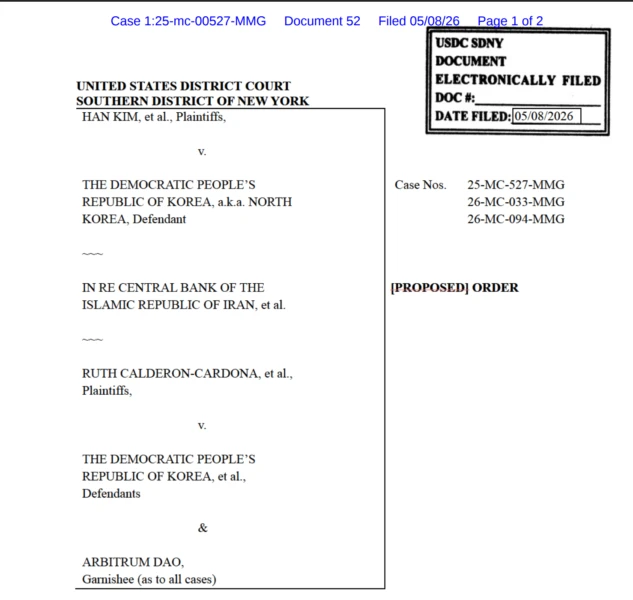
The 30,766 ETH at the center of the dispute sits on Arbitrum, the leading Ethereum layer-2 network, and was frozen after terrorism creditors obtained judgments against North Korea. Aave, the decentralized lending protocol, argues the funds belong to its users and should not be treated as assets of the North Korean state. The court has cleared the transfer of the Ether from Arbitrum to Aave, but the creditors retain their legal claim over the crypto, meaning Aave could still be forced to disgorge the value if the court rules against it. The three underlying judgments against North Korea total over $877 million, giving the creditors a strong incentive to pursue any crypto assets they can link to the regime. Aave's legal team, including lawyers from Morrison Cohen LLP and Gerstein Harrow, is arguing that the funds are user deposits, not state assets, and that freezing them violates the rights of innocent lenders and borrowers on the protocol. The case is being watched closely by the broader DeFi industry, as it tests whether decentralized protocols can shield user funds from sovereign seizure claims. If the creditors win, it will set a precedent that any crypto flowing through a protocol with ties to a sanctioned entity is vulnerable to attachment, chilling lending activity across the sector. The frozen funds represent roughly 0.3% of Aave's total value locked, but the legal exposure is disproportionate to the amount at stake.
Kelp DAO's $292M exploit: A bridge too far

Kelp DAO, the liquid restaking protocol behind rsETH, suffered a $292 million exploit on April 18, 2026, which the DAO attributes to a vulnerability in LayerZero's cross-chain messaging infrastructure. The exploit drained funds from Kelp DAO's contracts, leaving rsETH undercollateralized and triggering a crisis of confidence in the protocol. In response, Kelp DAO announced plans to migrate its entire cross-chain operations from LayerZero to Chainlink's CCIP, a direct competitor in the interoperability space. The migration is not just a technical fix; it is a statement about the economics of bridge security. LayerZero had been the dominant cross-chain protocol for many DeFi applications, but the Kelp DAO exploit, combined with Solv Protocol's simultaneous decision to move over $700 million in tokenized Bitcoin off LayerZero, creates a $1 billion-plus flight of total value locked from the platform. Chainlink CCIP, which offers formal verification and a more conservative security model, is now positioned as the safer alternative. The cost of this migration for Kelp DAO includes not only technical integration expenses but also the reputational damage of the exploit, which will raise its cost of capital as lenders demand higher yields to compensate for perceived risk. The exploit is the largest single loss from a cross-chain bridge in 2026.
Competitive reshuffle: Aave, Kelp DAO, and the winners of the bridge crisis
The LayerZero exploit has reshuffled the competitive landscape in DeFi. Aave, which has no direct exposure to the Kelp DAO exploit, benefits indirectly as a safe haven for lending activity fleeing protocols with bridge risk. The $71 million frozen on Arbitrum, however, creates a separate overhang for Aave, as users now question whether their deposits are safe from legal claims. Kelp DAO faces an existential threat: the $292 million exploit has eroded trust in rsETH, and the migration to Chainlink CCIP will take weeks or months, during which the protocol's total value locked will decline further. Solv Protocol's decision to move over $700 million in tokenized Bitcoin to Chainlink CCIP is a clear vote of confidence in the Chainlink ecosystem and a blow to LayerZero's market share. Chainlink, with its CCIP product, emerges as the clear winner, capturing two high-profile migrations totaling over $1 billion in assets. LayerZero, meanwhile, must now defend its reputation and prove that its infrastructure is secure enough to retain the rest of its user base. The DeFi United recovery effort, which has raised over $320 million to restore rsETH backing, shows that the community is willing to backstop a protocol in crisis, but that money is a stopgap, not a solution to the underlying security flaw. The fund is significant beyond Kelp DAO: if it successfully restores rsETH's collateral backing, it will establish a precedent that decentralized communities can mobilize nine-figure capital to absorb systemic bridge failures without relying on centralized custodians or government deposit guarantees. That outcome strengthens the long-term case for DeFi self-insurance mechanisms. It also raises a harder question for regulators: if markets can price bridge risk and communities can self-rescue at scale, the rationale for prescriptive government intervention weakens, even as cases like the Aave-North Korea dispute suggest sovereign enforcement still has reach.
Downstream effects on hyperscalers, fabs, and enterprise buyers
The LayerZero exploit and the Aave legal case have downstream implications that extend beyond DeFi. The migration of over $1 billion in assets from LayerZero to Chainlink CCIP will increase demand for Chainlink's oracle services, which in turn drives transaction volume on Ethereum and its layer-2s, including Arbitrum. This benefits infrastructure providers like Consensys, which builds tools for Ethereum developers, and Coinbase, which operates the Base layer-2 and offers staking services. The legal uncertainty around the Aave frozen funds will slow enterprise adoption of DeFi lending, as corporate treasurers and fintech companies like Stripe, which has been expanding its crypto services, will demand clearer legal protections before deploying capital into protocols that might be subject to sovereign seizure claims. Digital Currency Group, which has investments across the crypto ecosystem, faces indirect exposure through its portfolio companies that use LayerZero or Arbitrum. The $320 million DeFi United recovery fund, while large, is a fraction of the total value at risk in cross-chain bridges, and regulators like Summer Mersinger at the CFTC are likely to scrutinize whether these protocols have adequate risk management frameworks. The broader message for enterprise buyers is that bridge security is now a first-order risk factor, not a technical footnote.
Policy signal: What the Aave case says about DeFi's regulatory future
The Aave legal battle with North Korea terrorism creditors is a canary in the coal mine for DeFi regulation. The case tests whether decentralized protocols can claim that user funds are not subject to asset freezes or seizures tied to sovereign sanctions. If the court rules that the 30,766 ETH on Arbitrum is fair game for creditors, it will create a powerful incentive for protocols to implement know-your-customer and anti-money laundering controls, even if they claim to be fully decentralized. Joseph Lubin, CEO of Consensys, has been a vocal advocate for regulatory clarity in DeFi, and this case gives him ammunition to argue that protocols need legal safe harbors to operate without constant litigation risk. The three judgments against North Korea totaling over $877 million show that the U.S. legal system is willing to use crypto seizures as a tool of foreign policy, and DeFi protocols that cannot distinguish between user deposits and state-linked assets will face increasing legal exposure. Jason Nelson, writing for Decrypt, has noted that the case is a "stress test" for DeFi's claims of jurisdictional neutrality. The outcome will influence how protocols design their smart contracts, whether they integrate on-chain identity solutions, and how they handle frozen assets in future disputes. The case also casts a long shadow over DeFi's expansion in emerging markets. Latin American users have increasingly turned to lending protocols for access to dollar-denominated credit, depositing BTC and ETH as collateral to borrow stablecoins like USDC without liquidating their holdings. A ruling that exposes those user deposits to sovereign seizure claims would undermine the financial inclusion argument that the DeFi sector has used to justify its existence to skeptical regulators. Protocols cannot easily exit obligations created by U.S. federal court judgments, and fintech companies building user-friendly fiat on-ramps into DeFi will demand legal clarity before scaling. For now, Aave is fighting to keep the funds moving, but the legal claim remains, and the clock is ticking.
The Aave case and the Kelp DAO exploit together mark a turning point for DeFi. The industry can no longer pretend that cross-chain bridges are purely technical infrastructure — they are now legal and regulatory battlegrounds. The $71 million frozen on Arbitrum will be fought over in federal court for months or years, and the outcome will shape how protocols handle sanctions compliance, asset recovery, and user protection. The $1 billion-plus flight from LayerZero to Chainlink CCIP signals that the market is voting with its feet, choosing formal verification and institutional-grade security over the speed and flexibility that made LayerZero popular. DeFi United's $320 million recovery fund shows that the community is willing to backstop a crisis, but that is a reactive solution, not a preventive one. The next exploit will come, and the next legal battle will follow. Protocols that invest in robust security, clear legal frameworks, and transparent governance will survive; those that rely on trust alone will not. The era of DeFi as a regulatory gray zone is ending, and the winners will be the ones that adapt first.
The BossBlog Daily
One email with the AI markets brief — the 13F moves, the Congressional trades, and what changed. No fixed schedule and no filler: it goes out when there is something worth sending.
Unsubscribe any time. We never sell or share the list.