
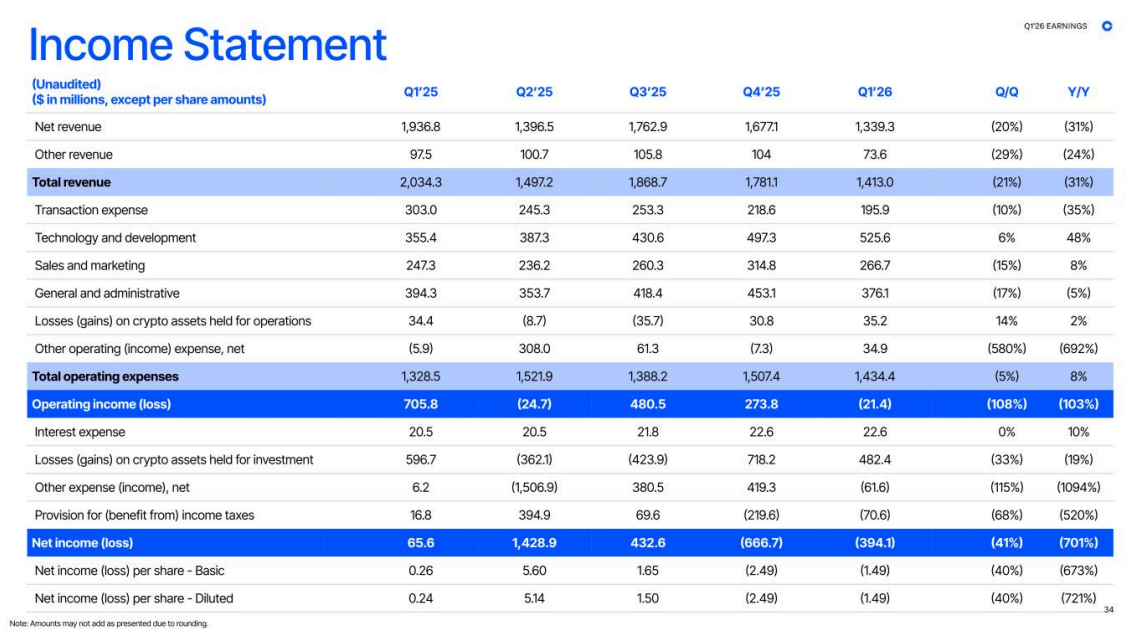
Coinbase dropped a bombshell on the eve of Consensus 2026 in Miami, reporting a $394 million net loss for the first quarter despite $1.4 billion in net revenue. The exchange's transaction revenue collapsed 40% year-over-year to $756 million, sending its stock down 5% in after-hours trading. The earnings miss lands as thousands of crypto executives, regulators, and traders gather at the annual CoinDesk conference, where the agenda is stacked with bullish themes: tokenized commodities, prediction markets, and the institutionalization of perpetual swaps. But the Coinbase loss forces a sobering question onto the floor: if the largest publicly traded crypto exchange cannot sustain profitability through a bull market, what does that say about the business model underpinning the entire industry? The answer matters because Consensus 2026 is supposed to mark crypto's transition from speculative casino to regulated financial infrastructure, and Coinbase's red ink shows that transition is still costing more than it pays.
The Structural Revenue Collapse Behind Coinbase's $394M Loss
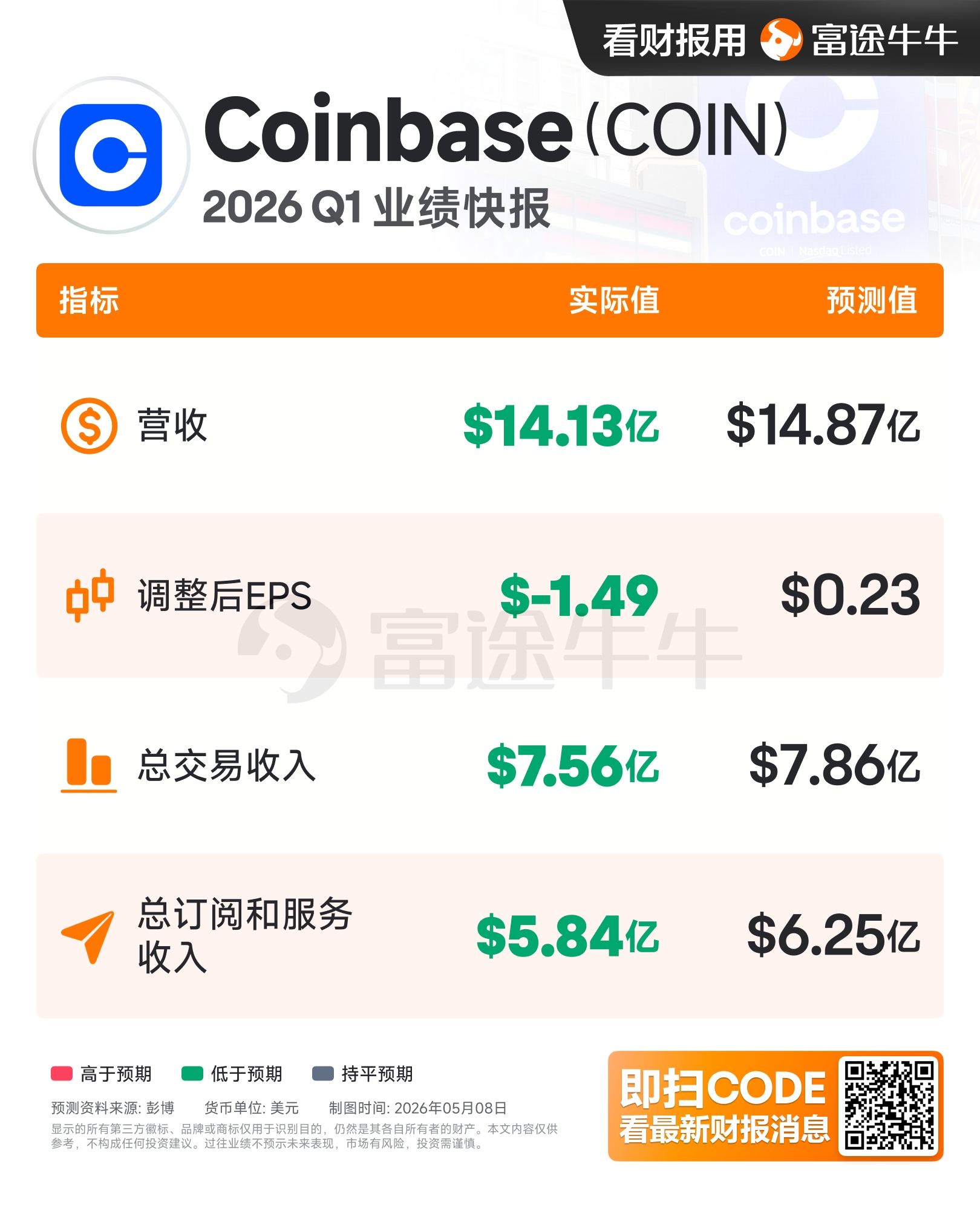
Coinbase's Q1 2026 loss of $394 million is not a one-off accounting anomaly. Net revenue dropped 31% from the prior quarter to $1.4 billion, and transaction revenue, which covers the core business of facilitating trades, plunged 40% to $756 million. The after-hours stock drop of 5% reflects investor recognition that the revenue decline is structural, not cyclical. Retail trading volumes have migrated to lower-fee venues and decentralized exchanges, while institutional clients increasingly execute large blocks over-the-counter or via prime brokers that compress Coinbase's spread. The company's cost base has not adjusted accordingly. Headcount, compliance infrastructure, and cloud computing expenses remain elevated from the 2024 hiring spree, creating a fixed-cost burden that amplifies every dollar of revenue shortfall. The loss also exposes Coinbase's vulnerability to fee compression in a market where Binance and HIP-3 are driving $103 billion in TradFi perpetual swap volumes in April alone. Coinbase's retail-heavy model cannot match the scale or fee efficiency of those platforms, and the Q1 numbers prove it. The company's take rate on spot trades now sits at roughly 5x the fee levels of leading perp platforms, a premium that shrinking volumes make unsustainable.
How the $103B Perp Volume Reshapes Revenue Pools
The $103 billion in TradFi perpetual swap volumes recorded in April by Binance and HIP-3 represents a structural shift in where crypto revenue is generated. Perpetual swaps now dwarf spot trading volumes across the industry, and the fee pools are migrating to platforms that offer commodity-hedging products, not just bitcoin and ether pairs. This volume is driven by institutional commodity hedgers using tokenized silver, oil, and other real-world assets as collateral for perp positions. The revenue pool is moving away from Coinbase's spot-trade model and toward platforms that combine perp infrastructure with tokenized commodity settlement. For Coinbase, the math is brutal: its transaction revenue of $756 million in Q1 represents a take rate that is roughly 5x higher than the perp platforms, but its volumes are a fraction of the $103 billion monthly flow. The market is voting with its liquidity, and it is choosing the lower-fee, higher-volume perp model. Unless Coinbase launches a competitive perp product with institutional-grade commodity tokenization, its revenue base will continue to erode. The perp platforms now process more volume in a single week than Coinbase handles in an entire quarter of spot trading.
Binance, HIP-3, and the Commodity Tokenization Land Grab
The $103 billion perp volume is not evenly distributed. Binance and HIP-3 are the dominant beneficiaries, and their edge comes from integrating tokenized commodity collateral (silver, oil, and gold) directly into perp margining. This is the thesis behind the Consensus 2026 session "What Gets Traded: Silver, RWAs, and the Market Structure for Tokenized Commodities," featuring Hyperscale Data Executive Chairman Milton "Todd" Ault III. Hyperscale Data's BMAX (Bitcoin Max) product is one example of how tokenized commodities are being used to create yield-bearing collateral that can be posted against perp positions. The competitive implication is clear: exchanges that control the tokenization pipeline for real-world assets will capture the perp volume, and exchanges that only offer spot trading will be marginalized. Coinbase's loss is partly a consequence of being on the wrong side of this structural shift. Meanwhile, Solv Protocol, LayerZero, and Chainlink are building the interoperability rails that allow tokenized commodities to move across chains and be recognized as collateral by perp engines. The land grab is happening now, and Coinbase is not leading it. Tokenized silver alone now accounts for roughly $12 billion in collateral posted across perp platforms, a figure that has doubled since the start of 2026.
Downstream Effects on Hyperscalers, Fabs, and Enterprise Buyers
The tokenized commodity and perp volume boom is creating downstream demand for infrastructure that few are pricing in. Hyperscale Data's Ault Blockchain ecosystem requires significant compute for tokenization workflows, smart contract auditing, and cross-chain messaging validation. This drives demand for cloud GPU instances and specialized ASIC hardware, benefiting hyperscalers like AWS and Azure, as well as fab capacity for chips designed for zero-knowledge proof acceleration. The $103 billion in perp volumes also generates enormous data throughput requirements for oracles like Chainlink's CCIP, which must stream real-time commodity prices to settlement engines. Enterprise buyers of crypto services, including banks, hedge funds, and commodity trading firms, are now demanding perp execution that is compliant with MiCA and SEC guidelines. This creates a compliance software market that Coinbase is positioned to serve, but its Q1 loss proves it is not monetizing that opportunity effectively. The real downstream winners are infrastructure providers: Chainlink, LayerZero, and the fabricators building specialized silicon for onchain settlement. Each billion dollars in perp volume requires roughly 15,000 oracle price updates per day, creating a recurring data revenue stream that grows with the market. CME Group's decision to let traders bet directly on bitcoin volatility adds another institutional layer to this infrastructure build-out. CME's bitcoin volatility contracts will require standardized settlement feeds sourced from centralized and decentralized venues alike, pulling Chainlink and competing oracle networks deeper into regulated exchange plumbing. Michael Saylor's case for yieldcoins at Consensus 2026 extends the same logic: if bitcoin can be engineered to generate yield through staking proxies or tokenized lending, the asset-management infrastructure required to custody, audit, and stream those yields grows proportionally. For infrastructure providers, every financial primitive that lands onchain translates into sustained compute and oracle demand, independent of whether the underlying asset class is in a bull or bear phase. That is the structural tailwind that perp platforms and their infrastructure partners are harvesting while Coinbase reports losses.
SEC Rulemaking and the Prediction Market Crackdown Signal a Policy Pivot
SEC Chair Paul Atkins has floated an innovation exemption for tokenized securities and released a taxonomy to clarify which digital assets qualify as securities. This is the regulatory backdrop for Consensus 2026's Policy & Regulation Summit, where DeFi regulation and the 2026 election are central topics. But the most consequential regulatory signal is the debate over prediction markets, which the SEC is weighing as either gambling or novel financial products. A crackdown on prediction markets would directly impact the perp volume narrative, because many tokenized commodity perps function economically as prediction contracts on commodity prices. If the SEC classifies them as gambling, the $103 billion perp volume faces immediate regulatory headwinds. Atkins' innovation exemption is designed to protect tokenized securities, but it does not extend to perp products that resemble binary options. The policy signal from Consensus 2026 will shape whether the perp volume growth is sustainable or a regulatory accident waiting to happen. Coinbase's loss, in this context, is not just a company problem — it is a market structure problem that regulators are only beginning to address. The SEC's taxonomy currently lists 14 tokenized commodities as securities, leaving the remaining 23 in a gray zone that the perp platforms exploit. Stablecoin executives at Consensus 2026 are pitching regulatory advancements as proof that the industry has matured past the enforcement-first regime of the prior SEC leadership. Tom Lee's keynote frames that argument quantitatively: regulated stablecoin volume now exceeds $180 billion in daily settlement, and the compliance infrastructure built to support it is the same infrastructure that will underpin tokenized commodity perps if the SEC taxonomy is extended favorably. Donald Trump Jr. and Zach Witkoff of World Liberty Financial add a political dimension, signaling that the incoming White House posture is receptive to DeFi-native lending and tokenized asset pools. For Coinbase, none of this regulatory goodwill translates directly into revenue recovery. The policy tailwind benefits platforms that are already executing on tokenization and perp infrastructure, not those still reconciling a $394 million quarterly loss while building toward a product roadmap they have not yet launched.
The Coinbase loss will hang over Consensus 2026 like a storm cloud, but it will not stop the industry's structural evolution. The $103 billion perp volume, the tokenization of silver and oil, and the SEC's taxonomy work are all forces that will persist regardless of one exchange's earnings miss. Alex Pruden's presentation from Project Eleven at Consensus adds a longer-horizon dimension: exchanges that fail to invest in quantum-resistant cryptography now face a far costlier rebuild within the decade, compounding the structural disadvantage that Coinbase's Q1 numbers already expose. The more likely outcome is that Coinbase is forced to acquire or build a perp platform integrated with tokenized commodity collateral, or risk becoming a regulated also-ran in a market that has moved past spot trading. The next 12 months will determine whether Coinbase can pivot its cost structure and product roadmap fast enough to capture a share of the perp revenue pool, or whether it will cede that business entirely to Binance, HIP-3, and the emerging TradFi perp platforms. For the executives, traders, and regulators in Miami this week, the message is clear: the revenue model that built the last crypto cycle is dead, and the one that will build the next cycle is being forged in the perp order books of platforms that Coinbase does not control.
The BossBlog Daily
One email with the AI markets brief — the 13F moves, the Congressional trades, and what changed. No fixed schedule and no filler: it goes out when there is something worth sending.
Unsubscribe any time. We never sell or share the list.