
Nine months after the GENIUS Act established the first federal regulatory framework for payment stablecoins, the Senate is now weighing the CLARITY Act, a comprehensive market structure bill that would set rules for the broader digital asset market, including registration, oversight, jurisdictional lines between the SEC and CFTC, and disclosure requirements. The stablecoin market has already surged 49% to $306 billion in the wake of the GENIUS Act, while Circle and Ripple secured provisional national banking charters from the Office of the Comptroller of the Currency (OCC). Yet the CLARITY Act remains stuck in the Senate, with Sen. Kirsten Gillibrand insisting on an ethics provision that has become a flashpoint for industry resistance. Nearly 70 million Americans, one in five, now own crypto, and the total market capitalization stands at $3.2 trillion, making the U.S. the world's largest crypto market by participation and volume. The stakes are existential: without a clear federal framework, the industry risks a fragmented state-by-state patchwork that would throttle the very growth the GENIUS Act unlocked and cede regulatory leadership to the EU and Singapore.
The $306B stablecoin boom and its regulatory catalyst
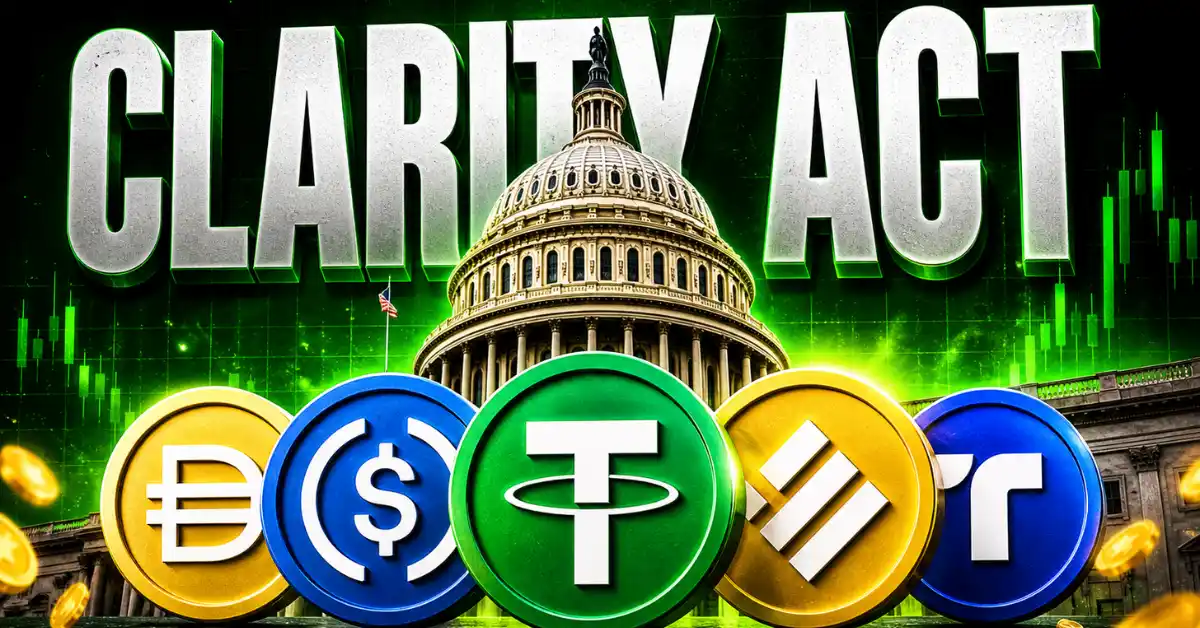
The GENIUS Act, passed nine months ago, created the first federal regulatory framework for payment stablecoins, resolving the long-standing question of whether these dollar-pegged tokens fell under state or federal jurisdiction. The result was immediate and dramatic: the stablecoin market grew 49% in 2025, reaching $306 billion by year-end. This growth was not accidental. The Act provided legal certainty for issuers like Circle and Ripple, which subsequently received provisional national banking charters from the OCC, allowing them to operate across all 50 states under a single federal regulator rather than navigating 50 separate state money transmitter licenses. The legislation also resolved the stablecoin yield question in a bipartisan manner, with Senators Tillis and Alsobrooks crafting a compromise that allowed for interest-bearing stablecoins under specific conditions. This regulatory clarity unlocked institutional capital that had been sitting on the sidelines, with major banks and payment processors beginning to integrate stablecoins into their settlement infrastructure. The $306 billion figure represents not just market appreciation but genuine organic growth in on-chain dollar usage for remittances, cross-border payments, and decentralized finance applications. The talent migration has been equally striking: 90% of senior crypto leadership searches are now U.S.-based, a reversal from the prior era when regulatory uncertainty pushed executives toward Dubai, Singapore, and the Cayman Islands. The OCC charters for Circle and Ripple represent the clearest signal yet that Washington intends to anchor the global stablecoin market onshore. With nearly 70 million Americans holding digital assets and a $3.2 trillion total market cap, the GENIUS Act's success has given the Senate a replicable template: clear rules drive capital formation, capital formation drives adoption, and adoption creates a constituency that makes regulation politically durable.
How the CLARITY Act rewrites the P&L for crypto firms
The CLARITY Act would extend the GENIUS Act's prohibition framework across the entire digital asset market, creating a single federal registration system for crypto exchanges, brokers, and custodians. For companies like Coinbase, the implications are direct and material. The bill would establish clear jurisdictional lines between the SEC and CFTC, ending the enforcement-by-guidance era that has cost the industry hundreds of millions in legal fees. Under the current regime, Coinbase has spent over $50 million on legal and compliance costs navigating conflicting regulatory signals. The CLARITY Act would replace this with a predictable fee structure: registered entities would pay annual licensing fees to the SEC or CFTC based on trading volume and custody assets. For the industry, the trade-off is significant. The digital assets industry has already made major concessions, including agreeing to expanded prohibitions on market manipulation and enhanced disclosure requirements for token issuers. The bill would also mandate segregation of customer assets, a provision that would require exchanges to hold reserves in qualified custodians, increasing operational costs but reducing counterparty risk. This segregation requirement directly addresses the FTX failure, where commingling of customer and proprietary funds masked insolvency until withdrawal demands exposed the gap. The net effect on P&L statements would be a shift from unpredictable legal expenses to fixed compliance costs, a trade most public crypto companies would welcome.
Coinbase's pivot and the competitive reshuffle
While the Senate debates the CLARITY Act, Coinbase is cutting jobs to rebuild itself as an "intelligence" company, a strategic pivot that signals the exchange's recognition that pure trading revenue is no longer sufficient. The move comes as the stablecoin boom has created new competitive dynamics: Circle and Ripple, now with national banking charters, are encroaching on Coinbase's traditional territory by offering integrated payment and custody services directly to institutional clients. The CLARITY Act would accelerate this reshuffling by lowering barriers to entry for federally regulated competitors. Under the proposed framework, any entity that registers with the SEC or CFTC can offer trading, custody, and staking services, effectively ending the era of regulatory moats that protected incumbents. For Coinbase, the pivot to "intelligence" means monetizing its vast dataset on blockchain transactions, wallet behavior, and market flows, a business line that would be largely unaffected by the CLARITY Act's trading rules. The bill's disclosure requirements for token issuers would actually benefit Coinbase's intelligence unit, as standardized reporting would make on-chain data more analyzable. The losers in this reshuffle are smaller, unregistered exchanges that lack the capital to meet the new compliance standards. Ninety percent of senior crypto leadership searches are now U.S.-based, indicating a talent migration toward regulated entities.
Downstream effects on hyperscalers and enterprise buyers
The CLARITY Act's second-order effects extend far beyond crypto-native firms. The bill's requirement for registered exchanges to maintain real-time audit trails and transaction monitoring systems will drive significant demand for cloud infrastructure, data analytics, and cybersecurity services. Amazon Web Services, Microsoft Azure, and Google Cloud are already competing for crypto compliance contracts, with the total addressable market estimated at $2 billion annually. The stablecoin boom to $306 billion has already created massive demand for blockchain node infrastructure, with AWS reporting a 40% increase in blockchain-related compute usage in 2025. For enterprise buyers, including banks, asset managers, and payment processors, the CLARITY Act would provide the legal certainty needed to deploy capital into digital asset custody and trading services. JPMorgan, Goldman Sachs, and BNY Mellon have all signaled they will launch or expand crypto services once federal registration is available. The bill's protection of non-custodial technologies, such as self-hosted wallets and decentralized protocols, ensures that the regulatory framework does not stifle innovation in DeFi, which currently accounts for $80 billion in total value locked. The net effect is a virtuous cycle: regulatory clarity drives institutional adoption, which drives infrastructure spending, which in turn creates sustained revenue streams for hyperscalers and enterprise software vendors.
The Gillibrand ethics provision as a policy signal
Sen. Gillibrand's insistence on an ethics provision in any crypto bill has become the primary obstacle to CLARITY Act passage. The provision would require crypto companies to disclose political contributions, lobbying expenditures, and conflicts of interest among executives and board members, a direct response to the industry's $130 million in federal lobbying spending in 2025. The demand reflects a broader shift in Washington: lawmakers are no longer willing to pass crypto legislation without addressing the industry's governance failures, from FTX to the recent enforcement actions against Binance. The ethics provision is not merely procedural. It would create a public registry of crypto industry political influence, potentially chilling the revolving door between regulators and the companies they oversee. Industry lobbyists argue the provision goes beyond what is required of traditional financial institutions, but Gillibrand's position has hardened after multiple crypto executives were found to have undisclosed conflicts during the GENIUS Act negotiations. The CLARITY Act's disclosure requirements would also reach digital asset participants' ties to foreign governments and sovereign wealth funds, a provision that has drawn bipartisan backing from lawmakers concerned about Chinese and Gulf state capital flows into U.S. crypto markets. The $3.2 trillion total market cap makes these inflows material to national security calculations, and the ethics provision reflects a simple arithmetic: an industry that spent $130 million lobbying Congress in 2025 cannot credibly claim to operate outside Washington's oversight architecture. The standoff reveals a deeper truth: the era of crypto exceptionalism in Washington is over. The CLARITY Act, if passed, would signal that digital assets are now treated as a mature financial sector subject to the same ethical standards as banking and securities. The bill's fate will determine whether the U.S. maintains its lead in crypto innovation or cedes ground to jurisdictions like the EU and Singapore that have already enacted comprehensive frameworks.
The CLARITY Act will pass this year, but not in its current form. Gillibrand will secure a watered-down ethics provision that requires disclosure of direct lobbying but not indirect influence through trade associations, a compromise that allows both sides to claim victory. The bill's passage will trigger a wave of consolidation in the crypto industry, with registered exchanges acquiring smaller competitors to achieve compliance scale. Circle and Ripple, now with national banking charters, will become the dominant infrastructure providers for institutional stablecoin flows, while Coinbase's intelligence pivot will prove prescient as trading margins compress under federal oversight. The stablecoin market will double again within 18 months, reaching $600 billion, as institutional capital floods into federally regulated products and the 70 million Americans already holding crypto gain access to safer, bank-grade custody options. The real winner will be the U.S. Treasury, which will gain unprecedented visibility into on-chain dollar flows, enabling more effective sanctions enforcement and anti-money laundering surveillance. The crypto industry will have traded its libertarian roots for regulatory legitimacy, and the $3.2 trillion market will reward it with sustained institutional inflows that prior regulatory uncertainty had foreclosed.
The BossBlog Daily
One email with the AI markets brief — the 13F moves, the Congressional trades, and what changed. No fixed schedule and no filler: it goes out when there is something worth sending.
Unsubscribe any time. We never sell or share the list.