
Kevin O??eary, the venture capitalist and ??hark Tank??star, told the Consensus 2026 audience in Miami that the tokenization boom Wall Street keeps talking about is nothing but talk until the U.S. delivers a clear federal crypto framework. O??eary, who has long positioned himself as a crypto pragmatist, argued that institutional capital will not touch tokenized assets, whether real estate, private equity, or art, without explicit rules governing issuance, custody, and secondary trading. He pointed to stablecoins as the counterexample: the GENIUS Act passed, and adoption followed almost immediately, with cross-border payments emerging as the first killer use case. But for everything else, the market remains frozen. O??eary claimed that 97% of the entire crypto market value is now concentrated in bitcoin and ether, with smaller tokens effectively ??laughtered??by regulatory uncertainty and the collapse of speculative retail demand. His diagnosis lands at a moment when the U.S. Securities and Exchange Commission is undergoing its own identity crisis. Under Chairman Paul Atkins and the Crypto Task Force led by Commissioner Hester Peirce, the agency is backing away from the ??egulation by enforcement??approach that defined the previous administration. Yet the legacy of that era is still playing out in court. Bittrex, the now-defunct exchange, has filed a motion to vacate a 2023 judgment and force the SEC to return its $24 million settlement, arguing the agency has since conceded its legal theory was wrong. Both stories converge on the same point: the cost of regulatory ambiguity is not just lost innovation ??it also means tens of millions of dollars in settlements with no remaining legal basis. Why this matters now: the window is closing for the SEC to prove it has truly changed course, and the crypto market is already voting with its feet. 97% of value sits in two assets that regulators have effectively blessed.
The structural consolidation behind 97% concentration
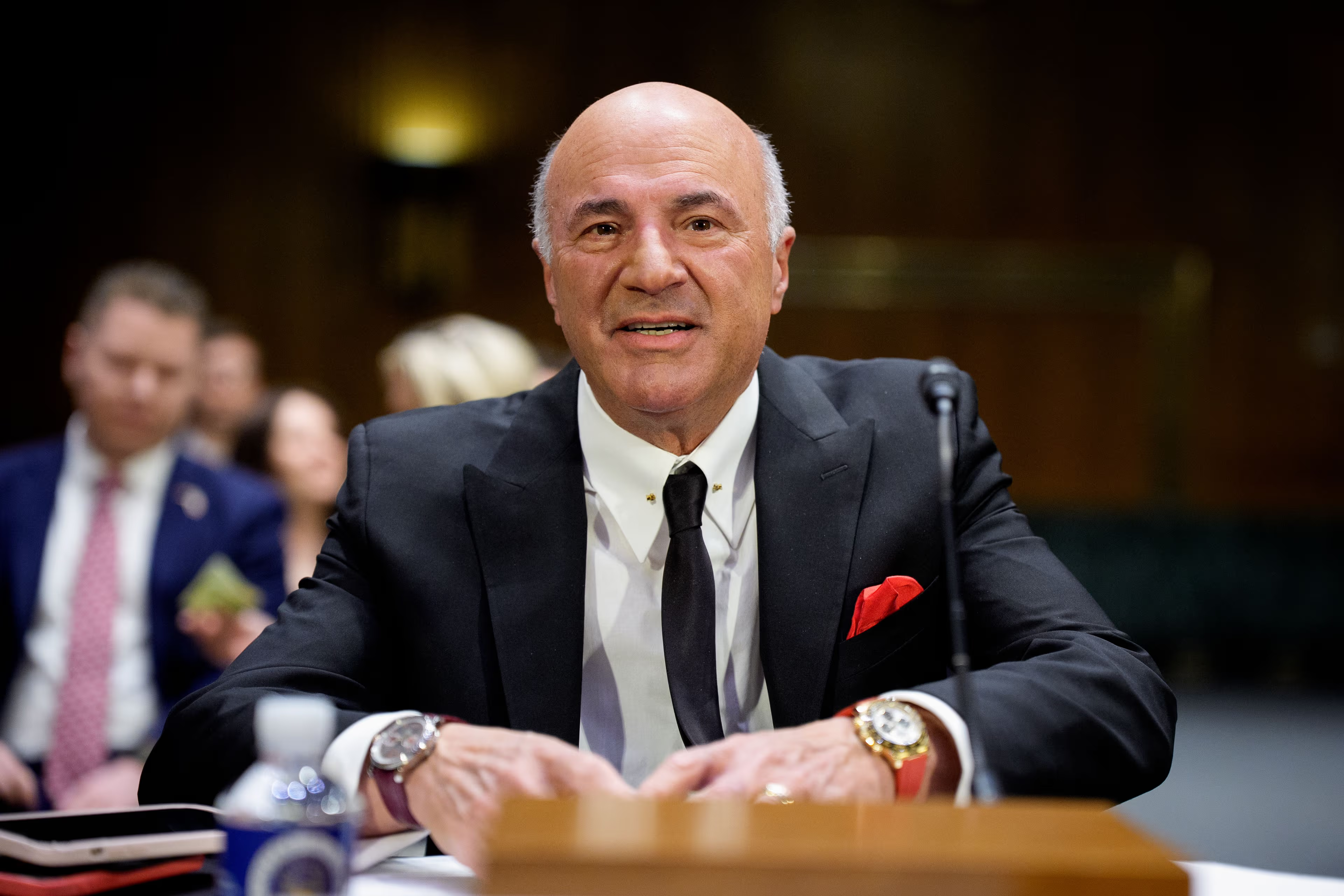
O??eary?? claim that 97% of total crypto market value resides in bitcoin and ether is not a casual observation. It is a structural verdict on the failure of the altcoin ecosystem to attract institutional demand. During the 2021 bull run, thousands of tokens vied for market share, fueled by retail speculation, low interest rates, and a regulatory vacuum that allowed projects to launch without clear securities classification. That vacuum is now filled with legal risk. The SEC under former Chair Gary Gensler brought enforcement actions against exchanges like Bittrex, Coinbase, and Kraken, alleging that many tokens listed on those platforms were unregistered securities. The result was a flight to safety. Bitcoin and ether, which the SEC has repeatedly declined to classify as securities, became the only assets that institutional allocators, including pension funds, endowments, and family offices, hold without triggering legal liability. O??eary?? 97% figure captures the aftermath of that dynamic. Smaller tokens lost liquidity, trading volume, and developer activity. Many projects that raised millions in venture funding now trade at fractions of their peak valuations. The concentration is self-reinforcing: as capital piles into BTC and ETH, the infrastructure around those assets, including ETFs, custody solutions, and derivatives markets, deepens, making them even more attractive relative to altcoins. O??eary described the situation as a ??laughter,??but the more precise term is a structural consolidation driven by regulatory risk. The market is not choosing bitcoin and ether because they are superior technologies; it is choosing them because they are the only assets with a clear legal status in the world?? largest capital market.
The $24 million settlement Bittrex wants back

Bittrex?? motion to vacate its 2023 settlement with the SEC and recover $24 million is the most direct test yet of whether the agency?? policy shift is substantive or cosmetic. The exchange settled with the SEC in 2023, agreeing to pay $24 million to resolve charges that it operated an unregistered securities exchange. At the time, Bittrex was already winding down its U.S. operations, and the settlement was a cost of exit. But the legal landscape has changed dramatically since then. The SEC under Chairman Paul Atkins and the Crypto Task Force led by Hester Peirce has publicly disavowed the ??egulation by enforcement??strategy. The agency has dropped or settled similar cases against other crypto firms on terms far more favorable than the original charges. Bittrex?? argument is straightforward: the SEC has effectively conceded that its legal theory in the Bittrex case was wrong, yet it has not returned the $24 million. In March 2026, the SEC moved to forfeit the funds to the Treasury for distribution to harmed customers, a step that would make recovery even harder. Bittrex is asking the court to vacate the 2023 judgment and compel the SEC to return the money. The case is a high-stakes test of the agency?? credibility. If the SEC fights to keep the $24 million despite abandoning the legal theory that justified it, the message to the industry will be clear: the policy shift is selective, and the cost of settling under the old regime is permanent. If the SEC returns the money, it sets a precedent that opens the door for other firms that settled under similar circumstances to seek relief. Either way, the Bittrex case will define the boundary between the old SEC and the new one.
Winners and losers in the regulatory reset
The shift in SEC policy creates clear winners and losers across the crypto ecosystem. The biggest winners are the infrastructure providers that serve the BTC and ETH markets. Coinbase, which faced its own SEC lawsuit over alleged unregistered securities, has seen its legal risk diminish as the agency drops enforcement actions and signals a willingness to create registration pathways. Coinbase?? custody business, its ETF servicing arm, and its staking products for ether all benefit from a regulatory environment that no longer treats every token listing as a potential violation. The losers are the altcoin projects that bet on a more permissive SEC to validate their token sales. Many of these projects raised capital at valuations that assumed a clear regulatory path. That path has not materialized. O??eary?? 97% figure is a direct measure of their failure: the market has decided that the risk of holding non-BTC/ETH tokens outweighs the potential upside. The second group of losers is the law firms and advisory boutiques that built practices around defending crypto enforcement actions. As the SEC pulls back from litigation, demand for those services will decline. The Bittrex case is an exception, a legacy dispute, but the pipeline of new enforcement cases has slowed to a trickle. The third group is the exchanges that survived the crackdown but never regained their U.S. market share. Bittrex is gone. Kraken settled and scaled back. Binance is fighting a separate set of charges. The exchanges that remain, Coinbase, Gemini, and a handful of smaller players, now operate in a market where the regulatory floor is higher but the competitive ceiling is lower. The winners are the incumbents with the balance sheets and legal teams to navigate the transition.
Downstream effects on hyperscalers, data centers, and tokenization
The concentration of crypto value in BTC and ETH has downstream consequences that extend far beyond token prices. Bitcoin mining and ether staking are both energy-intensive activities that require physical infrastructure: data centers, power purchase agreements, and cooling systems. O??eary has consistently argued that the real long-term value in crypto lies not in speculation but in blockchain infrastructure, corporate adoption, and the energy sector. That thesis is now being tested. Bitcoin miners like Riot Platforms and Marathon Digital have spent the past two years building large-scale facilities in Texas, New York, and overseas. Their business models depend on access to cheap power and favorable regulatory treatment. The SEC?? shift toward crypto-friendly policies reduces the risk that mining operations will face securities or commodities enforcement, but it does not solve the fundamental challenge of energy costs and grid capacity. For ether staking, the picture is different. The transition to proof-of-stake created a new class of institutional staking providers, including Lido, Rocket Pool, and centralized exchanges like Coinbase, that now control a significant share of the staked ether supply. Regulatory clarity on staking as a service is still evolving. The SEC under Atkins has not issued formal guidance on whether staking rewards constitute securities or commodities, leaving providers in a gray area. The bigger downstream story is tokenization. O??eary is blunt: without clear rules, tokenization of real-world assets will remain a pilot project. Banks and asset managers have spent billions building tokenization platforms: JPMorgan?? Onyx, BlackRock?? BUIDL, and Goldman Sachs??tokenized bond initiatives, but none have scaled beyond internal or limited-partner use cases. The reason is the same across every firm: without a U.S. regulatory framework for issuance, custody, and secondary trading, institutional capital will not commit at scale.
The GENIUS Act and the Bittrex fight as policy signals
The GENIUS Act, which established a federal framework for stablecoin issuance and reserve requirements, is the model for what a broader crypto regulatory package looks like in practice. It passed with bipartisan support, it created clear rules for issuers, and it unlocked institutional adoption almost immediately. O??eary cited cross-border payments as the proof point: stablecoins are now being used by multinational corporations to settle invoices and by remittance corridors to bypass traditional banking rails. The lesson for policymakers is that clear rules drive adoption. The lesson for the crypto industry is that the window for passing similar legislation on tokenization, market structure, and custody is narrowing. The Trump administration has signaled support for crypto-friendly policies, but the 2026 midterm elections are approaching, and the political window for bipartisan crypto legislation will close if the next Congress is more divided. The Bittrex case adds a layer of urgency. If the SEC fights to keep the $24 million, it will confirm the industry?? worst fear: that the agency?? policy shift is selective and that firms that settled under the old regime will not be made whole. That outcome would chill future settlements and encourage firms to litigate rather than settle, prolonging legal uncertainty for years. If the SEC returns the money, it sets a precedent that unlocks a wave of settlement reversals and force the agency to reckon with the financial consequences of its enforcement era. Either way, the Bittrex case is the first real test of whether the SEC under Atkins and Peirce is willing to put its money where its mouth is.
The next 12 months will determine whether the U.S. crypto market remains a two-asset oligopoly or expands into a broader ecosystem of tokenized securities, stablecoin-based payments, and institutional-grade infrastructure. O??eary?? 97% figure is a snapshot of the present, but it is also a warning: if regulation does not catch up, the market will continue to concentrate in BTC and ETH, and the tokenization boom that Wall Street has been promising for five years will remain a PowerPoint slide. The Bittrex case is the legal test, the GENIUS Act is the policy template, and the midterms are the political deadline. The industry has a narrow window to lock in the regulatory gains of the past year before the cycle turns.
The BossBlog Daily
One email with the AI markets brief — the 13F moves, the Congressional trades, and what changed. No fixed schedule and no filler: it goes out when there is something worth sending.
Unsubscribe any time. We never sell or share the list.