
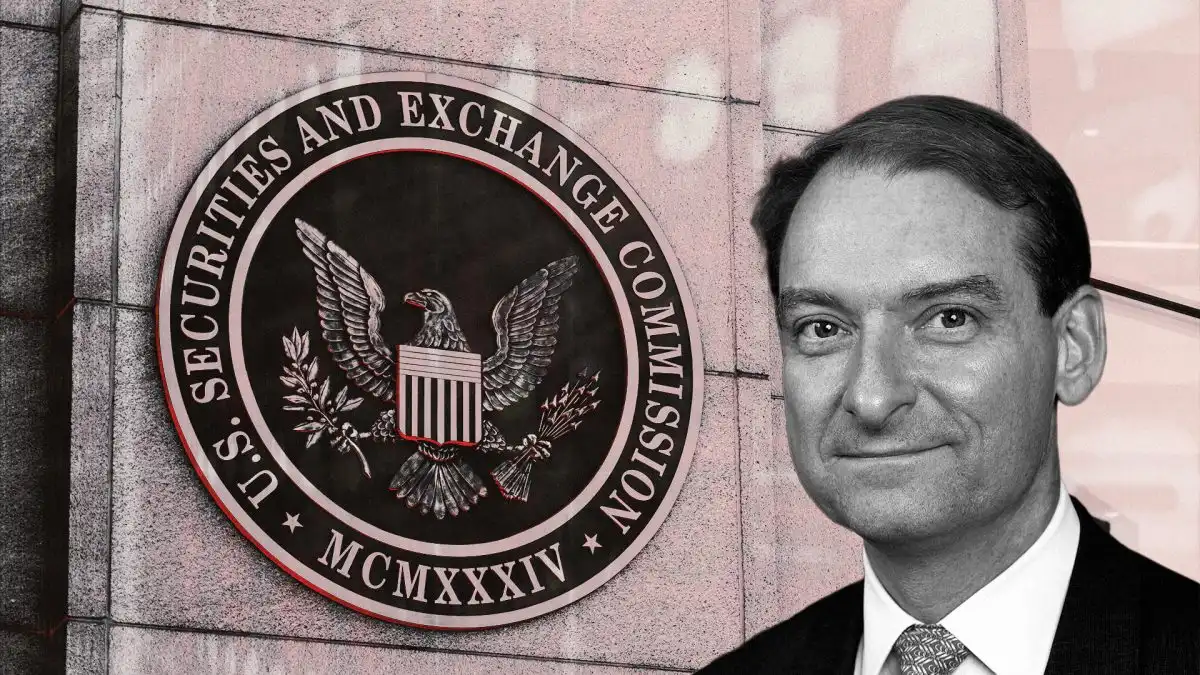
SEC Chair Paul Atkins is signaling a new regulatory framework for onchain markets and AI-driven finance, marking the most concrete shift in U.S. crypto policy since the agency's enforcement-heavy approach under previous leadership. In recent speeches and rulemaking proposals, Atkins floated an innovation exemption for tokenized securities and oversaw the release of a taxonomy designed to clarify which digital assets qualify as securities. The moves come as Bitcoin remains volatile, briefly holding above $80,000 before retreating below that level and liquidating $300 million in futures bets. The broader market is watching closely: Coinbase has rebounded amid an altcoin surge, while Kraken's parent company is pursuing an OCC charter to become a federal crypto bank. Atkins' signal is not a blanket deregulation. It is a structured attempt to define jurisdictional boundaries between the SEC and other regulators, particularly the CFTC, while carving out space for novel financial products. Why this matters now: with stablecoin legislation stalled in Congress and banks actively lobbying to slow the GENIUS Act, Atkins is using the SEC's rulemaking authority to preempt a patchwork of state laws and set federal standards before the next administration can reverse course.
Innovation Exemption Changes the Compliance Calculus for Token Issuers

Atkins' innovation exemption targets a specific pain point for issuers of tokenized securities: the requirement to register every token offering as a traditional security, which has effectively shut out most blockchain-based capital formation in the U.S. The exemption would allow certain tokenized securities to trade on registered alternative trading systems without full SEC registration, provided the issuer meets disclosure and custody standards tailored to digital assets. This is not a blanket exemption. It applies only to tokens that meet the new taxonomy's definition of a security, which Atkins' team has narrowed by excluding "fully decentralized" networks and utility tokens that do not promise future profits from the efforts of a promoter. The taxonomy itself is a critical document: it creates a three-tier classification system dividing digital assets into securities, commodities, and a new "hybrid instrument" category that will be jointly overseen by the SEC and CFTC. The CLARITY Act, which the crypto industry backs, would codify this framework into law, but Atkins is moving ahead with rulemaking in parallel to avoid waiting on a divided Congress. The exemption's practical effect is to lower the legal risk for companies like Coinbase and Kraken that want to list tokenized securities without triggering enforcement actions. It also creates a clear pathway for foreign issuers, including those from jurisdictions with their own digital securities frameworks, to access U.S. investors through registered broker-dealers.
DeFi Losses Reshape the Regulatory Timeline After $570M in Exploits
The SEC's rulemaking push is happening against a backdrop of escalating DeFi security failures that have drained over $570 million from protocols in two major incidents. The $292 million Kelp DAO exploit and the $285 million Drift hack, the latter executed by North Korean operatives who infiltrated the team in person, have exposed the limits of self-regulation in decentralized finance. These losses are not abstract: they directly affect the SEC's calculus on whether to grant the innovation exemption to DeFi protocols or restrict it to centralized, audited platforms. Atkins has signaled that the exemption will require "qualified custody" of user assets, a standard that most DeFi protocols cannot meet because they rely on smart contracts rather than regulated custodians like Anchorage Digital. The Drift hack is particularly instructive: North Korean spies used in-person infiltration to compromise the protocol's multisig wallet, a method that bypassed all smart contract auditing entirely. This has shifted the SEC's focus from code-level security to operational security, meaning who controls the keys, where they are located, and whether the team has undergone background checks. The Kelp DAO exploit involved a vulnerability in the protocol's reward distribution mechanism, highlighting the risks of complex tokenomics. For the SEC, these incidents reinforce the need for a taxonomy that distinguishes between protocols with identifiable operators, which can be held accountable, and truly anonymous systems that fall outside any regulatory perimeter.
Competitive Reshuffle: Gemini, Kalshi, and the Prediction Market Race
Atkins' regulatory vision is reshaping competition in the prediction market space, where Gemini, Kalshi, and Polymarket are jostling for position. Gemini secured a derivatives license from the SEC, positioning itself to challenge Kalshi and Polymarket with a regulated prediction market platform. This is a direct consequence of Atkins' taxonomy: prediction market contracts that settle in fiat currency and are offered by licensed exchanges fall under the SEC's jurisdiction as "security-based swaps," while those settling in crypto and operating on decentralized infrastructure are classified as commodities under CFTC oversight. Kalshi, which has already flagged insider trading cases, including a politician from the reality show "FBoy Island," is pushing for the SEC to adopt a narrower definition that exempts event contracts from securities regulation entirely. Polymarket has tapped Chainalysis for oversight, signaling that it expects to operate under a compliance-heavy framework regardless of the final rules. The competitive dynamics are significant: Gemini's brand and regulatory relationships give it an advantage in attracting institutional liquidity, while Polymarket's onchain settlement offers transparency that Kalshi's centralized model cannot match. Atkins' exemption for tokenized securities could also allow prediction markets to offer tokenized payout rights, creating a hybrid product that combines elements of derivatives and securities. The SEC is watching this space closely, as prediction markets have become a political flashpoint. The agency does not want to be seen as enabling gambling, but it also recognizes that regulated markets are preferable to unregulated offshore alternatives.
Downstream Effects on Hyperscalers, Fabs, and Enterprise Buyers
The SEC's rulemaking has second-order effects that extend far beyond crypto-native firms. Enterprise buyers of blockchain infrastructure, including hyperscalers like AWS and Azure as well as chipmakers and fab operators, are watching the taxonomy closely because it determines which digital assets their corporate clients can hold on balance sheets. If the SEC classifies a token as a security, it triggers custody, reporting, and capital requirements that make it unattractive for corporate treasuries. The innovation exemption changes this calculus: if a tokenized security qualifies for the exemption, it can be held by regulated custodians like Anchorage Digital without triggering the full weight of securities law. This is particularly relevant for stablecoins, where the battle between banks and crypto firms is intensifying. Anchorage Digital and M0 have teamed up to offer regulated stablecoins, while Agora is racing for a charter. Banks are pushing to slow stablecoin legislation, specifically the GENIUS Act, because they want to issue their own digital dollars without competing against unregulated crypto issuers. Atkins' taxonomy resolves this by classifying fiat-backed stablecoins as "payment stablecoins" under a new regulatory category that falls outside both securities and commodities law. For enterprise buyers, this clarity is essential: Tesla reported unchanged Bitcoin holdings but booked a $173 million digital asset loss, highlighting the accounting volatility that comes from holding assets with unclear regulatory status. The SEC's rules will also affect how companies like World Liberty, which has accused Justin Sun of misconduct, structure their token offerings and treasury operations.
Policy Signal: Atkins Draws Lines the Next Administration Cannot Easily Erase
Atkins' rulemaking is not just about crypto. It is a strategic move to entrench a regulatory philosophy that will outlast his tenure. By issuing a taxonomy and innovation exemption through formal rulemaking, Atkins is creating administrative law that would require a new SEC chair to go through the notice-and-comment process to reverse. This is a deliberate contrast to the previous administration's reliance on enforcement actions, which could be withdrawn with a single memo. The policy signal is clear: the SEC wants to be the primary regulator for digital asset markets, and it is willing to share jurisdiction with the CFTC on hybrid instruments rather than cede ground to state regulators or the Treasury Department. The timing is also significant: with the ECB's Christine Lagarde warning against copying the U.S. stablecoin model for the digital euro, and Brazil's central bank banning stablecoin settlement in cross-border payments, the U.S. is positioning itself as the global standard-setter for crypto regulation. Atkins' approach is pragmatic. He is not embracing crypto wholesale, but he is creating a framework that allows innovation to proceed within defined boundaries. The innovation exemption is the key lever: it gives the SEC the ability to grant or deny exemptions based on compliance with custody, disclosure, and operational security standards, effectively creating a licensing regime without calling it one. For market participants, the message is that the era of regulatory uncertainty is ending, but the era of compliance costs is just beginning.
The next 12 months will determine whether Atkins' framework becomes the global template or a uniquely American experiment. The innovation exemption will attract tokenized securities issuers from jurisdictions with lighter regulation, but it will also create a two-tier market: compliant tokens that trade on registered ATSs and unregistered tokens that remain in the gray market. The SEC's taxonomy will force every token project to classify itself, and those that fail to fit neatly into the securities, commodities, or hybrid categories will face the highest compliance costs. Prediction markets will test the boundaries of the exemption, especially if Gemini launches a product that combines derivatives with tokenized payouts. The DeFi security crisis will accelerate the push for qualified custody requirements, splitting the DeFi ecosystem into regulated and unregulated segments. And the stablecoin battle will intensify as banks and crypto firms race to secure charters under the new framework. Atkins is betting that regulatory clarity will attract institutional capital and innovation, but the risk is that the rules are too restrictive for the most innovative protocols and too permissive for the most predatory actors. The next SEC chair will inherit a framework that is harder to dismantle than to maintain, which is precisely Atkins' design.
The BossBlog Daily
One email with the AI markets brief — the 13F moves, the Congressional trades, and what changed. No fixed schedule and no filler: it goes out when there is something worth sending.
Unsubscribe any time. We never sell or share the list.