
The Federal Reserve held its target interest rate steady at 3.5%-3.75% following its April 2026 meeting, a decision that arrived as inflation remains stubbornly above the central bank's 2% target. The Consumer Price Index rose 0.9% in March alone, pushing annual inflation to 3.3%, the highest reading since May 2024. The Federal Open Market Committee voted 8-4 to maintain the current rate, a split that underscores internal disagreement over the path forward. Cleveland Fed President Beth Hammack stated that rates are likely on hold "for quite some time," a sentiment echoed by Chair Jerome Powell. The decision comes against a backdrop of rising geopolitical tensions, particularly the U.S.-Iran conflict, which is driving oil prices higher and adding fresh inflationary pressure to an already sticky pricing environment. For savers and investors, this extended pause is creating a bifurcated market: short-term deposit rates are rising as banks compete for funding, while longer-term yields remain subdued. This dynamic matters now because it signals that the Fed's "higher for longer" stance is not merely a holding pattern. It is actively reshaping the competitive landscape for retail deposits, utility stocks, and the broader fixed-income market, forcing a strategic recalibration across asset classes.
Short-Term CD Yields Rise Despite a Fed Pause
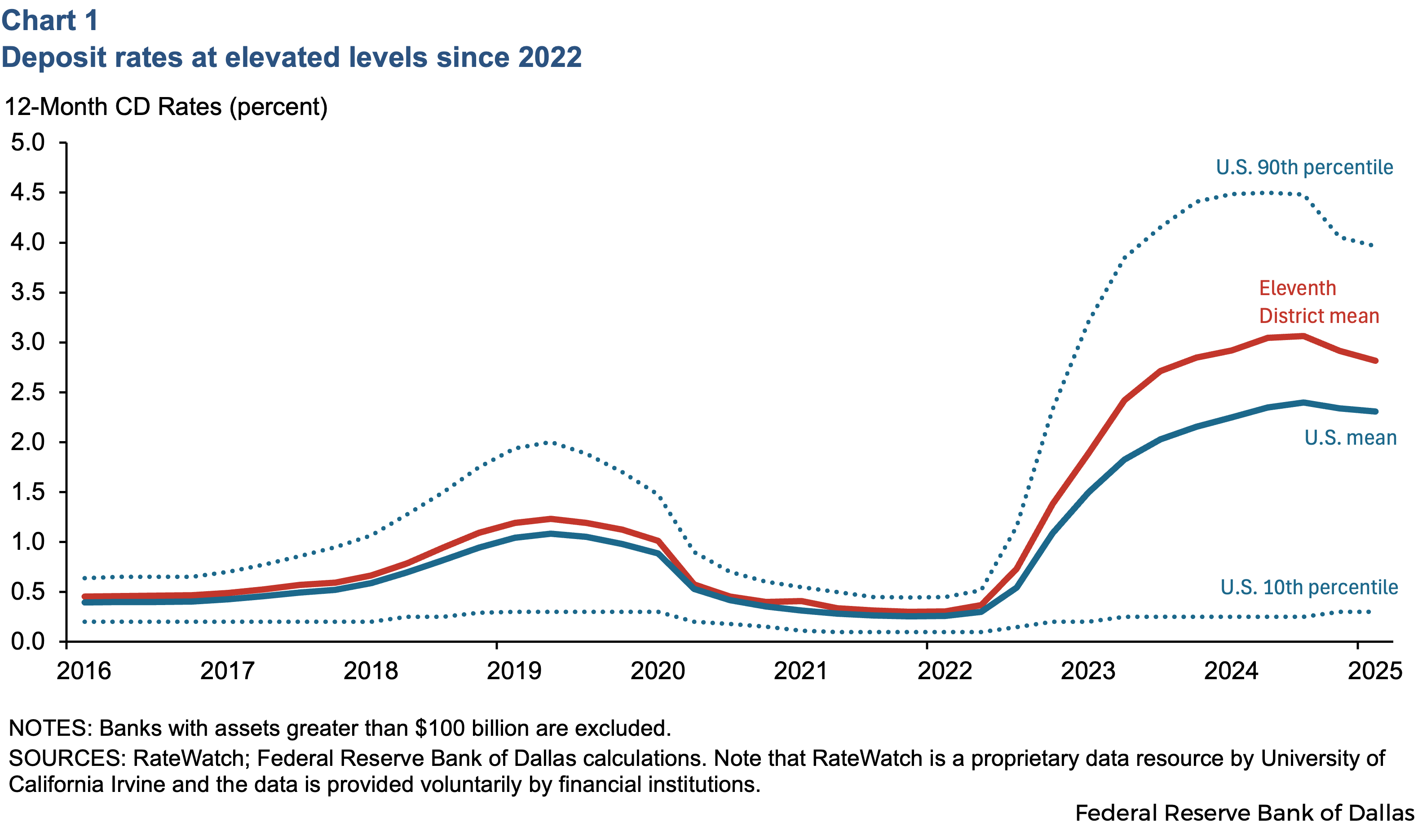
The most immediate market reaction to the Fed's hold decision has been a sharp divergence in certificate of deposit yields by maturity. In April, CD rates on maturities of one year or less rose 6 basis points to 3.71%, while yields on 13- to 36-month CDs increased by just 1 basis point to 2.62%. This 109-basis-point spread between short and intermediate maturities is the widest in over a year and reflects a fundamental shift in how banks are managing their balance sheets. Morgan Stanley analyst Manan Gosalia noted that eight of the 35 banks under the firm's coverage raised their CD yields in April, a move driven by accelerating loan growth and the market's delayed expectation for rate cuts. Banks are betting that the Fed will not cut rates anytime soon, so they are locking in short-term deposits to fund new lending rather than waiting for cheaper long-term funding. The average savings account still pays just 0.38%, according to the FDIC, creating a massive incentive for depositors to shift cash into CDs. The best high-yield savings accounts offer up to 5.00%, but those rates are variable and can drop quickly if the Fed eventually cuts. Short-term CDs offer a fixed rate for a defined period, making them an attractive hedge against the uncertainty of the Fed's next move. The divergence between short and intermediate maturities is a direct result of banks prioritizing liquidity over long-term liability management.
Banks Monetize the Deposit Competition

The rising CD yields are not a sign of banking sector strength. They are a tactical response to a funding squeeze. Loan demand is picking up as the economy adjusts to the 3.5%-3.75% rate environment, but deposit growth has not kept pace. The 75 basis points of rate cuts the Fed delivered in 2025 compressed net interest margins for many regional banks, and the current pause is forcing them to pay up for deposits to avoid shrinking their loan books. For the eight banks under Morgan Stanley coverage that raised CD yields, the calculus is straightforward: pay 3.71% for a one-year CD and lend at a spread that still generates positive net interest income, assuming loan rates remain elevated. The risk is that if the Fed eventually cuts rates, these banks will be stuck paying above-market deposit costs. That is precisely why the yield curve is steepening. Banks are willing to pay a premium for short-term certainty while avoiding long-term commitments. The 1-basis-point move in 13- to 36-month CDs is effectively a signal that banks expect rates to be lower in two to three years. This creates a natural arbitrage opportunity for depositors: lock in a 3.71% one-year CD now, then reinvest at potentially lower rates later, while banks absorb the duration risk. The gap between the FDIC average savings rate of 0.38% and the top one-year CD rate of 3.71% represents 333 basis points of yield that many depositors are leaving on the table. As awareness of this disparity grows, the flow of retail cash into time deposits is accelerating, providing banks with a stable, term-matched funding source that supports their loan growth ambitions without creating the duration mismatch risks that contributed to regional bank failures in 2023.
Winners and Losers in the Utility Sector
Utility funds are emerging as a defensive play in this high-rate, inflationary environment, and the Fed's hold decision has sharpened the case for owning them. The Franklin Utilities Fund (FKUTX), Fidelity Select Utilities (FSUTX), and American Century Utilities Inv (BULIX) are all positioned to benefit from the current macro setup. Utilities typically carry high debt loads, making them sensitive to interest rate changes. But the extended pause at 3.5%-3.75% removes the risk of further rate hikes while keeping the cost of debt predictable. More importantly, inflation at 3.3% allows regulated utilities to file for rate increases that pass through higher costs to consumers, a mechanism that directly boosts revenue and earnings. The geopolitical overlay, specifically the Iran conflict driving oil prices higher, adds another layer of support. Higher energy prices increase the relative value of regulated utilities, which offer stable, inflation-adjusted cash flows compared to volatile commodity-exposed energy stocks. The Franklin Utilities Fund, for example, holds a concentrated portfolio of electric and gas utilities with regulated rate bases that automatically adjust for inflation. Fidelity Select Utilities takes a broader approach, including some independent power producers that benefit from higher wholesale electricity prices. American Century Utilities Inv focuses on dividend growth, which becomes more attractive when the Fed is not cutting rates and bond yields are stable.
Downstream Effects on Loan Growth, Housing, and Corporate Borrowing
The Fed's extended hold at 3.5%-3.75% is creating a transmission mechanism that ripples through the entire credit market. Loan growth is accelerating precisely because banks are competing for deposits, which gives them the capacity to lend. But the cost of that funding, 3.71% for one-year CDs, sets a floor for lending rates. Mortgage rates, which have been hovering near 7%, are unlikely to fall meaningfully until the Fed signals a cut, which Hammack explicitly said will not happen "for quite some time." This keeps housing affordability constrained and suppresses refinancing activity, which in turn pressures mortgage-servicing stocks and homebuilder margins. Corporate borrowers face a similar dynamic: investment-grade bond yields remain elevated because the risk-free rate is not moving, and the spread compression that typically follows a Fed pause is being offset by inflation uncertainty. The 8-4 FOMC vote is particularly telling. Four dissenting members wanted a cut, which introduces policy uncertainty that makes CFOs hesitant to issue long-term debt. Instead, companies are turning to bank loans and floating-rate notes, which benefit from the steep short-end yield curve. This shift in financing preference is a direct consequence of the Fed's hold and will persist until the committee reaches a clearer consensus on the rate path. High-yield issuers face the steepest challenge: their floating-rate obligations are resetting at rates tied to the 3.5%-3.75% benchmark plus spread, and refinancing activity has slowed as CFOs wait for the Fed to signal its next move. The result is a credit market where quality dispersion is widening, with investment-grade spreads compressing while high-yield spreads drift wider in ways not seen since late 2024.
The Extended Hold Signals Fed Policy and Inflation Stance
The decision to hold rates at 3.5%-3.75% is not a neutral act. It is a deliberate signal that the Fed is willing to tolerate above-target inflation for longer in exchange for labor market stability. The 8-4 vote reveals a committee that is deeply divided but whose majority believes that cutting rates prematurely would repeat the mistake of 2021, when the Fed waited too long to tighten. Hammack's statement that rates will be on hold "for quite some time" is the clearest forward guidance the Fed has offered since the tightening cycle began. The fact that she also said "when rates change, the move will be to lower them" suggests the Fed sees the next move as a cut, but only after inflation convincingly trends toward 2%. The Iran conflict complicates that timeline by adding a supply-side shock to oil prices, which feeds directly into headline CPI. The Fed cannot control energy prices, but it can hold rates steady to prevent second-round effects from spilling into wages and core services. This policy stance effectively punts the rate-cut decision to late 2026 or even 2027, depending on how the geopolitical situation evolves. For market participants, the message is clear: the era of easy money is not returning soon, and portfolio construction must account for a regime of structurally higher real rates.
The extended hold at 3.5%-3.75% will continue to reshape the competitive dynamics across deposit markets, utility stocks, and corporate credit through the remainder of 2026. CD yields on short maturities are likely to drift higher as loan growth accelerates and banks compete for a shrinking pool of retail deposits, with Morgan Stanley's Gosalia expecting rates to remain flat to slightly higher. Utility funds will benefit from the inflation pass-through mechanism and the absence of rate-hike risk, making them a core defensive holding for income-oriented portfolios. The real action, however, will be in the credit markets, where the steep short-end yield curve is forcing borrowers to rethink their funding strategies and lenders to accept compressed margins in exchange for volume. The 8-4 FOMC vote ensures that policy uncertainty will persist, keeping volatility elevated in rate-sensitive sectors. Investors should expect the Fed to hold steady through at least the third quarter of 2026, with the first cut dependent on a material softening in the labor market or a sharp decline in energy prices. Until then, the playbook is simple: lock in short-term yields, overweight regulated utilities, and avoid duration risk in fixed income.
The BossBlog Daily
One email with the AI markets brief — the 13F moves, the Congressional trades, and what changed. No fixed schedule and no filler: it goes out when there is something worth sending.
Unsubscribe any time. We never sell or share the list.