
Kevin Warsh, President Donald Trump's pick to lead the Federal Reserve, will preside over his first Federal Open Market Committee meeting on June 17 with markets fully expecting the central bank to hold its benchmark rate steady at 3.50%-3.75%. The decision, which would mark the eighth consecutive meeting without a rate change since late 2025, comes as inflation remains roughly double the Fed's 2% long-term target. Fed funds futures tracked by CME Group's FedWatch tool show virtually no chance of a rate cut in June, and the real debate among economists centers on whether Warsh will signal a pivot toward tightening. The new chair inherits an economy where borrowing costs have been frozen for nearly a year, consumer savings rates have collapsed to a national average of 0.38%, and the White House has publicly pressured the central bank to lower rates. Warsh's first meeting is a high-stakes signal of whether the Fed will maintain its current posture, pivot toward the Trump administration's preference for cheaper money, or break with both and raise rates to combat persistent inflation. Why this matters now: Warsh's communication style, honed during the 2008-09 crisis as a Fed governor under Ben Bernanke and refined through a decade of arguing the central bank should say less about its thinking, will make every word from this meeting a parsing exercise for bond traders, equity investors, and corporate finance officers who have built their 2026 plans around a steady-rate environment.
The Late-2025 Holding Pattern That Set the Stage
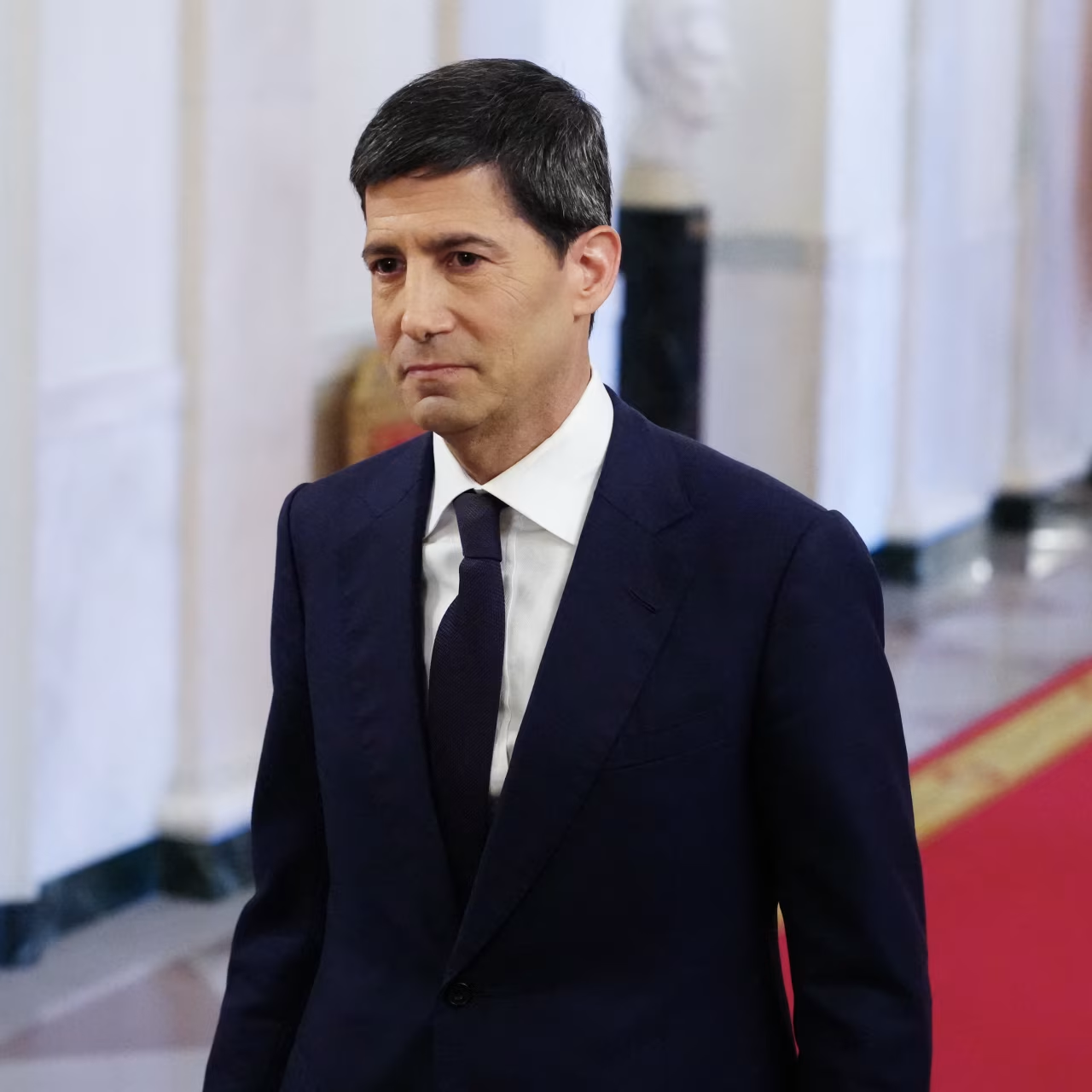
The current federal funds rate target range of 3.50%-3.75% represents a holding pattern that has been in place since late 2025, when the Fed last cut rates. That decision ended a tightening cycle that began in 2022 and pushed rates to their highest level in two decades. The FOMC's decision to pause and then hold reflected a calculation that the economy had reached a neutral rate, one that neither stimulates nor restricts growth, while inflation remained stubbornly above target. The June 17 meeting marks the first time Warsh will steer that consensus, and his background suggests he will approach the rate-setting process differently than his predecessors. As a Fed governor during the 2008-09 financial crisis, Warsh witnessed Bernanke's innovations in both bond holdings and communication strategy. But Warsh has argued for over a decade that the Fed should say less about its thinking, a philosophy that stands in direct contrast to the forward-guidance-heavy approach of the Bernanke and Janet Yellen eras. The FedWatch tool data from CME Group confirms that market participants see no path to a cut in June, but the probability of a hike has crept higher as inflation data has come in hot. The 3.50%-3.75% range is not a destination; it is a waypoint. Warsh's first decision as chair will be whether to signal that the next move is up, down, or a continued wait-and-see.
How Steady Rates Reshape the Consumer P&L
The decision to hold rates at 3.50%-3.75% creates a diverging set of winners and losers in the consumer economy. On the savings side, the national average interest rate for savings accounts has fallen to 0.38%, according to data cited by Yahoo Finance. That figure is a stark reminder that most depositors are earning almost nothing on their cash, even as the Fed's benchmark rate sits at levels that would have been considered high a decade ago. The gap between the national average and what disciplined savers can earn is enormous: high-yield savings accounts currently offer roughly 10 times the national average, meaning consumers who do not shop around are leaving significant returns on the table. Certificates of deposit and money market accounts similarly offer tiered returns that reward active management. On the borrowing side, steady rates mean credit card APRs, auto loan rates, and mortgage rates remain elevated. The consumer who carries a balance is paying a premium for the Fed's inflation fight, while the consumer who holds cash is subsidizing the banks that pay near-zero on deposits. This dynamic creates a clear incentive for households to shift cash into higher-yielding products, a trend that benefits online banks and money market funds at the expense of traditional brick-and-mortar institutions. The longer rates stay at 3.50%-3.75%, the more this behavioral shift compounds. Warsh's Fed inherits a consumer credit market where the cost of borrowing is fixed but the return on savings is negotiable, and the spread between the two is a direct tax on financial passivity. The average household with $10,000 in a standard savings account earns just $38 per year in interest, while a household that moves that same cash into a high-yield account earning 3.80% collects $380 annually, a tenfold difference that compounds over time.
The Competitive Reshuffle Among Banks and Asset Managers
The steady-rate environment at 3.50%-3.75% reshapes the competitive dynamics across financial services in ways that favor agile online lenders and punish traditional deposit franchises. Large national banks that rely on low-cost core deposits are seeing those deposits flow out to higher-yielding alternatives, as consumers finally respond to the 10x spread between the national average savings rate of 0.38% and the best high-yield savings accounts. This disintermediation benefits asset managers and fintech platforms that offer money market funds and brokered CDs, while squeezing net interest margins at regional banks that cannot afford to compete on deposit pricing. The CME Group's FedWatch tool, which tracks fed funds futures, has become an essential data product for every treasury desk and corporate finance team trying to game out the next move. Warsh's communication philosophy, saying less and surprising more, makes that tool more valuable and more volatile. The Dow Jones Industrial Average and broader equity markets have priced in a steady-rate equilibrium, and any deviation from that baseline will trigger a repricing across sectors. Banks that have hedged for a hike will benefit if Warsh signals tightening; banks that have positioned for a cut will get squeezed. The biggest competitive risk is for the regional banks that loaded up on longer-duration bonds during the low-rate era and now face mark-to-market losses if rates rise. Warsh's first meeting is not just a policy decision; it is a competitive event that will separate the well-positioned financial institutions from the overexposed ones.
Downstream Effects on Corporate Borrowing and Capex
The Fed's decision to hold rates at 3.50%-3.75% sends a powerful signal to corporate finance officers who have been delaying capital expenditure decisions since late 2025. Every week of steady rates is a week of predictable borrowing costs, which should theoretically unlock capex that has been frozen by uncertainty. But the inflation data, running at roughly double the 2% target, creates a countervailing force: companies face rising input costs that eat into the returns on any new investment. The net effect is a stalemate. Corporate bond issuance has remained robust as companies lock in current rates, but the maturity wall coming due in 2027-2028 means treasurers are watching Warsh's every word for signs of a rate trajectory. The supply chain effects are equally significant. Manufacturers that borrow to finance inventory are paying the same rate they were a year ago, while their customers are demanding lower prices. This margin squeeze is most acute in industries like automotive and housing, where financing costs directly affect demand. The homebuilders and auto lenders have already adjusted their business models to a 3.50%-3.75% world, but a hike would push mortgage rates above 7% and choke off demand. Warsh's first meeting will be parsed not just for the rate decision but for the language around the balance sheet. The Fed has been allowing its bond holdings to roll off, a process that tightens financial conditions without a rate move. Any signal that Warsh wants to accelerate or slow that runoff will have direct implications for Treasury yields and, by extension, corporate borrowing costs across the curve. Investment-grade spreads have compressed to near-cycle lows on the assumption of a steady-rate regime, meaning a surprise hike would force a rapid repricing of corporate debt. High-yield issuers, many of whom refinanced at floating rates when the benchmark was near zero, face the sharpest exposure: each 25-basis-point increase in the fed funds rate translates directly into higher coupon payments and tighter free cash flow margins. Finance officers watching the June 17 statement are not just reading the rate line; they are reading the balance-sheet paragraph for clues about whether Warsh plans to tighten through the front end, the back end, or both simultaneously.
Warsh's Policy Signal and the Trump Administration Dynamic
Kevin Warsh's first FOMC meeting is as much a political signal as an economic one. Appointed by President Trump, who has publicly called for lower rates, Warsh now presides over a central bank that is expected to hold rates steady while inflation runs at double the 2% target. The tension between the White House's preference for cheaper money and the Fed's statutory mandate to control inflation is the defining fault line of Warsh's tenure. His background as a Fed governor during the 2008-09 crisis, where he witnessed Bernanke's aggressive interventions, shows he understands the political pressure that comes with the job. But his decade-long advocacy for the Fed to say less about its thinking points to a chair who will resist being boxed in by market expectations or political demands. The Wall Street Journal has reported that Warsh wants the Fed to stop explaining everything, a philosophy that would represent a sharp break from the transparency regime that Bernanke built. If Warsh follows through, the June 17 statement will be shorter, the press conference will be more guarded, and the dot plot, the quarterly projection of rate expectations, will be de-emphasized or eliminated. For markets, that reduction in information flow is itself a policy signal. It tells traders that they cannot rely on Fed guidance and must instead read the data directly. It tells the White House that the Fed will not be swayed by public pressure. And it tells the global financial system that the Warsh era will be defined by action, not explanation. The first meeting is the opening move in that strategy.
The BossBlog Daily
One email with the AI markets brief — the 13F moves, the Congressional trades, and what changed. No fixed schedule and no filler: it goes out when there is something worth sending.
Unsubscribe any time. We never sell or share the list.