
Kevin Warsh chairs his first Federal Open Market Committee meeting this week, three weeks into his tenure as chairman, with inflation roaring back at its fastest pace in three years due to energy price shocks from the Iran conflict. The Fed is expected to hold its benchmark rate steady at 3.5%–3.75%, but bond markets are already pricing in rate hikes by December, a stark reversal from January when traders expected at least half a percentage point of cuts in 2026. The inflation surge, driven by a 0.5% month-over-month jump in the headline CPI, reflects the pass-through of crude oil prices that have spiked since hostilities disrupted Strait of Hormuz shipping lanes. Warsh, a former Fed governor who served during the 2008–09 financial crisis and observed Ben Bernanke’s innovations in bond holdings and communication, now faces a high-stakes test of his independence. President Donald Trump has publicly pressured for lower rates, while the bond market is betting the opposite direction. Warsh’s press conference will be parsed for signs of his approach to transparency and whether he will dial back the Fed’s habit of explaining every policy move. The outcome will set the tone for global monetary policy divergence as the European Central Bank raises rates for the first time in nearly three years and the Bank of England holds at 3.75%.
Energy Supply Shock Drives the 0.5% CPI Jump
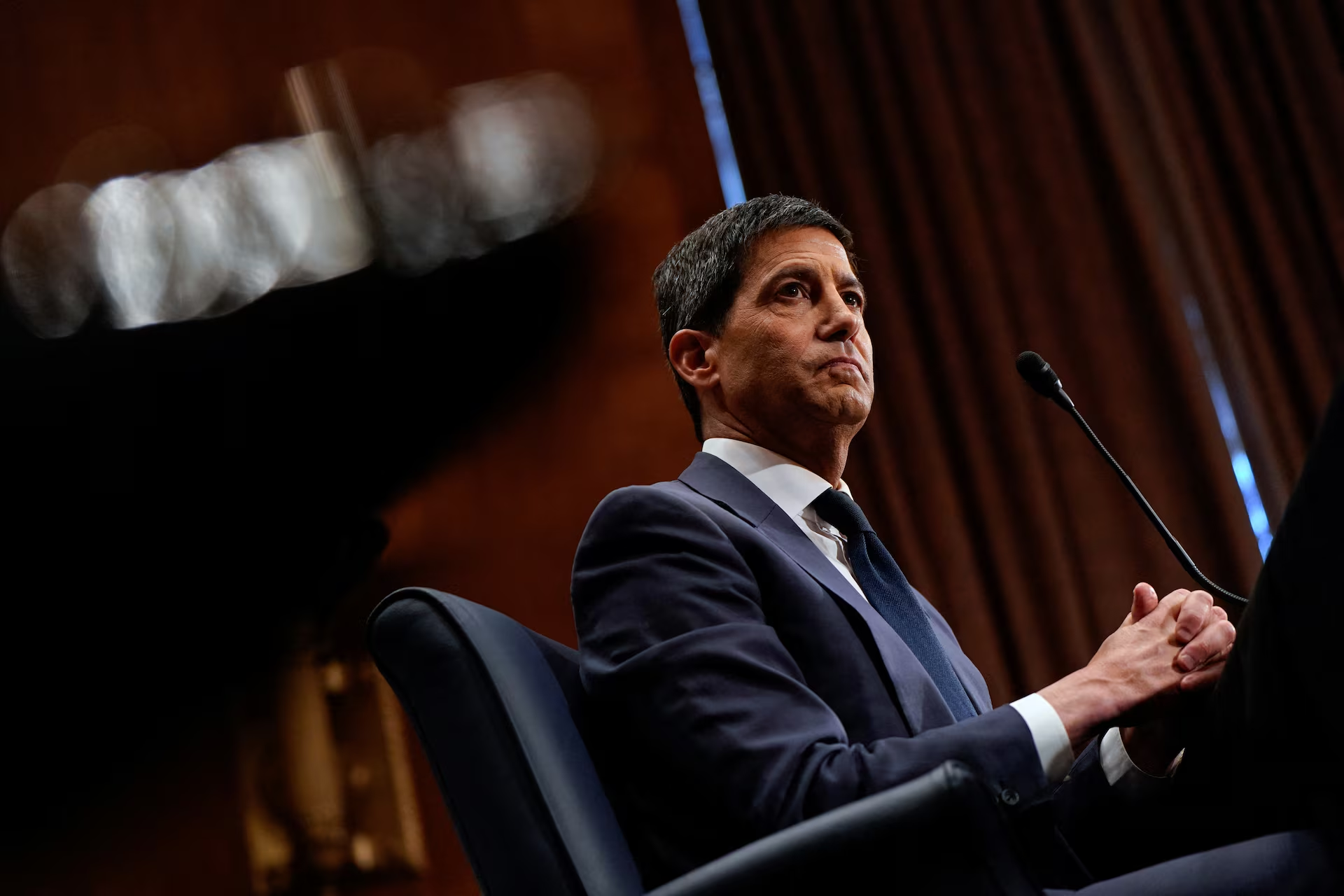
The inflation acceleration that confronts Warsh’s first meeting is not a broad-based demand shock but a concentrated energy supply shock. The Iran conflict has driven crude oil above $95 per barrel, up 22% since the start of 2026, with the headline CPI rising 0.5% month-over-month in May, the largest single-month increase in three years. Energy goods and services accounted for roughly 70 basis points of that gain, according to Deutsche Bank estimates cited by Bloomberg. Core inflation, which strips out food and energy, rose a more modest 0.2%, but the persistence of energy pass-through into transportation and industrial inputs is already showing up in producer prices. The Fed’s preferred inflation gauge, the core PCE deflator, is running at an annualized 3.1%, well above the 2% target. The mechanics are straightforward: higher gasoline prices directly lift CPI, while diesel and jet fuel costs cascade into trucking freight rates, airline tickets, and logistics margins. Sanjay Raja, chief economist at Deutsche Bank, noted in a research note that the energy shock is “unlikely to fade quickly” given the geopolitical risk premium embedded in futures curves. The FOMC’s Summary of Economic Projections, to be released alongside the rate decision, will revise up the 2026 inflation forecast by at least 0.3 percentage points. This creates a mechanical bind for Warsh: the Taylor rule implied rate would be above 4%, yet the committee is holding at 3.5%–3.75%. The gap between the actual rate and the rule-implied rate is the widest since the 1970s, a fact that bond traders are exploiting by shorting the front end of the Treasury curve.
Rate Hike Bets Reshape Bank Margins and Equity Risk
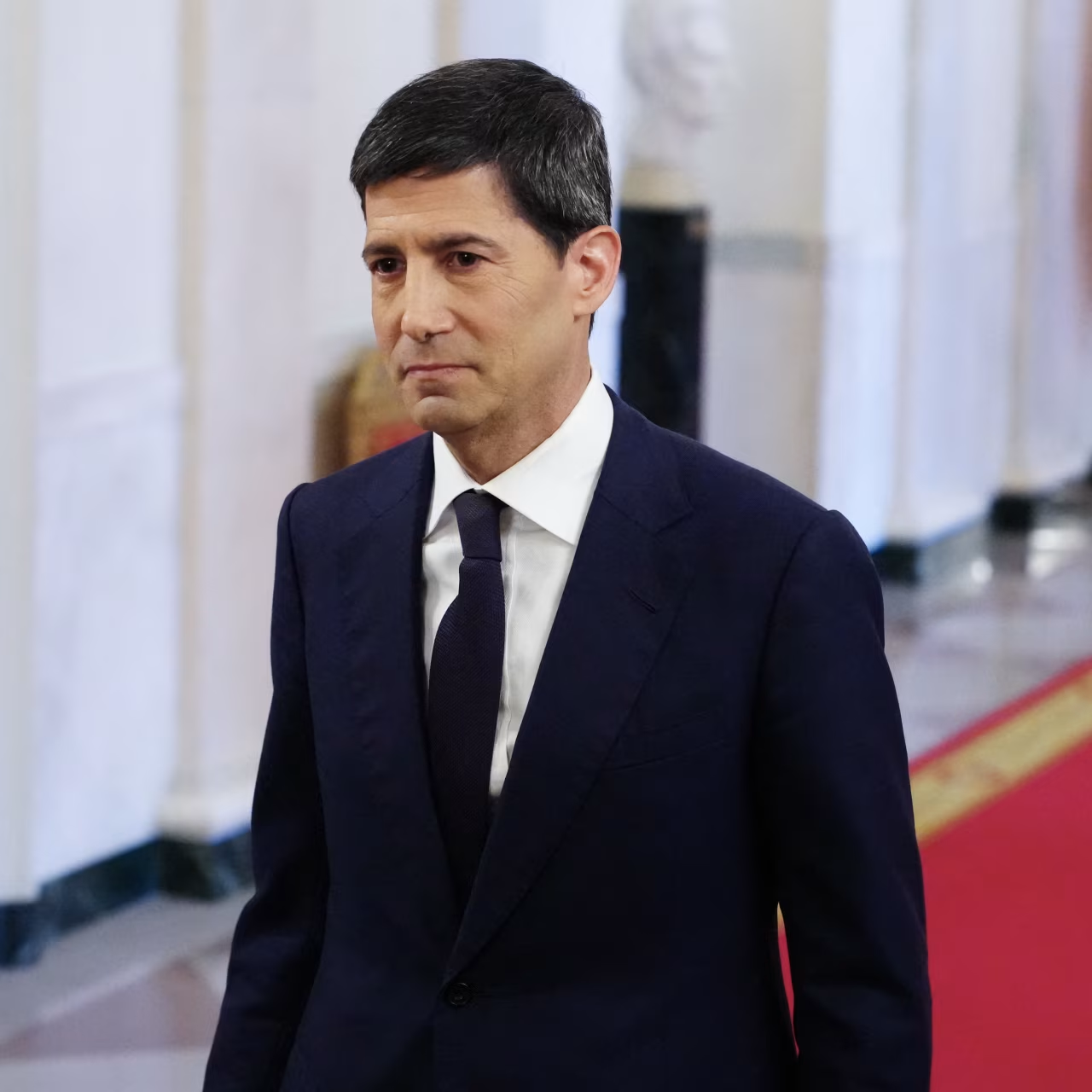
The bond market’s repricing of rate hikes by December has immediate consequences for bank net interest margins, corporate borrowing costs, and equity valuations. The yield on the 2-year US Treasury note has climbed 45 basis points since the Iran conflict escalated, to 4.12%, while the 10-year yield has risen to 4.55%. This steepening of the yield curve, with the 2s-10s spread widening to 43 basis points from 18 basis points in March, is a net positive for bank profitability, as lenders can borrow short-term at the fed funds rate and lend long-term at higher yields. But the flip side is that corporate bond spreads have widened by 25 basis points for investment-grade issuers and 65 basis points for high-yield, reflecting higher default risk in a rising-rate environment. For the S&P 500 Index, which trades at 21.5 times forward earnings, the implied equity risk premium has compressed to 3.2%, the lowest since 2021. Former Fed Chair Jerome Powell warned in his final press conference that elevated valuations are vulnerable to a rate shock, noting that “higher rates reduce spending, corporate profits, and stock valuations.” The math is unforgiving: if the 10-year yield rises to 5%, the equity risk premium would turn negative, triggering a multiple compression that could shave 15%–20% off the S&P 500. Warsh’s first policy statement will be parsed for any signal that the FOMC is willing to tolerate higher inflation to avoid a market rout, a trade-off that Powell explicitly rejected. The bond market is betting that Warsh will eventually cave to market pressure and hike, pricing in a 75% probability of a 25-basis-point move by December.
Deutsche Bank and Bloomberg Gain as Volatility Returns
The return of rate-hike expectations and geopolitical volatility reshuffles the competitive landscape across Wall Street. Deutsche Bank, which has rebuilt its rates trading desk over the past three years under CEO Christian Sewing, is positioned to capture outsized market share as hedge funds and asset managers rebalance portfolios in response to the energy shock. The bank’s fixed-income, currencies, and commodities revenue rose 18% year-over-year in the first quarter, and the second quarter is tracking even stronger, driven by client demand for hedging instruments tied to oil price volatility and interest rate derivatives. Bloomberg, meanwhile, benefits from the surge in demand for real-time data and analytics as traders scramble to model scenarios for the Iran conflict’s impact on inflation and central bank policy. The Bloomberg Terminal’s fixed-income analytics suite, including the function for tracking FOMC meeting probabilities, has seen usage spike 30% since April. On the losing side are leveraged buyout firms and private equity sponsors that loaded up on floating-rate debt during the low-rate era. The Andersen Institute, a think tank focused on financial stability, estimates that 12% of US leveraged loans are at risk of distress if the Fed hikes rates by 50 basis points, given that the average loan carries a spread of Libor plus 375 basis points. Regional banks, which hold large portfolios of longer-duration Treasury bonds and mortgage-backed securities, face renewed unrealized losses if yields continue to rise. The KBW Regional Banking Index has fallen 8% since the Iran conflict began, underperforming the broader market by 5 percentage points.
Energy and Rate Pressures Hit Hyperscalers, Fabs, and Enterprise Buyers
The energy shock and rate-hike expectations cascade through the capital expenditure plans of hyperscale cloud providers and semiconductor fabricators. Microsoft, Amazon, and Google collectively budgeted $180 billion in capex for 2026, with a significant portion allocated to data center construction and GPU clusters for AI workloads. But rising interest rates increase the cost of financing these projects, while higher energy prices directly inflate the operating costs of running data centers, which consume 10–20 megawatts each. A 20% increase in electricity costs adds roughly $2 million per year to the operating expense of a typical hyperscale data center, compressing margins that are already under pressure from GPU amortization. For semiconductor fabs, the calculus is even more acute. TSMC’s Arizona fab, which requires $40 billion in capital investment over a decade, faces higher borrowing costs if the Fed tightens, while the energy-intensive process of chip manufacturing, where a single fab consumes as much electricity as 50,000 homes, sees its cost structure shift upward. Enterprise buyers of IT hardware and software are also pulling back. A survey by the Andersen Institute found that 34% of CIOs plan to delay or reduce non-critical technology spending if the Fed raises rates, citing the higher cost of capital for leasing and financing equipment. The net effect is a tightening of corporate credit conditions that acts as a monetary transmission mechanism independent of the policy rate itself. Warsh’s Fed will need to weigh whether the energy shock is transitory enough to avoid triggering a capex pullback that would slow productivity growth and, by extension, the economy’s long-run potential output.
Warsh’s Communication Strategy Signals a Regime Shift
Warsh’s first press conference will be the most closely watched Fed communication event since Powell’s 2022 Jackson Hole speech. The new chairman has long argued that the Fed should say less about its thinking, a view rooted in his experience as a Fed governor during the Bernanke era, when the central bank pioneered forward guidance and quantitative easing. Warsh believes that excessive transparency, specifically publishing the dot plot, holding press conferences after every meeting, and providing detailed economic projections, creates market volatility rather than reducing it, because traders over-interpret every nuance. James Clouse, a former deputy director of the Fed’s Division of Monetary Affairs, told Bloomberg that Warsh is likely to “simplify the communication framework” by reducing the frequency of press conferences and possibly eliminating the dot plot altogether. This would represent a regime shift from the Powell and Bernanke playbooks, which prioritized clarity and predictability. The risk is that less communication, in the current environment of geopolitical uncertainty and inflation volatility, could amplify market confusion. Enda Curran and Catarina Saraiva, writing for Bloomberg, noted that Warsh’s approach “will be scrutinized for commitment to independence” given Trump’s public pressure for lower rates. If Warsh uses his opening statement to emphasize the Fed’s data-dependent approach and its willingness to hike if inflation persists, he will signal independence. If he hedges or avoids the topic, markets will interpret it as deference to the White House. Greg Ritchie of Bloomberg observed that the bond market is already pricing in a “Warsh premium” — an extra 10 basis points of term premium on long-dated Treasuries, reflecting uncertainty about the new chairman’s reaction function.
Warsh’s first meeting will not produce a rate change, but it will define the trajectory for the rest of 2026. The bond market has already moved against him, pricing in hikes that he has not yet signaled. If he confirms the market’s hawkish bias, equities will sell off and the dollar will strengthen, tightening financial conditions without a formal move. If he pushes back, inflation expectations will unanchor and long-term yields will rise anyway. The only clean path is for the Iran conflict to de-escalate and oil prices to retreat, but that outcome is not in the Fed’s control. Warsh must navigate a three-way tension between Trump’s political pressure, the bond market’s inflation fears, and the real economy’s fragility. His legacy begins not with a rate decision, but with a single press conference that will tell investors whether the Fed under his leadership is a source of stability or a source of volatility.
The BossBlog Daily
One email with the AI markets brief — the 13F moves, the Congressional trades, and what changed. No fixed schedule and no filler: it goes out when there is something worth sending.
Unsubscribe any time. We never sell or share the list.