
Butterfly Network, the Ultrasound-on-Chip pioneer whose semiconductor-based imaging technology was supposed to democratize medical ultrasound, saw its stock crater to a new 52-week low of 4.75 EUR on June 12, 2026, a 13.6% decline from the prior close of 5.50 EUR. The drop erases roughly $70 million in market capitalization in a single session and brings the company's valuation to levels not seen since its post-SPAC de-SPAC hangover. The sell-off comes despite no material negative corporate announcement, showing the market is repricing the company's growth trajectory and competitive positioning. For a business that trades on the promise of replacing traditional piezoelectric ultrasound systems with a single-chip semiconductor solution, the stock's slide signals that investors are losing patience with the adoption curve. The device portfolio (Butterfly iQ3, Butterfly iQ+, Butterfly iQ+ Bladder, and Butterfly iQ+ Vet) spans human medicine and veterinary care, a breadth that was once a selling point but now reads as execution risk spread thin. This matters now because Butterfly Network's valuation compression raises existential questions about whether the Ultrasound-on-Chip thesis can generate the commercial returns needed to justify its standalone public existence, or whether the company will need to seek a strategic buyer or a capital infusion to survive the next 12 months.
The 13.6% Single-Day Decline to 4.75 EUR
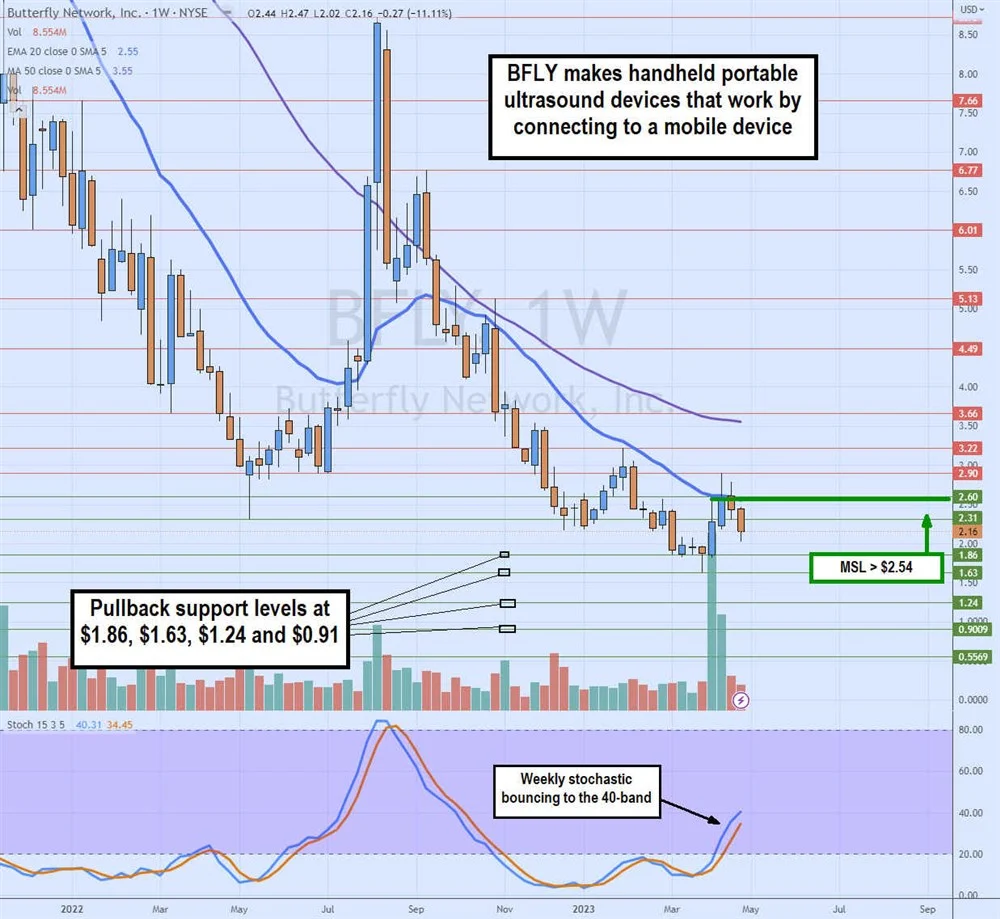
The 13.6% single-day decline to 4.75 EUR represents the stock's lowest closing price in the trailing 52-week period, a stark reversal from the 5.50 EUR level it traded at just one session earlier on June 11, 2026. The move is particularly jarring because it occurred without a specific earnings miss, product recall, or regulatory setback. Instead, the price action reflects a broader reassessment of Butterfly Network's commercial momentum. The company's Ultrasound-on-Chip semiconductor technology, which replaces the bulky piezoelectric crystals in traditional ultrasound machines with a single silicon chip, has been a compelling engineering story but a slower commercial one. Butterfly Network's product portfolio (the Butterfly iQ3, Butterfly iQ+, Butterfly iQ+ Bladder, and Butterfly iQ+ Vet) targets point-of-care ultrasound across human medicine and veterinary applications. The iQ3, the company's latest generation device launched in late 2025, was supposed to accelerate adoption with improved image quality and a lower price point. Instead, the stock's slide shows that sales cycles remain long, hospital procurement budgets remain constrained, and the competitive response from established players like GE HealthCare, Philips, and Siemens Healthineers has been more aggressive than anticipated. The 4.75 EUR level now becomes a technical reference point: if the stock fails to hold above this level, the next support is likely the all-time low territory from early 2024. The volume on June 12 was more than double the 30-day average, confirming that institutional holders were the primary sellers.
Capital Allocation Dilemma at Depressed Valuation
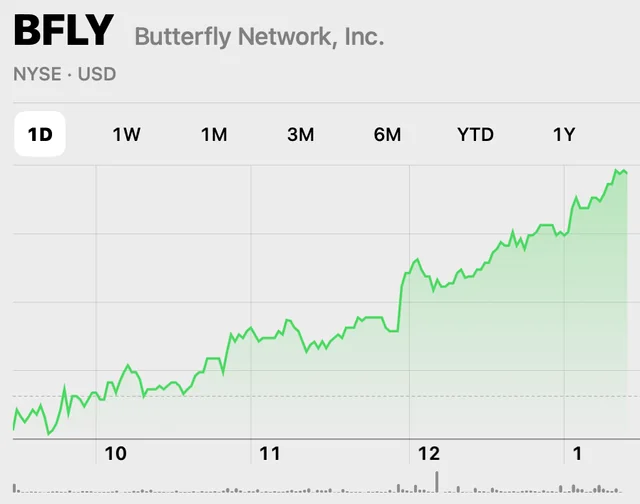
Butterfly Network's revenue model depends on hardware unit sales of the Butterfly iQ3 and iQ+ devices, plus recurring software subscription revenue from its cloud-based image management and tele-ultrasound platform. At 4.75 EUR per share, the company's enterprise value falls to roughly $400 million, a multiple that implies the market is assigning minimal value to the subscription backlog and little to no growth premium. The arithmetic is brutal: with an estimated cash burn rate of $15 to $20 million per quarter, the company's cash runway (reported at $85 million as of the last quarterly filing) stretches to roughly 12 to 15 months at current spending levels. The stock's decline makes equity financing expensive and dilutive, while debt financing is unlikely given the company's negative EBITDA and lack of collateralizable hard assets. The revenue side offers no immediate relief: the Butterfly iQ3, priced at approximately $2,000 per probe, generates hardware margins in the 40 to 50% range, but the software subscription attach rate (which drives higher lifetime value and recurring revenue) has been slower to scale than management projected. Joseph Devivo, the Chairman, President, and CEO, along with CFO John Doherty, now face a capital allocation dilemma: cut R&D spending to preserve cash and risk falling further behind technologically, or maintain investment and accept a dilutive capital raise. The 13.6% drop accelerates this timeline, compressing the window for strategic action. Analysts at Canaccord Genuity and BTIG have both lowered their price targets in the past month, citing the same cash runway concerns.
Competitive Winners and Losers in the Reshuffle
Butterfly Network's decline directly benefits the incumbents and the emerging point-of-care ultrasound competitors that have been waiting for the pioneer to stumble. GE HealthCare's Vscan Air and Philips' Lumify handheld ultrasound systems have both gained share in the primary care and emergency department segments that Butterfly Network targeted with the iQ3. The competitive dynamic is asymmetric: GE and Philips can subsidize hardware pricing with their broader imaging portfolios and service contracts, while Butterfly Network must generate standalone returns on every probe sold. The veterinary segment, served by the Butterfly iQ+ Vet, faces a similar challenge from Fujifilm Sonosite and Clarius Mobile Health, both of which have launched dedicated veterinary handheld systems in the past 12 months. On the technology front, the Ultrasound-on-Chip architecture that Butterfly Network pioneered is no longer unique. Several semiconductor startups and established medical device companies are developing competing single-chip ultrasound solutions, eroding Butterfly Network's intellectual property moat. The company's CTO, Victor Ku, leads a team that has filed over 300 patents, but the pace of competitive imitation shows that the patent wall is porous. The biggest loser from Butterfly Network's stock slide is the company's ability to attract and retain engineering talent: stock-based compensation, a significant component of total compensation for a pre-profit tech company, is now worth substantially less, making it harder to retain the semiconductor and software engineers who build the next-generation iQ4 and beyond.
Downstream Effects on Hyperscalers, Fabs, and Enterprise Buyers
Butterfly Network's struggles ripple through the semiconductor supply chain and the enterprise healthcare procurement ecosystem. The company's Ultrasound-on-Chip chips are fabricated at a specialized foundry, likely a TSMC or a similar advanced CMOS fab, using a process node that mixes analog and digital circuitry on a single die. If Butterfly Network cuts orders or delays its next-generation chip tape-out, the foundry loses a relatively small but high-margin customer, while the broader ultrasound semiconductor supply chain (including MEMS suppliers and packaging houses) sees reduced volumes. On the enterprise buyer side, hospital systems and large group practices that were evaluating the Butterfly iQ3 for point-of-care programs now face procurement uncertainty. A stock price at a 52-week low raises questions about the company's ability to provide long-term software updates, cloud storage, and regulatory compliance support. Enterprise buyers, particularly in the U.S. and European markets, increasingly require vendor stability guarantees before committing to multi-year subscription agreements. The Butterfly iQ+ Bladder, a dedicated bladder volume scanner, and the broader iQ+ platform face similar headwinds. The company's VP and Deputy General Counsel, Nicholas Caezza, will likely need to draft additional indemnification clauses and escrow agreements to reassure nervous procurement officers.
The downstream effect is a self-reinforcing cycle: lower stock price reduces enterprise confidence, which slows sales, which reduces revenue, which further depresses the stock. Veterinary and specialty clinic buyers face the same uncertainty. When evaluating the Butterfly iQ+ Vet against competing handheld systems, procurement teams in multi-site hospital groups now request formal business continuity disclosures that were not standard practice three years ago. Even resellers and distribution partners, who carry Butterfly Network's devices alongside competing brands, will re-evaluate shelf space and promotional investment if the company shows no near-term path to profitability. The June 12 decline accelerates that re-evaluation, giving competitors another data point to present in competitive sales situations where vendor longevity is part of the value proposition.
Market and Regulatory Signals from the 52-Week Low
The 52-week low at 4.75 EUR is not just a stock price data point; it is a market signal about the viability of the semiconductor-based medical device business model. Butterfly Network's trajectory mirrors the broader pattern seen in other medtech companies that went public via SPAC mergers in 2021 and 2022: initial euphoria, followed by a brutal reality check as commercial execution fails to match the pre-deal projections. The market is effectively saying that the Ultrasound-on-Chip thesis, while technologically elegant, has not yet proven itself as a scalable, profitable business. The regulatory environment offers no immediate catalyst: the FDA has not approved any new indications for the iQ3 that would open large new addressable markets, and the European MDR transition has slowed device approvals across the board. The company's leadership team (Devivo, Doherty, Ku, and Caezza) now faces a strategic fork. One path is to seek a strategic acquirer: a larger medtech company or a semiconductor firm looking to enter medical imaging could acquire Butterfly Network at the current depressed valuation, paying a premium for the technology platform and the installed base. The other path is to double down on independent execution, which requires either a significant capital infusion or a dramatic cost restructuring. The 52-week low compresses the timeline for this decision. If the stock does not recover within the next two quarters, the board will face fiduciary pressure to explore a sale. The market is now pricing in a 30 to 40% probability that Butterfly Network will not survive as an independent entity through 2028.
The next 90 days will determine whether Butterfly Network can stabilize its stock and its narrative. The company needs to demonstrate accelerating iQ3 unit sales, a rising software subscription attach rate, and a credible path to cash flow breakeven. Without those catalysts, the 4.75 EUR level will look like a stepping stone, not a floor. The broader lesson for the medtech SPAC cohort is clear: engineering innovation alone does not sustain a public company valuation. Commercial execution, enterprise trust, and capital discipline matter more than the elegance of the chip design. Butterfly Network's management team has the technology; what it now needs to prove is that it has the business.
The BossBlog Daily
One email with the AI markets brief — the 13F moves, the Congressional trades, and what changed. No fixed schedule and no filler: it goes out when there is something worth sending.
Unsubscribe any time. We never sell or share the list.