
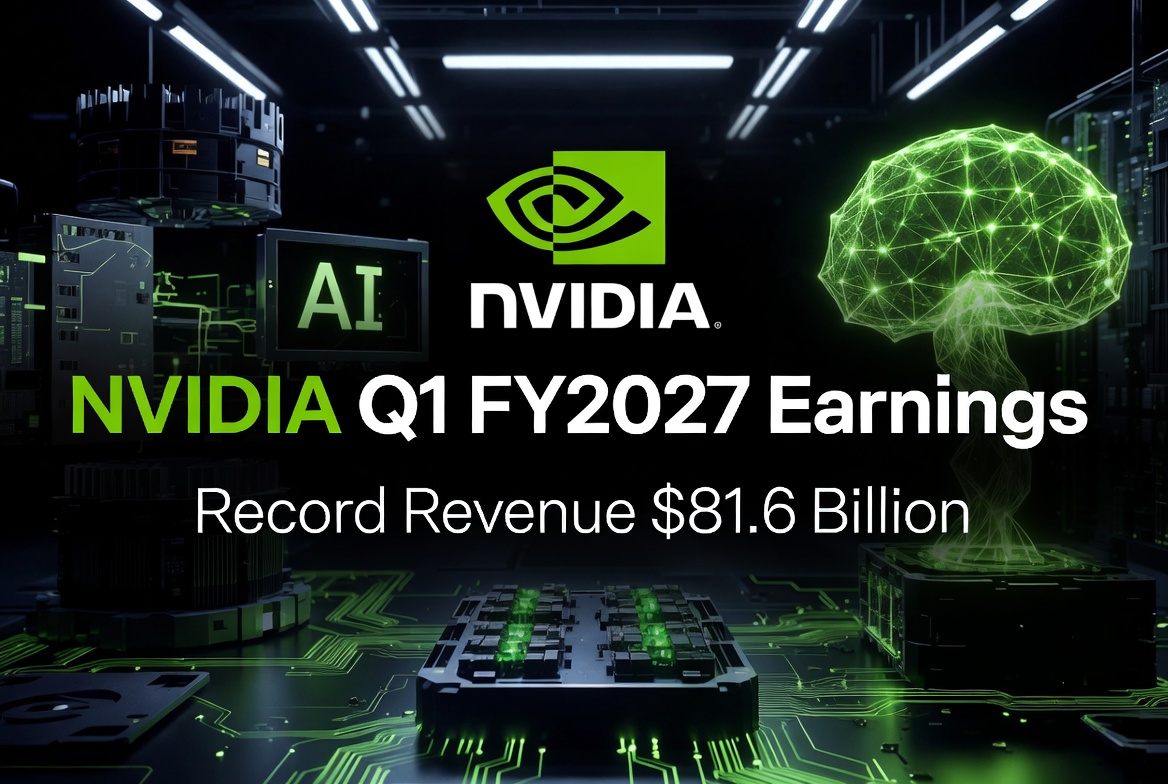
NVIDIA delivered a record Q1 FY2027 revenue of $81.6 billion, up 85% year-over-year and 20% sequentially, powered by Data Center sales of $75.2 billion, a 92% YoY surge that underscores the relentless acceleration of AI infrastructure buildout. GAAP diluted earnings per share hit $1.87, beating consensus estimates of roughly $1.77, while operating cash flow reached $50.3 billion and free cash flow hit $48.6 billion. The company raised its quarterly dividend from $0.01 to $0.25 per share, a 25x increase, and authorized an additional $80 billion for share repurchases, signaling a new phase of shareholder returns. Q2 FY2027 revenue guidance of $89.1–92.8 billion (centered around $91 billion) came in comfortably above consensus of approximately $87.3 billion, though it explicitly excludes any Data Center compute revenue from China. Despite the beat, shares slipped 1.5% in after-hours trading, suggesting the market had already priced in the AI supercycle. This quarter marks a critical inflection point: NVIDIA is no longer just a growth story. It is a cash-generating machine returning capital to shareholders while its fastest-ever product ramp, the Blackwell GPU platform, becomes the new baseline for hyperscalers.
Data Center Revenue Breakdown: Compute and Networking Surge
The Data Center segment delivered $75.2 billion in revenue, up 92% year-over-year and 21% sequentially, now representing 87% of total company revenue, up from 80% a year earlier. Within that, Data Center compute revenue reached $60.4 billion, up 77% YoY, while networking revenue hit $14.8 billion, nearly tripling year-over-year with a 199% increase. The networking surge reflects the critical role of NVLink and Spectrum-X in scaling AI clusters, as hyperscalers move beyond simple GPU purchases to full-scale AI factory deployments. CFO Colette Kress noted that hundreds of thousands of Blackwell GPUs have already been deployed by hyperscalers and frontier model builders. The Blackwell platform is now the baseline for new deployments, described by management as the fastest product ramp in NVIDIA's history. Early benchmarks of the Vera Rubin successor architecture indicate it will deliver roughly 3.3 times the performance per watt of Blackwell, though mass production is not expected until 2027. GAAP gross margin stood at 74.9%, with non-GAAP gross margin at 75.0%, demonstrating that NVIDIA maintains pricing power even as it scales production volumes. The margin resilience is particularly notable given the ramp of a new architecture, which typically carries higher initial costs. The company's non-GAAP net income hit $45.5 billion, up 139% YoY, translating to a net margin of roughly 56%, a figure that dwarfs most software companies and underscores the operating leverage inherent in NVIDIA's design-heavy, fab-lite business model.
Capital Allocation Shift: $80B Buyback and Dividend Hike
NVIDIA's decision to raise its quarterly dividend from $0.01 to $0.25 per share and authorize $80 billion in new share repurchases marks a structural shift in capital allocation. At $0.25 per share quarterly, the annual dividend payout would cost approximately $6.25 billion based on current shares outstanding, a fraction of the $48.6 billion in free cash flow generated in Q1 alone. The $80 billion buyback authorization is roughly 1.65 times Q1's free cash flow, signaling management's confidence that the AI investment cycle has multi-year durability. For context, free cash flow surged from $35 billion in the prior quarter to $48.6 billion, giving NVIDIA ample firepower to both reinvest in R&D and return capital. The dividend hike from a token $0.01 to a meaningful $0.25 per share also broadens NVIDIA's investor base, making it eligible for income-focused funds and dividend-growth strategies that previously ignored the stock. This capital return program effectively reduces the equity overhang: with $80 billion authorized, NVIDIA can retire roughly 5-6% of its outstanding shares at current prices, mechanically boosting EPS even if revenue growth slows. The move signals that management views the current valuation, approximately 30 times forward earnings, as attractive for buybacks, a vote of confidence that contrasts with the muted after-hours stock reaction.
Competitive Dynamics: Networking Dominance and Ecosystem Lock-In
NVIDIA's dominance is now so pronounced that its competitive impact is reshaping the entire semiconductor and cloud computing landscape. Microsoft, Amazon, Google, and Meta Platforms collectively represent a significant portion of Data Center revenue, and their commitment to Blackwell deployments locks them into NVIDIA's ecosystem for at least the next 12-18 months. The networking revenue surge, $14.8 billion, up 199% YoY, directly threatens incumbents like Broadcom and Marvell in the data center networking market, as NVLink and Spectrum-X create a vertically integrated fabric that competitors cannot easily replicate. Jensen Huang's emphasis on "AI factory" infrastructure as a new category, distinct from conventional cloud computing, reframes the competitive question: the contest is no longer GPU versus GPU but rather which company can deliver a complete AI factory stack across compute, networking, and software. NVIDIA's CUDA ecosystem, now over a decade deep, gives it a software moat that AMD's ROCm and Intel's oneAPI have consistently failed to breach at scale. For AMD and Intel, the message is stark: NVIDIA's Data Center revenue alone ($75.2 billion) is now larger than AMD's entire annual revenue, and Blackwell's "fastest ramp in history" means the window for competitive GPU alternatives is narrowing. Dell and other server OEMs benefit from the Blackwell ecosystem, as hyperscalers and enterprise customers need complete systems rather than bare GPUs. However, the concentration risk is rising: Data Center now accounts for 87% of total revenue, up from 80% a year ago, making NVIDIA more exposed to any slowdown in AI capex. The Q2 guidance explicitly excluding China Data Center compute revenue also creates a void that domestic Chinese chip companies like Huawei (with its Ascend series) and Cambricon are racing to fill, though their process-node limitations keep them several generations behind.
Supply Chain and Regulatory Pressures: CoWoS Bottlenecks and China Headwinds
The Blackwell ramp creates cascading effects across the supply chain. TSMC's advanced packaging capacity, particularly CoWoS (chip-on-wafer-on-substrate), remains a structural bottleneck: each NVL72 rack requires 72 Blackwell dies, and at the hyperscaler deployment pace of nearly a thousand racks per week, TSMC's packaging lines are running at maximum utilization. NVIDIA's ramp is absorbing a disproportionate share of available capacity, squeezing out smaller AI chip designers. For hyperscalers like Microsoft, Amazon, and Google, the Blackwell deployment cycle means they must commit to massive capex budgets 12-18 months in advance, with Q2 guidance of $91 billion implying that hyperscaler spending will remain elevated through calendar 2026. The networking revenue tripling also signals that AI clusters are becoming network-bound rather than compute-bound, driving demand for high-speed interconnects from companies like Arista Networks and Cisco, though NVIDIA's Spectrum-X is capturing an increasing share. For enterprise buyers, the Blackwell ramp creates a two-tier market: hyperscalers get priority access to new silicon, while enterprises face extended lead times and higher prices for H200 and prior-generation GPUs. The Vera CPU, announced alongside Blackwell, positions NVIDIA to encroach on Intel and AMD's traditional server CPU turf, offering a unified memory architecture that reduces data movement overhead. On the regulatory front, the explicit exclusion of China Data Center compute revenue from Q2 guidance confirms that export controls are a permanent structural headwind, not a temporary disruption. This forces NVIDIA to rely even more heavily on Western hyperscalers for growth, further concentrating its revenue base.
Shareholder Returns Signal Market Maturity
NVIDIA's capital return program, a 25x dividend increase and $80 billion buyback, is the clearest signal yet that the AI chip cycle has entered a mature phase. Companies typically initiate aggressive shareholder returns only when they believe their core market has reached a scale where reinvestment opportunities cannot absorb all available cash. With free cash flow of $48.6 billion in a single quarter, NVIDIA is generating more cash than most S&P 500 companies generate in a year. The dividend hike to $0.25 per share, while still modest in absolute terms, represents a psychological shift: NVIDIA is now a dividend-growth story, not just a growth story. This move broadens the shareholder base to include income-focused institutional investors, pension funds, and dividend aristocrat strategies that previously excluded the stock. The $80 billion buyback authorization also serves as a floor under the stock price, signaling that management will step in as a buyer if the market misprices the shares. For the broader market, this signals that the AI infrastructure buildout is not a speculative bubble but a sustained capital cycle with predictable cash flows. CEO Jensen Huang's emphasis on AI factory buildout and agentic AI as long-term drivers reinforces the narrative that this is a multi-decade transformation, not a single product cycle. The after-hours stock decline of 1.5% suggests that some investors expected even more aggressive guidance, but the capital return program provides a tangible floor for total shareholder returns.
The real test for NVIDIA will come in the second half of FY2027, when the Blackwell ramp reaches full production and the company must demonstrate that it can sustain revenue growth from a $90 billion quarterly run rate. NVIDIA's roadmap already points toward Rubin, the next-generation architecture slated for 2027, which promises a further step-change in compute density and energy efficiency. If the transition from Blackwell to Rubin follows the same cadence as the Hopper-to-Blackwell cycle, NVIDIA will need to persuade hyperscalers to commit to another multi-hundred-billion-dollar upgrade cycle before the current one has fully depreciated. The China export headwind, now explicitly excluded from guidance, will create a $5-10 billion quarterly revenue gap that must be filled by Western hyperscalers and enterprise customers. If Microsoft, Amazon, Google, and Meta maintain their current capex trajectories, NVIDIA can absorb that gap. But any sign of capex moderation from the hyperscalers, perhaps driven by concerns about AI ROI or regulatory scrutiny of data center power consumption, would expose the concentration risk embedded in that 87% Data Center revenue share. The dividend and buyback program gives management a tool to support the stock through any temporary turbulence, but it cannot replace organic revenue growth. The next 12 months will determine whether NVIDIA transitions from a hypergrowth anomaly into a durable, cash-generating blue chip, or whether the law of large numbers finally catches up with the fastest-growing large company in history.
The BossBlog Daily
Essential insights on AI, Finance, and Tech. Delivered every morning at 06:00 Asia/Shanghai. No noise.
Unsubscribe anytime. No spam.
Tools mentioned
AffiliateSelected partner tools related to this topic.
AI Copilot Suite
Content drafting, summarization, and workflow automation.
Try AI Copilot →
AI Model Monitoring
Track model quality, latency, and drift with alerts.
View Monitoring Tool →
Low-fee Global Broker
Multi-market access with transparent pricing.
Open Broker Account →
Some links above are affiliate links. We earn a commission if you sign up through them, at no extra cost to you. Affiliate revenue does not influence editorial coverage. See methodology.
The BossBlog Daily
Essential insights on AI, Finance, and Tech. Delivered every morning at 06:00 Asia/Shanghai. No noise.
Unsubscribe anytime. No spam.
Tools mentioned
AffiliateSelected partner tools related to this topic.
AI Copilot Suite
Content drafting, summarization, and workflow automation.
Try AI Copilot →
AI Model Monitoring
Track model quality, latency, and drift with alerts.
View Monitoring Tool →
Low-fee Global Broker
Multi-market access with transparent pricing.
Open Broker Account →
Some links above are affiliate links. We earn a commission if you sign up through them, at no extra cost to you. Affiliate revenue does not influence editorial coverage. See methodology.