
Nvidia reported fiscal second-quarter revenue of $96.2 billion, up 106% year-over-year and ahead of the $92.17 billion consensus estimate, with Data Center revenue surging 117% to $89.0 billion. Non-GAAP EPS came in at $2.22 versus the $2.10 expected, and the company guided Q3 revenue to $108 billion, plus or minus 2%, well above analyst projections. The stock jumped 8.7% to $227.98, pushing the company's market cap to $5.5 trillion, and the broader market rallied with the Nasdaq up 1.6% to 26,541.35. CFO Colette Kress told investors to expect fiscal 2028 revenue growth of 70%, a figure that dwarfs the 44% analysts had modeled. CEO Jensen Huang declared that "AI has reached its inflection point" and that "compute is revenue," framing the quarter as validation of the AI buildout thesis. The results arrive at a critical moment: hyperscalers are committing to multi-year GPU purchases, supply chain constraints are shifting from silicon to memory, and Nvidia's own balance sheet is taking on new leverage. This quarter settles the debate about whether AI demand can sustain its pace, and the answer is a definitive yes, with implications for every chipmaker, cloud provider, and enterprise buyer in the market.
Where the $96.2 Billion Came From
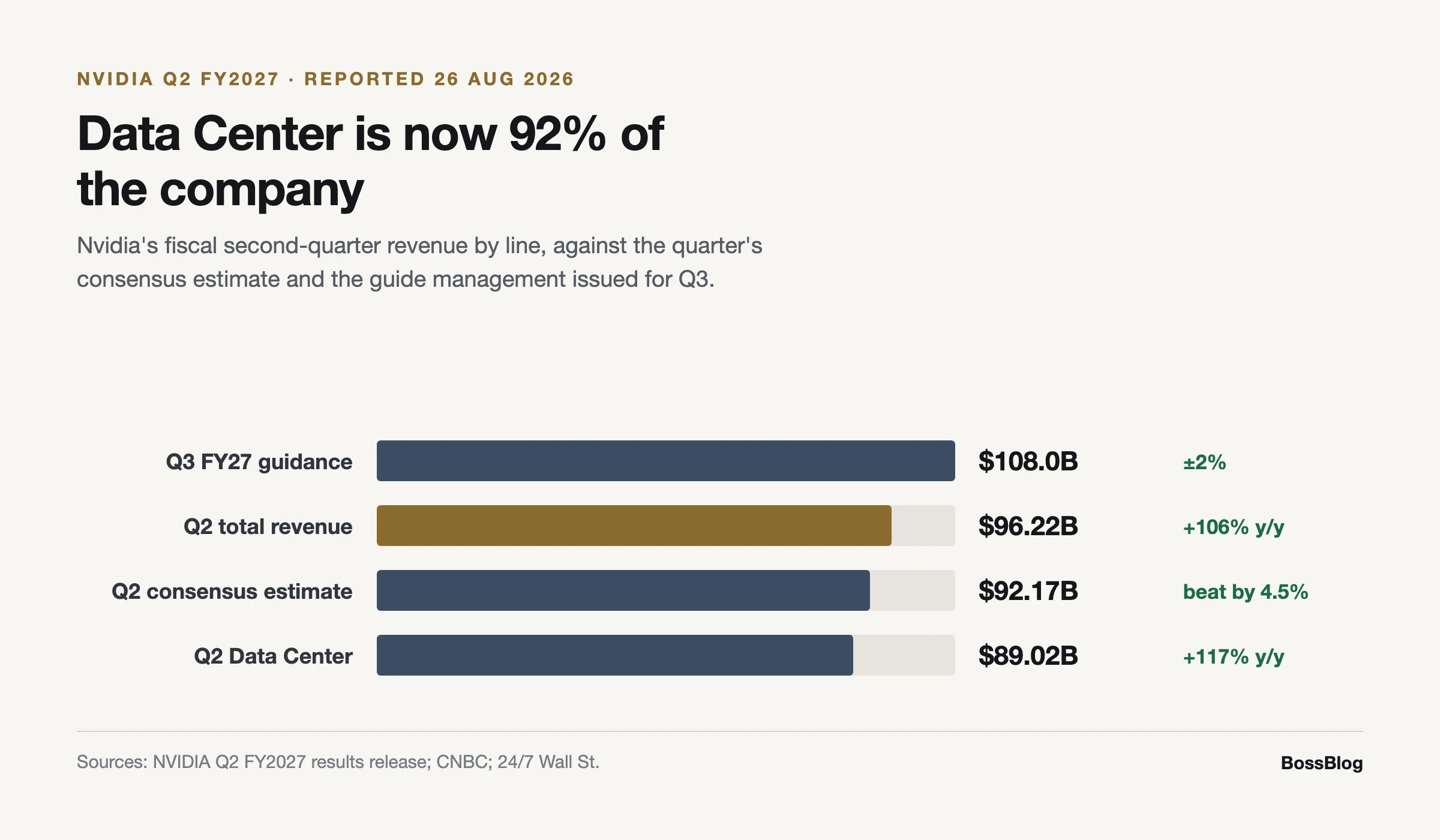
Data Center revenue of $89.02 billion carried the quarter, up 117% year-over-year and 18% sequentially, with the Blackwell Ultra architecture driving much of the acceleration. Data Center Networking rose 138% year-over-year, reflecting the attach rate of Spectrum-6 and other networking gear to GPU clusters. Hopper shipments represented less than 1% of Data Center revenue in Q2, confirming that the transition to Blackwell Ultra is essentially complete and that customers are buying the newest silicon at full price rather than discounting prior-generation inventory. GAAP and non-GAAP gross margins both came in at 75.0%, a level that underscores Nvidia's pricing power even as it ramps production volumes. Operating income reached $63.7 billion on a GAAP basis and GAAP EPS landed at $2.46, while CNBC put net income at $53.95 billion, or $2.22 per share, against $24.76 billion and $1.87 per share a year earlier. The company returned approximately $26.0 billion to shareholders in Q2 through buybacks and dividends, with $99.0 billion remaining in its share repurchase authorization. The quarterly cash dividend stands at $0.25 per share. Nvidia's guidance for Q3 implies another 18% sequential increase in revenue, and the company is not assuming any Data Center compute revenue from China in its outlook, a conservative stance that leaves room for upside if export restrictions ease or if the company finds compliant pathways to serve that market.
How the $279 Billion Supply Pipeline Works

Nvidia's supply commitments have swelled to $279 billion, and the composition of that figure matters for understanding the company's margin trajectory and its ability to deliver on the 70% growth forecast for fiscal 2028. The bulk of these commitments are for memory, specifically HBM and related components for the Vera Rubin platform, which is now ramping into full production with partners including CoreWeave, Google Cloud, Microsoft Azure, Oracle Cloud Infrastructure, and Nebius. The memory supply chain is the binding constraint on GPU output, and Nvidia is effectively pre-paying and locking in allocation to ensure it can ship the volume its customers demand. This strategy shifts risk onto Nvidia's balance sheet in exchange for supply certainty, and it explains why the company's debt profile has changed. As of July 26, Nvidia had $33.5 billion in senior notes outstanding, up from $2.75 billion of debt due in one to five years in the prior quarter, plus a $25 billion commercial paper program. The company flagged indebtedness as a risk factor in its quarterly filing, a notable admission for a business generating $53.95 billion in quarterly net income. The trade-off is clear: Nvidia is using its balance sheet to secure the memory supply that will determine whether it can hit its fiscal 2028 targets, and the $15 billion of debt due in the next one to five years is a manageable cost for that strategic advantage.
The Competitive Reshuffle Among Chipmakers
Nvidia's results sent a shockwave through the semiconductor sector, with Broadcom up 4.5% and Intel up 4.4% in the aftermath, but the dynamics beneath those moves are more nuanced than a simple rising-tide story. Broadcom's gain reflects its position as a custom ASIC designer for hyperscalers, a business that benefits from the overall AI capex boom even as it competes with Nvidia for certain workloads. Intel's move is more about sentiment and the possibility that AI infrastructure spending lifts all boats, though Intel's data center GPU offerings remain marginal. Advanced Micro Devices is the clear loser in this quarter's narrative: Nvidia's Data Center revenue of $89 billion in a single quarter dwarfs AMD's entire annual data center GPU revenue, and the 117% growth rate shows that Nvidia is not losing share to AMD's MI-series accelerators. The more interesting competitive dynamic is at the system level, where Nvidia's Spectrum-6 networking products are displacing traditional Ethernet and InfiniBand vendors, and where the Vera Rubin platform's full production ramp creates a moat that custom silicon cannot easily cross. The AWS deal for 2 million additional GPUs, which Huang noted includes "millions of CPUs," shows that even hyperscalers that design their own silicon are deepening their commitment to Nvidia's platforms.
That CPU detail deserves more weight than it received on the call. Amazon has spent years building Graviton to move general-purpose compute off third-party silicon, and Trainium to move training off Nvidia. Committing to millions of CPUs alongside 2 million GPUs says the in-house program is running as a complement to Nvidia rather than a replacement for it, at least through the Vera Rubin generation. The same read applies to Google, which ships its own TPUs and still appears on Nvidia's list of Vera Rubin launch partners alongside CoreWeave, Microsoft Azure, Oracle Cloud Infrastructure, and Nebius. Custom accelerators have not stopped growing, but they are absorbing workloads at the margin while the frontier training and inference tier consolidates further onto Nvidia's stack. The guidance assumes zero Data Center compute revenue from China, which means Nvidia is projecting 70% growth in fiscal 2028 while writing off the single largest addressable market it once served.
Downstream Effects on Hyperscalers and the Memory Supply Chain
The $279 billion in supply commitments, mostly for memory, signals that the HBM and DRAM supply chain will be operating at maximum capacity for the next several quarters, with pricing power shifting to memory makers like SK Hynix, Samsung, and Micron. For hyperscalers, the AWS deal for 2 million GPUs and the Vera Rubin production ramp with CoreWeave, Google Cloud, Microsoft Azure, Oracle Cloud Infrastructure, and Nebius means that cloud capacity will expand dramatically, but at a cost. These companies are making multi-year commitments that will pressure their own margins even as they position to capture AI workloads. The enterprise software layer is also reacting: Salesforce shares surged 22.6% after beating earnings and revenue estimates, with EPS of $5.9 versus the $3.27 expected, showing that AI-driven productivity gains are starting to show up in software company financials. The broader market response was emphatic, with the S&P 500 up 0.7% to 7,730.99 and the tech-heavy XLK ETF up 3.2%, while the VIX fell 4.6% to 14.51, indicating that investors are reading Nvidia's results as a signal that the AI trade has more room to run. The key second-order effect is on power infrastructure: every million GPUs deployed requires gigawatts of new data center capacity, and that demand is driving investment in everything from grid upgrades to on-site generation.
What the 70% Growth Forecast Signals About the AI Cycle
Kress's guidance for fiscal 2028 revenue growth of 70% is the most important number in this earnings report, and it represents a fundamental re-rating of the AI cycle's duration and intensity. Analysts had modeled 44% growth, and Nvidia is telling the market that the actual demand trajectory is nearly 60% higher than the consensus view. That 26-percentage-point gap between guidance and consensus is the entire argument, compressed into one number: the sell side has been modeling a decelerating buildout, and the company that sells the picks and shovels says the opposite. The signal to the broader market is that AI infrastructure spending is not a one-time buildout but a sustained multi-year investment cycle, and that the compute requirements for frontier models and enterprise AI applications are still expanding. Huang's framing that "AI has reached its inflection point" and that "its tokens are productive and profitable" is a direct response to skeptics who argue that AI monetization lags investment. The 70% growth forecast also has implications for the competitive landscape: it tells AMD, Intel, and custom silicon vendors that they are competing for a market that is growing fast enough to accommodate multiple winners, even as Nvidia maintains its dominant share. The guidance assumes zero China compute revenue, which means the actual growth will be higher if that market reopens, and it embeds the memory supply commitments that Nvidia has already locked in.
The next twelve months will test whether Nvidia can execute on the Vera Rubin ramp at the scale implied by its $279 billion supply commitments, and whether the memory supply chain can deliver the HBM volumes required to support $108 billion in quarterly revenue by Q3 and beyond. The 70% growth forecast for fiscal 2028 sets a high bar, and the company's ability to hit it will depend on factors largely outside its control: memory yields, power availability, and the pace of hyperscaler data center construction. The debt buildout to $33.5 billion in senior notes is a calculated bet that the supply certainty it purchases will translate into revenue growth that far exceeds the cost of capital. Investors will also watch whether the Fed's policy stance, with Chairman Kevin Warsh speaking at Jackson Hole, shifts in a way that affects the cost of financing for the massive AI infrastructure buildout. The competitive response from AMD, Intel, and custom silicon players will intensify, but Nvidia's lead in networking, software, and full-stack integration gives it a moat that is widening, not narrowing. The AI trade has moved from speculative to fundamental, and Nvidia's numbers now anchor the entire market's expectations for the next several quarters.
The BossBlog Daily
One email with the AI markets brief — the 13F moves, the Congressional trades, and what changed. No fixed schedule and no filler: it goes out when there is something worth sending.
Unsubscribe any time. We never sell or share the list.