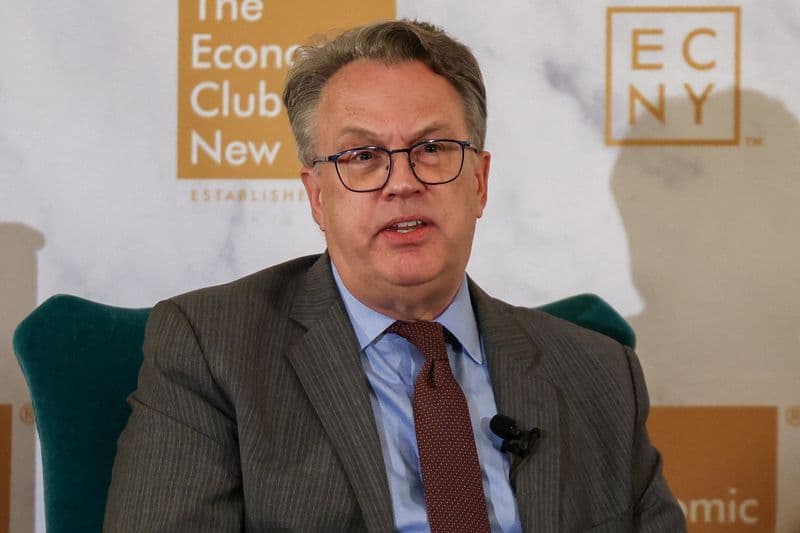
New York Federal Reserve President John C. Williams on Friday reiterated that the central bank's current monetary policy stance is appropriate for the economic outlook, even as inflation remains stubbornly elevated. Speaking in a public appearance, Williams said the federal funds rate target range of 3.5% to 3.75% is well-positioned given a "solid" U.S. economy and a labor market that is "doing quite well." He acknowledged that inflation will stay high in the near term, with the Personal Consumption Expenditures (PCE) price index running around 4% and core inflation above 3%, but predicted that price pressures will ease later this year. The remarks come as financial markets, which have largely seen the Fed on hold, are beginning to weigh the prospect of a rate increase. This shift underscores the delicate balance the central bank must strike between taming inflation and sustaining growth. This matters now because any signal of a potential hike would ripple through bond markets, corporate borrowing costs, and equity valuations, reshaping the investment landscape for the second half of 2026.
The Mechanics of a Hold vs. a Hike
Williams’s core message is one of patience: the Fed is not rushing to adjust rates despite inflation running well above its 2% target. The federal funds rate target range of 3.5% to 3.75% represents a level that Williams and his colleagues believe is sufficiently restrictive to cool the economy over time without triggering a recession. The key mechanism at play is the distinction between near-term and longer-term inflation expectations. Williams noted that near-term expectations have ticked up due to recent events, a reference to persistent supply-side pressures and residual fiscal stimulus, but longer-term expectations remain stable. This stability is the Fed’s primary anchor. As long as households and businesses do not expect high inflation to become permanent, the central bank can afford to hold rates steady and let the lagged effects of previous tightening work through the system. A rate hike, by contrast, would be a response to evidence that longer-term expectations are becoming unmoored. Williams’s language suggests the Fed is not there yet, but the fact that markets are now pricing in some probability of a hike indicates that the threshold for action is lower than it was six months ago. The difference between a hold and a hike is essentially a bet on whether current inflation is transitory or structural.
Where the Inflation Numbers Bite
The arithmetic of inflation is unforgiving. With PCE inflation around 4% and core inflation above 3%, the Fed is still miles from its 2% target. These figures are not abstract. They directly impact real interest rates, which determine the true cost of borrowing for businesses and consumers. At a nominal fed funds rate of 3.5% to 3.75% and inflation at 4%, the real policy rate is negative, meaning monetary policy is actually accommodative in inflation-adjusted terms. That is a problem for a central bank trying to cool demand. Williams’s forecast that inflation will ease later this year is therefore critical. If he is wrong and inflation stays elevated, the Fed will be forced to raise rates simply to achieve a neutral or restrictive real stance. The market’s growing consideration of a rate hike reflects this arithmetic. Bond traders are pricing in the risk that the Fed will need to push the nominal rate above 4% to achieve a positive real rate. For corporate borrowers, this means higher refinancing costs and tighter credit conditions. For equity investors, it compresses valuation multiples, particularly for growth stocks that are most sensitive to discount rates. The numbers are concrete: a 25-basis-point hike would add roughly $25 billion in annual interest costs across the U.S. corporate bond market, based on outstanding investment-grade and high-yield debt.
The composition of that inflation also matters. Services inflation, which accounts for roughly 60% of the PCE basket, is running hotter than goods inflation and is historically stickier. Shelter costs, which the Bureau of Economic Analysis incorporates with a significant lag from actual rent contracts, remain a tailwind for services inflation well into 2026. Healthcare services, another major component, are seeing renewed price acceleration as provider contracts reset. This means even if goods disinflation continues, as it has since the supply-chain normalization of 2023 and 2024, the services component alone keeps overall PCE above 3% through the summer. Williams’s prediction of easing rests on assumptions about shelter and services that are far from guaranteed. The Fed’s own quarterly projections, last updated in March, showed the median member expecting PCE to reach 2.8% by year-end, a trajectory that requires a meaningful deceleration in rent and healthcare costs in the back half of 2026.
Competitive Reshuffle in Rate-Sensitive Sectors
The Fed’s rate stance creates winners and losers across the financial ecosystem. Regional banks, which rely on net interest margins, are the most exposed to a prolonged hold or a hike. If rates stay at 3.5%–3.75%, their funding costs, particularly for deposits, will continue to rise, compressing spreads. A hike would exacerbate this, potentially triggering another round of deposit outflows to money market funds, which are yielding around 4.5%. On the other hand, large money-center banks with diversified revenue streams, such as JPMorgan Chase and Goldman Sachs, can offset margin compression with higher trading and advisory fees. The insurance sector is a clear beneficiary: life insurers and property-casualty underwriters are earning higher yields on their bond portfolios without a corresponding increase in policy payouts. The technology sector faces the headwind of higher discount rates, which reduce the present value of future cash flows. Growth stocks, particularly in AI and cloud computing, are the most vulnerable. Conversely, energy and materials companies, which generate strong cash flows and have pricing power, are relatively insulated. The competitive dynamic is shifting capital allocation: investors are rotating from long-duration assets to short-duration instruments, and from high-multiple growth names to value and income plays.
Downstream Effects on Corporate Capex and Hiring
The Fed’s policy stance directly influences corporate capital expenditure and hiring decisions. With the fed funds rate at 3.5%–3.75%, the cost of capital for non-financial companies has risen sharply. The average yield on investment-grade corporate bonds is now around 5.5%, up from 3.2% in early 2024. This higher cost is already weighing on capex plans. Companies in rate-sensitive sectors such as housing, commercial real estate, and manufacturing are deferring expansion projects. Homebuilders like D.R. Horton and Lennar are seeing higher mortgage rates, with the 30-year fixed rate above 7%, which is cooling demand. Commercial real estate developers are facing a refinancing wall in 2026–2027, with higher rates threatening to trigger defaults on properties with floating-rate debt. The labor market, which Williams described as "doing quite well," is showing signs of softening at the margin. Job openings are declining, and temporary help services, a leading indicator, have contracted for three consecutive months. If the Fed holds rates steady, the lagged effect of past tightening will continue to slow hiring. If it raises rates, the impact will accelerate. For enterprise technology buyers, higher rates mean tighter IT budgets, which will slow the adoption of AI infrastructure and cloud services. Hyperscalers like Amazon Web Services and Microsoft Azure are already reporting longer sales cycles for large deals.
The Policy Signal: A Fed That Is Watching and Waiting
Williams’s remarks are best read as a deliberate policy signal: the Fed is comfortable with the current rate level but is not complacent. The emphasis on stable longer-term inflation expectations is a message to markets that the central bank will not overreact to short-term data. However, the acknowledgment that near-term expectations have risen, and that markets are weighing a hike, signals the Fed is preparing the ground for a rate increase if inflation does not ease as forecast. This is a classic Greenspan-era playbook: talk dovish, but keep the hawkish option open. The signal is particularly important for the Treasury market. The yield curve has been inverted for over two years, with the 2-year yield above the 10-year yield. A rate hike would steepen the curve, potentially normalizing it, which would be a positive for banks but a negative for the Treasury’s borrowing costs. The U.S. government is running a deficit of roughly $1.5 trillion, and higher rates increase the cost of servicing the $35 trillion national debt. Williams’s stance also has international implications: a Fed hold or hike supports the U.S. dollar, which puts pressure on emerging-market currencies and forces central banks in Asia and Latin America to maintain tighter policies. The bottom line is that the Fed is in a holding pattern, but the runway is getting shorter.
The market’s growing consideration of a rate hike is not a prediction. It is a hedge. As the second half of 2026 unfolds, the key variable will be the trajectory of core PCE inflation. If it falls below 3% by September, the hold will hold. If it stays above 3.5%, the Fed will have little choice but to act. Williams’s comments buy the central bank time, but not unlimited time. The risk is that by waiting too long, the Fed will be forced to raise rates more aggressively later, which would increase the probability of a hard landing. For investors, the prudent strategy is to position for a higher-for-longer rate environment, with a bias toward short-duration fixed income, value equities, and sectors with pricing power. The era of easy money is definitively over. The question is whether the Fed can engineer a soft landing without breaking the economy. Williams’s answer is a cautious yes, but the data will have the final word. Investors who ignore the rate-hike optionality embedded in current Fed communication do so at their own risk. The bond market is already adjusting; equity portfolios that have not followed are behind the curve.
The BossBlog Daily
Essential insights on AI, Finance, and Tech. Delivered every morning at 06:00 Asia/Shanghai. No noise.
Unsubscribe anytime. No spam.
Tools mentioned
AffiliateSelected partner tools related to this topic.
AI Copilot Suite
Content drafting, summarization, and workflow automation.
Try AI Copilot →
AI Model Monitoring
Track model quality, latency, and drift with alerts.
View Monitoring Tool →
Low-fee Global Broker
Multi-market access with transparent pricing.
Open Broker Account →
Some links above are affiliate links. We earn a commission if you sign up through them, at no extra cost to you. Affiliate revenue does not influence editorial coverage. See methodology.
The BossBlog Daily
Essential insights on AI, Finance, and Tech. Delivered every morning at 06:00 Asia/Shanghai. No noise.
Unsubscribe anytime. No spam.
Tools mentioned
AffiliateSelected partner tools related to this topic.
AI Copilot Suite
Content drafting, summarization, and workflow automation.
Try AI Copilot →
AI Model Monitoring
Track model quality, latency, and drift with alerts.
View Monitoring Tool →
Low-fee Global Broker
Multi-market access with transparent pricing.
Open Broker Account →
Some links above are affiliate links. We earn a commission if you sign up through them, at no extra cost to you. Affiliate revenue does not influence editorial coverage. See methodology.