
Anthropic and OpenAI have collectively raised $5.5 billion to launch consulting operations, marking the most aggressive push by AI labs to embed their technology directly into corporate workflows. Anthropic formed a new company with Blackstone, Goldman Sachs, and Hellman & Friedman, raising $1.5 billion, while OpenAI secured a $4 billion arrangement with 19 investors including Brookfield and TPG. Both deals are structured to deploy AI engineers into client businesses to build custom tools, bypassing the traditional software sales model that has struggled to gain traction with enterprise buyers. The move comes as AI labs face mounting pressure to demonstrate recurring revenue beyond API calls and subscription tiers. The consulting push defies a well-documented history of technology companies failing to scale services businesses. IBM's consulting arm, for example, generates thin margins compared to its software division. But the scale of capital committed here shows investors believe AI's transformative potential justifies the risk. Why this matters now: with $5.5 billion in dedicated consulting capital, Anthropic and OpenAI are betting that embedding engineers inside client organizations will unlock adoption faster than any product roadmap can deliver, and the outcome will determine whether AI labs become platform companies or glorified outsourced R&D shops.
The $1.5 billion and $4 billion investor syndicates
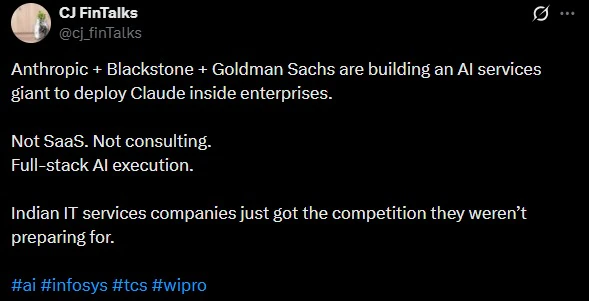
Anthropic's consulting vehicle is a newly formed company capitalized by Blackstone, Goldman Sachs, and Hellman & Friedman, each contributing to the $1.5 billion total. The structure is unusual. Rather than raising venture capital or debt, Anthropic created a separate legal entity dedicated to services, insulating its core research operations from the liabilities and margin pressures of consulting. OpenAI's $4 billion arrangement involves 19 investors, including Brookfield and TPG, and follows a similar logic: the capital is ring-fenced for deploying engineers into client environments, not for training frontier models. The investor syndicates reflect a shift in who finances AI infrastructure. Blackstone and Brookfield are traditionally real estate and infrastructure investors, not early-stage tech backers. Their participation signals that AI consulting is being treated as an asset class with predictable cash flows, not as venture-stage speculation. Goldman Sachs and TPG bring deep experience in structuring large-scale services spin-outs, having advised on similar moves in the IT outsourcing and cloud migration waves of the 2010s. The $5.5 billion total is roughly equivalent to the annual revenue of Accenture's North America operations, suggesting the AI labs are targeting a services market that will eventually rival the largest IT consulting firms. The capital is structured to provide multi-year runways, with each investor receiving a share of future consulting revenue rather than equity in the core AI labs.
How the money flows through the P&L
The consulting model changes the economics of AI labs in three ways. First, it converts variable API revenue into fixed-fee services contracts, which carry higher margins but also higher labor costs. Anthropic and OpenAI will need to hire thousands of engineers to staff client engagements, with fully loaded costs per engineer likely exceeding $400,000 annually in major markets. Second, the deals create a captive distribution channel for the labs' own models. When an Anthropic engineer builds a custom tool for a Blackstone portfolio company, that tool will run on Anthropic's API, generating inference revenue that carries gross margins above 70%. Third, the consulting arm can cross-sell higher-margin products including fine-tuning services, custom datasets, and managed inference ??bundles that are difficult to move through self-serve channels but command premium pricing in a managed engagement. The risk is that consulting margins compress as the business scales. Accenture's operating margin hovers around 15%, while OpenAI's API business likely operates above 50%. If the consulting push cannibalizes API revenue by locking clients into fixed-price contracts, the blended margin will fall. The $5.5 billion capital cushion gives both labs a multi-year runway to experiment with pricing models before profitability becomes a board-level concern. The fixed-fee structure also provides predictable revenue that public markets value more highly than variable API consumption.
Who gains and who loses in the competitive reshuffle
The consulting push directly threatens established IT services firms. Accenture, Infosys, and Tata Consultancy Services have all built AI practices, but they lack proprietary models. Anthropic and OpenAI can offer clients exclusive access to frontier models combined with engineering talent, a bundle that traditional consultancies cannot replicate. The biggest loser will be McKinsey and BCG, which have invested heavily in AI capabilities but rely on partnerships with OpenAI and Anthropic for model access. Those partnerships now become competitive relationships. For hyperscalers, the impact is mixed. Microsoft, which has invested $13 billion in OpenAI, benefits if consulting engagements drive Azure consumption. But if OpenAI embeds engineers using its own infrastructure, Microsoft loses the cloud margin. Amazon and Google face a similar dynamic with Anthropic. CoreWeave, which recently achieved the top ranking for inference speed and price-performance on Moonshot AI's Kimi K2.6 model across 11 providers, stands to gain as a neutral infrastructure provider. The benchmark win, conducted by Artificial Analysis, positions CoreWeave as a preferred partner for AI labs that want to avoid hyperscaler lock-in. CoreWeave, listed on Nasdaq as CRWV, now offers inference performance that rivals or exceeds the major cloud providers, making it an attractive option for consulting engagements that require predictable latency.
Downstream effects on hyperscalers, fabs, and enterprise buyers
The consulting push will accelerate demand for inference infrastructure, benefiting companies like CoreWeave that specialize in GPU-accelerated computing. Each consulting engagement requires dedicated compute capacity for model serving, fine-tuning, and custom training. If Anthropic and OpenAI deploy 10,000 engineers across client sites, the associated inference workload will require 50,000 to 100,000 GPUs, creating a new demand vector that is not captured in current hyperscaler capex forecasts. For semiconductor companies, the shift from API-based to consulting-driven consumption favors inference-optimized chips over training hardware. NVIDIA's H100 and B200 GPUs dominate training, but inference workloads increasingly run on custom ASICs from Google, Amazon, and startups. Enterprise buyers face a different calculus. Instead of negotiating API pricing or building in-house AI teams, they can now buy a turnkey solution from Anthropic or OpenAI with guaranteed access to the latest models. This reduces the risk of vendor lock-in because the consulting contract includes the engineering talent to migrate between models. The downside is cost: a typical consulting engagement with Anthropic will run $5 million to $20 million annually, pricing out all but the largest enterprises. Mid-market companies will likely continue using API-based offerings from OpenAI, Anthropic, or Moonshot AI, which recently launched Kimi K2.6 with strong inference performance on CoreWeave's infrastructure. The consulting model also creates a new procurement category for enterprise buyers, who can now budget for AI transformation as a services line item rather than a technology experiment.
What the consulting push signals about AI market strategy
The $5.5 billion consulting push is a strategic admission that AI models alone are not sufficient to capture enterprise value. OpenAI and Anthropic have both achieved remarkable technical milestones, but enterprise adoption has lagged because most companies lack the engineering talent to integrate frontier models into production systems. By embedding engineers directly into client organizations, the labs are effectively outsourcing the last mile of AI deployment to themselves. This mirrors the strategy that cloud providers used a decade ago. AWS, Azure, and Google Cloud all launched professional services organizations to help enterprises migrate workloads, and those services became the primary driver of cloud adoption. The difference is scale: AWS's professional services team never raised $4 billion in dedicated capital. The move also signals that AI labs expect the consulting business to generate proprietary data that improves their models. Every custom tool built for a client produces training data, usage patterns, and feedback loops that can be fed back into the base model. This creates a flywheel that pure-play consultancies cannot replicate. The F1 paddock has become an unexpected hub for these deal flows. Investor Immpana Srri noted that over five years, F1 events have transformed into tech meetups. Lightspeed launched an Aston Martin program in Miami and plans to expand to Silverstone, using the paddock to connect AI founders with enterprise buyers. The consulting push will likely accelerate this trend, as AI executives seek face-to-face relationships with the CIOs and CTOs who will sign multi-million dollar engagements.
The consulting push will reshape how AI labs are valued by public markets. If Anthropic and OpenAI can demonstrate that their services business generates recurring revenue with gross margins above 40%, the market will assign a higher multiple to their equity than to pure-play model providers. The risk is that the consulting business becomes a distraction, pulling engineering talent away from frontier model research. OpenAI's $4 billion arrangement with 19 investors buys time to manage that tension, but the clock is ticking. CoreWeave's benchmark win on Kimi K2.6 shows that inference performance is becoming a commodity, and the real moat will be the relationships and data that consulting engagements create. The next 12 months will determine whether the $5.5 billion bet pays off, or whether AI consulting joins the long list of technology services businesses that promised transformation but delivered only margin compression. The capital structure of these deals also provides a template for other AI labs seeking to fund services operations without diluting core research equity. If the model succeeds, it will trigger a wave of similar consulting spin-outs from labs like Cohere, Mistral, and Moonshot AI, each seeking to capture enterprise value through embedded engineering rather than API sales alone. The Anthropic??lackstone vehicle and OpenAI's 19-investor consortium have effectively set a new financing standard: ring-fence the services risk from the core research entity, bring in infrastructure investors who understand annuity cash flows, and use the consulting revenue to fund the next generation of model training. That structural separation is what IBM, Accenture, and the classic systems integrators never had, and it may be the key variable that allows AI labs to scale services without sacrificing the innovation velocity that made them valuable in the first place.
The BossBlog Daily
One email with the AI markets brief — the 13F moves, the Congressional trades, and what changed. No fixed schedule and no filler: it goes out when there is something worth sending.
Unsubscribe any time. We never sell or share the list.