
The Formula 1 paddock has become the most unlikely but hottest venue for startup dealmaking, as investor Immpana Srri demonstrated by scouting deals at the Miami Grand Prix last weekend. Over a three-day weekend, Srri noted that the paddock has evolved from a racing hospitality zone into a dedicated tech meeting ground over the past five years, where founders, venture capitalists, and corporate sponsors now regularly close financing rounds and partnership agreements between practice sessions. Lightspeed, the venture capital firm, kicked off its Aston Martin partnership program in Miami, using the race to meet portfolio companies and source new AI deals. The firm plans to continue the program at US races including Las Vegas in November, and will expand internationally to Silverstone. The shift matters because AI startups, which require massive capital and distribution partnerships, now find their most productive deal flow not in Sand Hill Road boardrooms but in the high-speed, high-stakes environment of an F1 weekend. This is a signal that the geography of venture capital is being rewritten by the need for speed.
Lightspeed's Structured Deal-Sourcing Machine
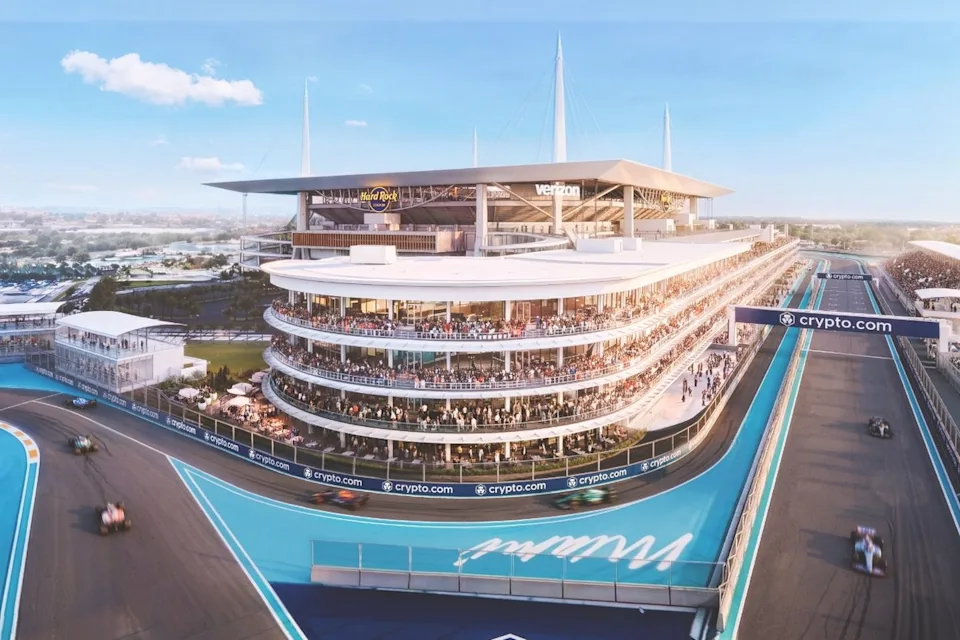
The Lightspeed-Aston Martin partnership is not a branding exercise but a structured deal-sourcing machine. Lightspeed partner Machiz framed the logic bluntly: "In AI, distribution is speed." The program, which debuted in Miami, gives Lightspeed access to Aston Martin's corporate hospitality network, engineering talent, and global race calendar. For a venture firm that needs to deploy capital into AI startups at a rapid clip, the paddock offers a concentrated pool of potential founders and customers who are already operating at the intersection of hardware, software, and high-performance computing. The three-day weekend in Miami generated dozens of introductions, according to Srri, who said the density of decision-makers in one place makes the paddock more efficient than a month of standard office meetings. The program will extend to Las Vegas in November and then cross the Atlantic to Silverstone, giving Lightspeed a year-round deal pipeline anchored to the F1 calendar. The economics are straightforward: a single partnership that yields one breakout AI portfolio company justifies the entire sponsorship cost, and the network effects compound as more founders show up expecting to find capital. Lightspeed's Machiz has stated that the firm views the paddock as a permanent sourcing channel rather than a one-off marketing stunt, reinforcing the structural shift in how venture capital identifies AI opportunities.
How the Money Flows Through the P&L
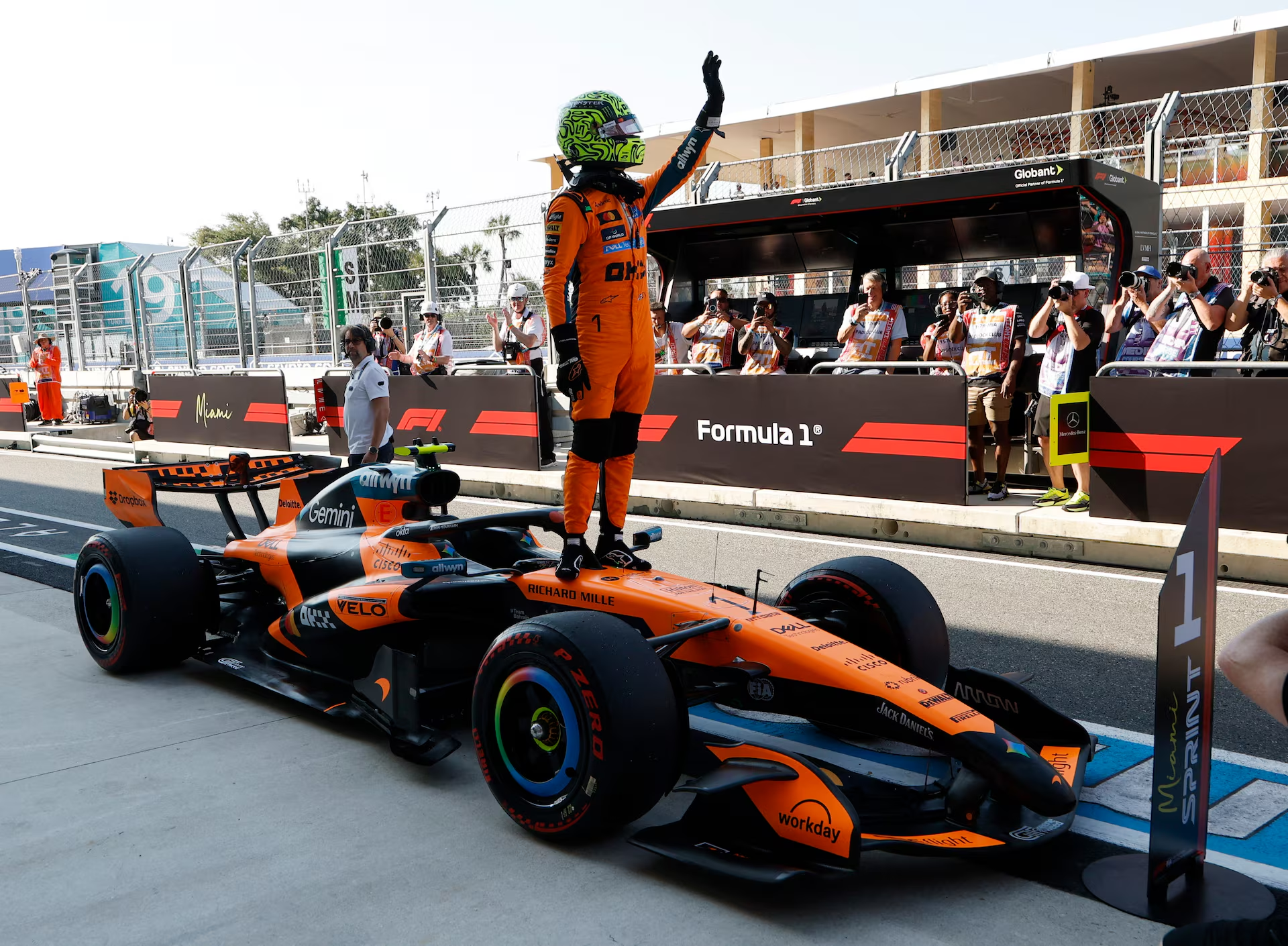
For Lightspeed, the Aston Martin program is a marketing expense that doubles as a sourcing channel, but the real financial impact shows up in portfolio returns. The firm is betting that AI startups sourced through the paddock will have higher hit rates because the founders they meet there are already operating in capital-intensive, high-velocity markets. The cost of the partnership, estimated in the millions annually for a top-tier F1 team sponsorship, is trivial compared to the management fees Lightspeed collects on its funds, which run into the hundreds of millions. The ROI calculation hinges on deal flow quality, not quantity. If the paddock generates one or two Series A investments per race weekend that later become unicorns, the program pays for itself many times over. For Aston Martin, the partnership provides non-dilutive revenue and positions the team as a technology platform rather than just a racing outfit. The team's engineering division, which already works with aerospace and defense contractors, can now pitch itself to AI startups needing simulation, thermal management, and real-time data processing expertise. The cross-sell potential between Lightspeed's portfolio and Aston Martin's technical capabilities creates a revenue loop that neither party could achieve alone. Lightspeed's internal projections show that even a single successful portfolio company sourced through the paddock can offset the entire multi-year sponsorship cost, making the financial calculus heavily favorable.
Competitive Reshuffle Among Venture Firms
The Lightspeed move pressures every other top-tier venture firm to either match the F1 strategy or find an equivalent high-density networking venue. Sequoia, Andreessen Horowitz, and Accel have traditionally relied on exclusive conferences like Allen & Company's Sun Valley retreat or their own CEO summits, but those events happen once a year and lack the continuous deal flow that a full race calendar provides. The F1 paddock offers 23 race weekends per year across five continents, giving Lightspeed a recurring, predictable sourcing cadence that no conference can match. Smaller firms without the budget for an Aston Martin-level partnership will be forced to piggyback on existing sponsorships or create pop-up hospitality suites at races, but they will lack the institutional access that comes with a named team partnership. The asymmetry is stark: Lightspeed now has a permanent seat at the table where AI founders and hyperscaler executives naturally congregate, while competitors scramble for day passes. The firm's early mover advantage in F1 dealmaking will persist for several seasons, as team sponsorship inventory is limited and multi-year contracts lock out rivals. Lightspeed's Machiz has noted that the firm is already fielding inquiries from other VCs seeking to replicate the model, confirming that the competitive landscape is shifting rapidly.
Downstream Effects on Hyperscalers, Fabs, and Enterprise Buyers
The F1 paddock's emergence as an AI deal hub has second-order implications for the entire AI infrastructure stack. When Lightspeed sources a deal at the Miami Grand Prix, the startup it backs will need compute immediately. That demand flows directly to hyperscalers like AWS, Azure, and Google Cloud, as well as to GPU cloud providers like Nebius, Lambda, and CoreWeave. Notably, these three infrastructure players have publicly stated they will reject TPUs from Google in favor of NVIDIA GPUs, creating a bifurcated market where F1-sourced AI startups will have to choose between vendor lock-in and performance. The paddock also concentrates enterprise buyers: every F1 team is itself a data-intensive operation generating terabytes of telemetry per race, and teams like Mercedes, Ferrari, and Red Bull are increasingly building in-house AI models for strategy, car setup, and simulation. A startup that closes a deal with Lightspeed in the paddock can walk 50 meters and pitch its product to a team principal who needs real-time predictive analytics. The density of both capital and demand in one physical space compresses the typical 18-month enterprise sales cycle into a single weekend. The GPU cloud providers, in particular, are racing to secure contracts with these F1-sourced startups, knowing that early commitments lock in long-term revenue streams. TechCrunch reports that the rejection of TPUs by Nebius, Lambda, and CoreWeave signals a broader consolidation around NVIDIA hardware, which sets the technical floor for every AI company Lightspeed backs through the paddock. This infrastructure preference is not a commodity choice but a strategic one: NVIDIA's CUDA ecosystem gives startups access to the widest pool of engineering talent, the most mature tooling, and the fastest route from prototype to production. For SpaceX, which The Information notes is pitching AI lab partnerships as part of its upcoming IPO roadshow, the F1 paddock represents a parallel channel for enterprise AI deals where the aerospace firm's compute infrastructure and satellite connectivity offer a differentiated pitch. The convergence of motorsport, venture capital, and AI infrastructure in a single physical venue is not accidental. It reflects a structural reality: the fastest-moving industries share the same need for real-time data, edge compute, and low-latency decision-making, and the F1 paddock serves all three simultaneously.
Policy and Strategy Signal From the Bank of England
The F1 paddock dealmaking boom coincides with a stark warning from Britain's bank regulator, which expects "quite significant disruption" from the latest AI models. The Bank of England's financial stability report, published days before the Miami Grand Prix, flags that AI-driven trading algorithms, credit underwriting models, and operational automation amplify systemic risks in ways that existing regulatory frameworks cannot contain, according to Reuters. The timing is not coincidental: as venture capital flows into AI startups at F1 velocity, regulators are racing to understand the aggregate risk. Lightspeed's Machiz argues that distribution is speed, and the Bank of England's message is that speed without guardrails creates instability. The tension between the paddock's dealmaking exuberance and Threadneedle Street's caution defines the current moment in AI finance. Founders who raise capital in the high-octane environment of an F1 weekend will eventually face a regulatory landscape that is tightening, not loosening. The question is whether the deals struck in Miami can survive the scrutiny that will follow from London, Washington, and Brussels. The Bank of England's warning adds a layer of uncertainty to the paddock's dealmaking calculus, as regulatory risk becomes a factor in every investment decision.
The F1 paddock will cement its status as the premier venue for AI dealmaking through the 2026 season and beyond, but the model faces a structural test. Lightspeed's expansion to Silverstone and Las Vegas assumes that the density of decision-makers will persist, yet the very success of the strategy dilutes its value as every venture firm tries to replicate it. The more profound shift is that AI startups now demand a dealmaking environment that mirrors their own product velocity, continuous, global, and high-stakes. The paddock delivers that, but it also exposes founders and investors to the same volatility that defines F1 racing: one crash can end the weekend. As the Bank of England warns of systemic disruption and infrastructure players like Nebius, Lambda, and CoreWeave pick sides in the GPU war, the deals made in the paddock will face their own pit-lane test of endurance. The winners will be those who treat the race weekend not as a party but as a pressure cooker for decisions that will define the next decade of AI investment. Lightspeed has placed its bet on the paddock as the defining venue for that pressure, and the rest of the venture industry is watching from the pit wall.
The BossBlog Daily
One email with the AI markets brief — the 13F moves, the Congressional trades, and what changed. No fixed schedule and no filler: it goes out when there is something worth sending.
Unsubscribe any time. We never sell or share the list.