
New Federal Reserve Chair Kevin Warsh has delivered a clear signal that the central bank will prioritize its credibility over asset prices, a stance that threatens to keep interest rates elevated for years and upend market expectations built on imminent rate cuts. In a carefully parsed statement, Warsh indicated that declaring victory over inflation requires a shift in public perception beyond merely hitting the 2% target. This is a far more demanding standard than markets had priced in. The S&P 500 closed at 7,599.96, up 0.26%, while the Nasdaq rose 0.42% to 27,086.81, but these modest gains mask a growing divergence between equity optimism and fixed-income reality. The U.S. 10-year yield settled at 4.461%, and the VIX jumped 4.77% to 16.05, signaling rising anxiety. Warsh's hawkish posture directly challenges the narrative that drove the stock market rally since late 2025: that the Fed would pivot to easing as inflation cooled. If Warsh holds the line, the downside risk to risk assets is substantial, particularly for rate-sensitive sectors that have borrowed against future cuts. This matters now because the new Fed chair is effectively resetting the policy framework from one that accommodated market expectations to one that demands proof of durable disinflation, a shift that will ripple through every asset class, corporate balance sheet, and capital allocation decision in the second half of 2026.
Warsh Moves the Goalpost for Rate Cuts
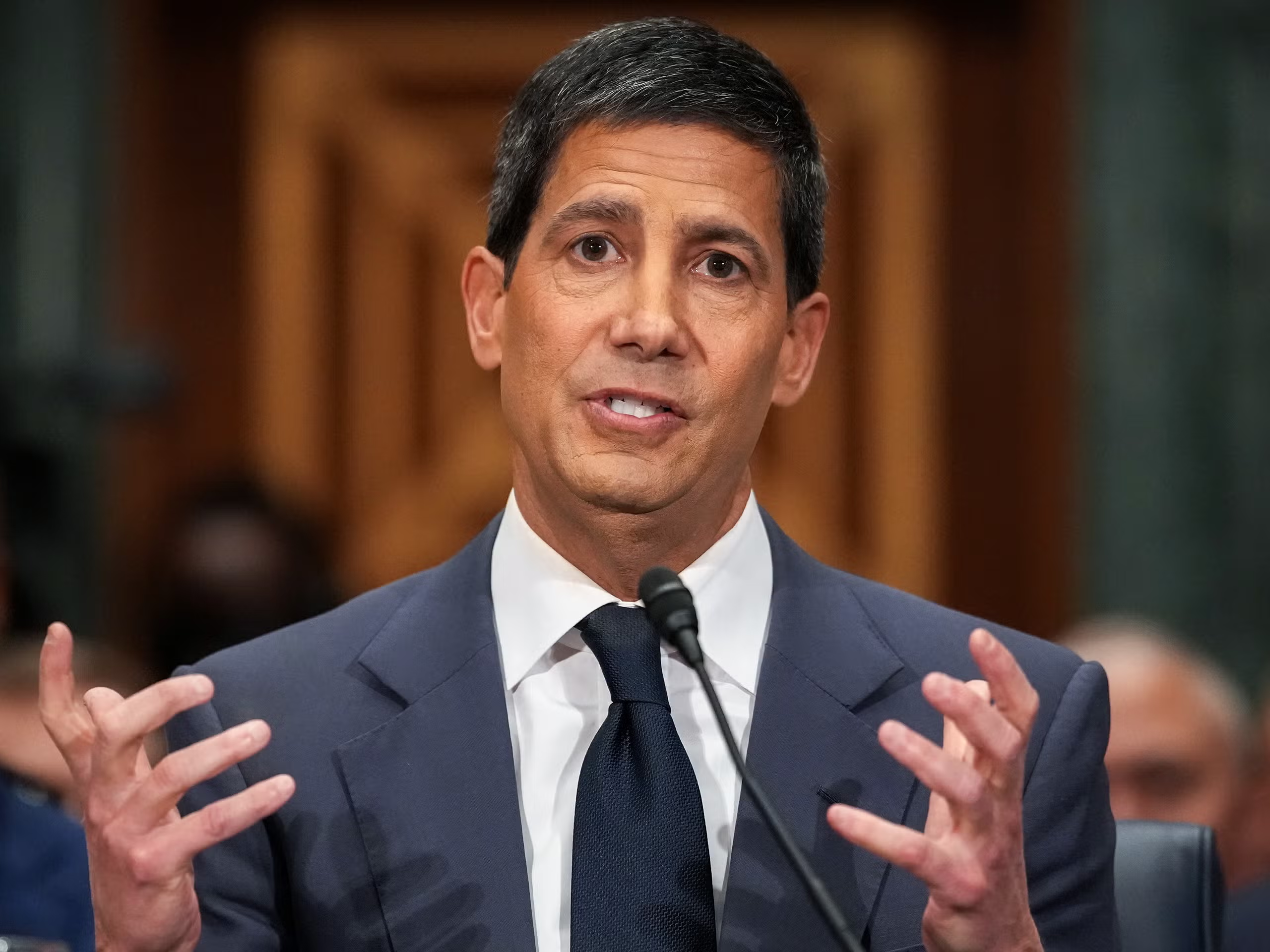
Warsh's key signal came in his insistence that inflation victory requires a "public perception shift" beyond the mechanical achievement of a 2% reading on the personal consumption expenditures price index. This is a material departure from the Powell-era framework, where the Fed communicated a data-dependent path tied explicitly to the inflation statistic. By introducing a subjective, perception-based criterion, Warsh has effectively moved the goalpost for rate cuts without specifying the new finish line. The market had been pricing in the first rate cut by September 2026, with a cumulative 75 basis points of easing by year-end. That timeline now looks aggressive. Warsh's language shows he will tolerate above-target inflation readings for longer if the public still perceives prices as high. This condition will persist even as year-over-year comparisons moderate. The 2% target remains the stated goal, but Warsh has layered on an additional requirement: that households and businesses must believe inflation is under control. This is a fundamentally different regime, one that gives the Fed more discretion to hold rates steady even if the data improves. For markets, the shift introduces a new source of uncertainty: not just what the data says, but what the public thinks about the data. That perception gap is unhedgeable in any traditional asset class, and it will keep the Fed on hold longer than the dot plot currently implies.
The $570 Billion Rate-Cut Trade Unravels
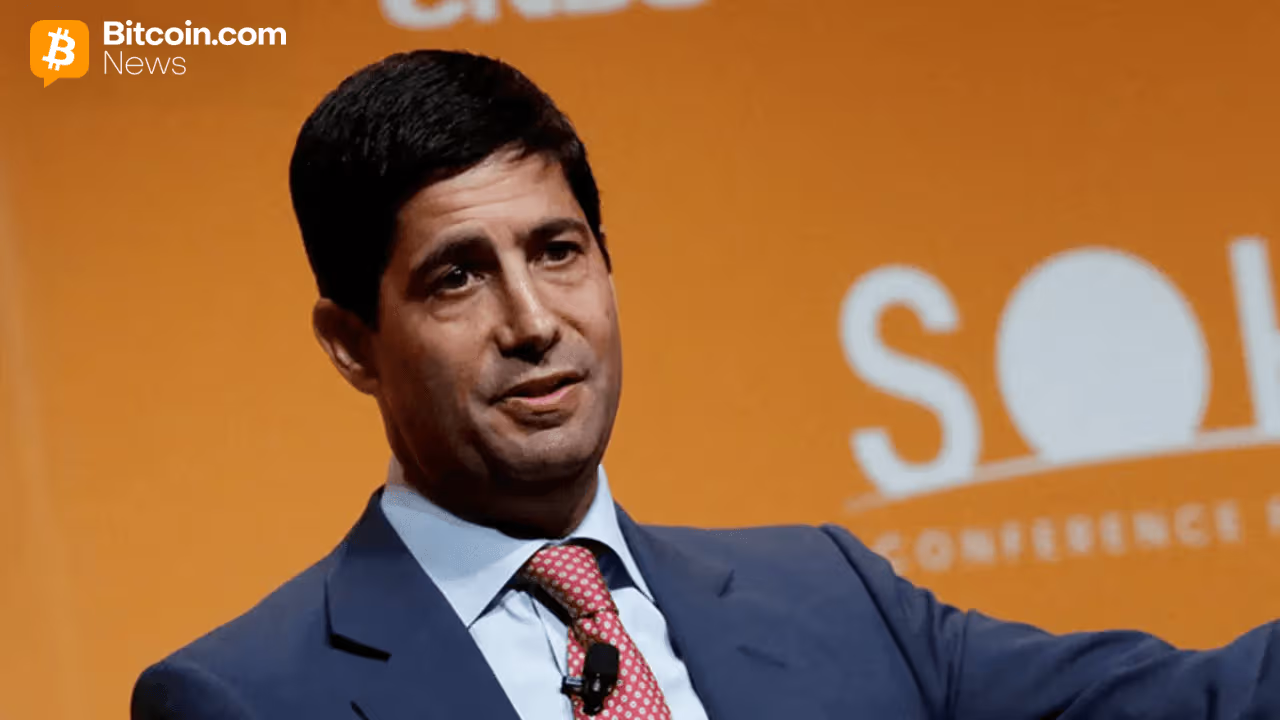
The stock market rally that began in late 2025 was built on a simple thesis: the Fed would cut rates in 2026, easing financial conditions and boosting equity valuations. That trade is now under direct threat. The S&P 500's forward price-to-earnings multiple of 22x assumes a benign rate environment that Warsh's comments directly undermine. Rate-sensitive sectors are already showing stress. Intel fell 5.14% to $114.68, reflecting the double blow of higher discount rates on future earnings and the capital-intensive nature of its foundry buildout. NVIDIA dropped 1.45% to $211.14, a modest decline that masks the deeper risk to high-duration growth stocks if the risk-free rate stays elevated. Conversely, Ford rose 4.74% to $17.44, a counter-cyclical move that suggests investors are rotating into value and away from growth. The KBW Nasdaq Bank Index fell 0.38% to 168.78, as higher-for-longer rates compress net interest margins for regional lenders while benefiting the largest money-center banks with large securities portfolios. SoFi Technologies jumped 7.37% to $18.22, a puzzling move that may reflect short-covering or a bet that its fintech model benefits from a steep yield curve. The broader message is clear: the rate-cut trade is unwinding, and the rotation out of high-duration assets has begun. The dollar index rose 0.23% to 95.79, while gold fell 1.72% to $4,514.10, as the real yield on inflation-protected securities rose on the hawkish repricing. Every asset class is recalibrating to a world where the Fed's next move is not a cut but a prolonged pause.
Intel and NVIDIA Face a Higher-for-Longer Squeeze
The competitive landscape in semiconductors is shifting as Warsh's hawkish stance raises the cost of capital for the industry's most capital-intensive players. Intel, already struggling with the $100B+ cost of its foundry turnaround, is the most exposed. Its 5.14% stock decline on the day reflects the market's recognition that higher rates for longer will delay the payback period on its fabrication plant investments. Intel's foundry business requires sustained capital expenditure for years before generating meaningful returns; a 4.5% risk-free rate versus 3.5% changes the net present value of those cash flows by billions. NVIDIA, while less capital-intensive in manufacturing, faces a different risk: its valuation multiple is built on expectations of explosive earnings growth from AI infrastructure spending. A higher discount rate compresses that multiple, and the 1.45% drop in its stock price likely understates the risk. If enterprise customers delay AI hardware purchases because their own cost of capital has risen, NVIDIA's revenue growth will decelerate faster than analysts project. Ondas Inc., a smaller defense-tech player, fell 0.23% to $13.22, a relatively muted move that reflects its niche positioning. The competitive winner in this environment is likely Ford and other industrial incumbents with pricing power and shorter-duration cash flows. Ford's 4.74% gain signals that value-oriented, dividend-paying stocks with tangible assets are the safe haven in a higher-for-longer regime. The semiconductor trade, which dominated market returns for two years, is now the most vulnerable to Warsh's policy shift.
Downstream Capex Freeze Threatens Hyperscaler Buildout
The second-order effects of Warsh's hawkish stance will hit hardest in the capital expenditure budgets of hyperscale cloud providers and their supply chains. Microsoft, Amazon, Google, and Meta have collectively committed over $200 billion to AI infrastructure through 2027, much of it financed at floating rates or with debt that will need refinancing at current elevated yields. If the Fed holds rates at 4.5% or higher through 2027, the cost of servicing that debt rises by $5-7 billion annually across the four companies. The immediate response will be a pullback in the most speculative projects: new data center builds in secondary markets, early-stage chip design partnerships, and long-duration R&D bets. This directly impacts Intel's foundry, which depends on hyperscaler commitments to fill its Ohio and Arizona fabs. If those orders slow, Intel's utilization rates drop, and its foundry losses widen. The downstream supply chain, from ASML's lithography equipment to Applied Materials' deposition tools, will see order delays as hyperscalers push out delivery timelines. The U.S. 10-year yield at 4.461% is already pricing in this scenario, but the equity market has not fully discounted the capex freeze. The KBW Nasdaq Bank Index's 0.38% decline reflects the banking sector's exposure to project finance loans for data center construction, which will slow as developers struggle to underwrite projects at higher rates. The crude oil price surge of 5.73% to $92.37 adds another layer of cost pressure, raising the operating expense of running data centers and further compressing hyperscaler margins. The capex cycle that drove the AI boom is now at risk of a sharp deceleration.
Warsh's Credibility Play Resets the Fed's Strategic Posture
Warsh's emphasis on credibility over asset prices is not just a tactical choice. It is a strategic signal about the Fed's institutional priorities under his leadership. By explicitly stating that the Fed will not cut rates to rescue markets, Warsh is breaking from the Greenspan and Bernanke playbooks, where the central bank often eased financial conditions in response to market stress. This is a return to the Volcker doctrine: the Fed will tolerate asset price declines to achieve price stability. The contrast with former Chair Jerome Powell, who accepted an award for political courage from the Kennedy family while warning that the central bank cannot survive if administrations remove officials over policy disagreements, is instructive. Powell's defense of Fed independence was about protecting the institution from political interference; Warsh's stance is about protecting the institution's credibility from market pressure. The two priorities are complementary but distinct. Powell, now a Fed governor after breaking convention to keep his board seat, represents the old guard's focus on institutional integrity. Warsh represents a new generation's focus on policy toughness. The market must now navigate a Fed that is both politically embattled and monetarily hawkish. This combination historically leads to higher volatility and lower equity returns. The VIX at 16.05, up 4.77%, is still below crisis levels, but it is pricing in a regime shift. The dollar index at 95.79, up 0.23%, reflects capital inflows from investors seeking the safety of U.S. yields. Warsh has drawn a line in the sand: the Fed will not blink, and markets must adjust.
The implications for the second half of 2026 are stark. If Warsh maintains this posture through the summer, the probability of a rate cut in 2026 drops below 50%, and the equity market will need to reprice to a higher equilibrium discount rate. The most vulnerable sectors are high-duration growth stocks, speculative tech, and levered real estate investment trusts. The safest havens are short-duration bonds, energy stocks benefiting from the crude oil rally, and industrial value plays like Ford. The dollar will strengthen further, pressuring emerging market currencies and commodities priced in dollars, with gold's 1.72% decline on the day a leading indicator of that trend. The real test will come in September, when the Fed releases its next Summary of Economic Projections. If Warsh's dot plot shows no cuts through 2027, the market will face its most significant repricing since the 2022 rate hike cycle began. The new Fed chair has made his position clear: credibility comes first, and asset prices will bear the cost. Investors who built portfolios on the assumption of imminent easing must now rebuild them for a world where the Fed's next move is not a cut but a conviction.
The BossBlog Daily
Essential insights on AI, Finance, and Tech. Delivered every morning at 06:00 Asia/Shanghai. No noise.
Unsubscribe anytime. No spam.
Tools mentioned
AffiliateSelected partner tools related to this topic.
AI Copilot Suite
Content drafting, summarization, and workflow automation.
Try AI Copilot →
AI Model Monitoring
Track model quality, latency, and drift with alerts.
View Monitoring Tool →
Low-fee Global Broker
Multi-market access with transparent pricing.
Open Broker Account →
Some links above are affiliate links. We earn a commission if you sign up through them, at no extra cost to you. Affiliate revenue does not influence editorial coverage. See methodology.
The BossBlog Daily
Essential insights on AI, Finance, and Tech. Delivered every morning at 06:00 Asia/Shanghai. No noise.
Unsubscribe anytime. No spam.
Tools mentioned
AffiliateSelected partner tools related to this topic.
AI Copilot Suite
Content drafting, summarization, and workflow automation.
Try AI Copilot →
AI Model Monitoring
Track model quality, latency, and drift with alerts.
View Monitoring Tool →
Low-fee Global Broker
Multi-market access with transparent pricing.
Open Broker Account →
Some links above are affiliate links. We earn a commission if you sign up through them, at no extra cost to you. Affiliate revenue does not influence editorial coverage. See methodology.