
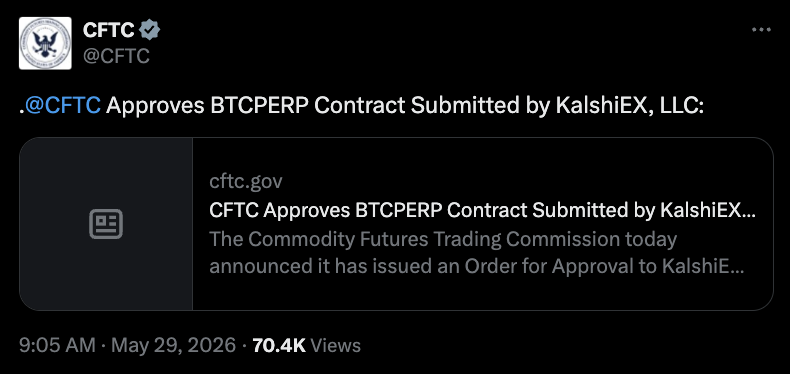
The Commodity Futures Trading Commission on May 28 approved the first regulated bitcoin perpetual futures contracts in the United States, granting Kalshi and Coinbase the right to list products that have for years been the exclusive domain of offshore exchanges like Binance and Hyperliquid. KalshiEX LLC received clearance to list its BTCPERP contract, while Coinbase's CFM subsidiary won approval to offer perpetual futures routed through Coinbase Bermuda as foreign futures. CFTC Chairman Mike Selig called the move a major step forward that shifts perpetual trading from offshore markets to a domestic regulatory framework, arguing the approach will limit excessive leverage, volatility, and systemic risk. The approval arrives alongside a broader wave of US regulatory clarity: the GENIUS Act stablecoin bill passed the Senate 68-30 and now heads to the House, while the 309-page Clarity Act crypto market structure bill moves through the Senate Banking Committee. This combination of derivatives, stablecoin, and market structure legislation represents the most complete US crypto regulatory moment to date, and it comes as the offshore market has already demonstrated its scale. Hyperliquid alone generated $800 million in revenue in 2025, processing $2.9 trillion in perpetual futures volume with $7 billion in open interest. The question now is whether regulated US products can capture a meaningful share of that offshore flow.
How the CFTC opened the door to regulated perpetuals
The CFTC's approval creates a 24/7 trading framework for crypto perpetual contracts, a structural departure from traditional futures that settle on fixed expiration dates. Kalshi's BTCPERP contract and Coinbase's Bermuda-routed perpetuals operate under CFTC oversight with position limits, margin requirements, and reporting obligations that offshore exchanges have historically avoided. Chairman Selig explicitly tied the approval to risk reduction, stating that bringing perpetuals onshore will limit excessive leverage and systemic risk. This is a direct response to the volatility that has characterized unregulated crypto derivatives markets. The mechanism matters because perpetual futures, or "perps", are the dominant instrument in crypto trading, accounting for the vast majority of volume across exchanges. Unlike traditional futures, perps use a funding rate mechanism to keep contract prices anchored to spot prices, enabling traders to maintain leveraged positions indefinitely. The CFTC's framework requires Kalshi and Coinbase to adhere to existing derivatives rules while accommodating the 24/7 nature of crypto markets, a hybrid approach that regulators have spent years developing. The approval also creates a clear jurisdictional line: the CFTC oversees perpetuals as commodities derivatives, while SEC-regulated products like ETFs and spot trusts operate under a separate regime. This bifurcation matters for institutional allocators who have avoided offshore perp platforms due to legal uncertainty and counterparty risk.
The $2.9 trillion offshore volume migration opportunity
The economic stakes are enormous. Hyperliquid processed $2.9 trillion in perpetual futures volume in 2025, generating $800 million in revenue and holding $7 billion in open interest. All of this came from a platform that blocks US users. Binance's offshore perp business is even larger, though the exchange has faced ongoing regulatory pressure globally. The CFTC's approval creates a regulated onshore alternative that can capture a portion of that flow, particularly from institutional traders who have been priced out of offshore markets by legal risk and operational complexity. Kalshi and Coinbase will compete directly with these offshore incumbents, but the revenue mechanics differ significantly. Offshore perp exchanges generate revenue primarily through trading fees and funding rate spreads, with Hyperliquid's $800 million in 2025 revenue implying an effective fee rate of roughly 2.8 basis points on its $2.9 trillion volume. US-regulated platforms will face higher compliance costs, capital requirements, and potential position limits that compress margins. However, they gain access to institutional capital that has been unable to trade perps at scale. Pension funds, endowments, and asset managers with mandates requiring regulated counterparties now have a viable onshore option. The revenue opportunity for Kalshi and Coinbase depends on how much of the $2.9 trillion offshore volume migrates onshore and at what fee rates. Even capturing 10% of that volume at similar fee rates would generate roughly $80 million in annual revenue, but the real prize is the institutional flow that has never traded perps at all.

The competitive reshuffle: Kalshi and Coinbase versus Binance and Hyperliquid
The CFTC approval reshapes the competitive landscape for crypto derivatives. Kalshi and Coinbase become the first US-regulated perp platforms, giving them a structural advantage over Binance and Hyperliquid, which cannot serve US customers. Binance has been fighting regulatory battles across multiple jurisdictions and has lost significant market share in spot trading, but its perp business remains dominant globally. Hyperliquid, by contrast, has grown rapidly precisely because it operates outside US regulation. Its $2.9 trillion volume and $800 million revenue in 2025 demonstrate the demand that the CFTC is now trying to capture. The competitive dynamics extend beyond the perp platforms themselves. Grayscale and Bitwise are both racing to launch HYPE-related ETF products, with Grayscale negotiating a $115 million seed investment in HYPE tokens for a Hyperliquid Staking ETF. These products would give traditional investors exposure to Hyperliquid's ecosystem without trading on the platform directly, creating a two-tier market: regulated perps for direct traders and ETF wrappers for passive allocators. The XRP ETF market provides a recent analogue. XRP funds took in $35 million in the week ending May 29 while bitcoin and ether ETFs lost $2 billion combined, signaling rotation within crypto rather than net outflows. The perp approval directly accelerates this rotation as institutional capital shifts from spot ETFs to derivatives products that offer more efficient leverage, hedging, and directional positioning.
Downstream effects on hyperscalers, staking infrastructure, and enterprise buyers
The CFTC's approval triggers second-order effects across the crypto infrastructure stack. Hyperliquid is expanding beyond perps into tokenized equities, commodities, and prediction markets, building a 24/7 blockchain-based financial platform that Grayscale analysts identify as a candidate for the infrastructure layer most of traditional finance settles on in the coming decade. The platform currently blocks US users, but the CFTC approval creates a pathway for Hyperliquid to seek US regulatory approval or partner with licensed intermediaries. This development would transform its revenue model and valuation. The staking infrastructure layer also benefits. Grayscale's planned Hyperliquid Staking ETF requires staking infrastructure to generate yield on HYPE tokens, creating demand for validators and staking-as-a-service providers. The $115 million seed investment signals institutional confidence in Hyperliquid's proof-of-stake network, which competes with Ethereum and Solana for staking flows. Enterprise buyers of crypto services gain a regulated perp product that can be integrated into existing risk management frameworks. Banks, hedge funds, and asset managers now have a derivatives product they can offer to clients without the legal uncertainty of offshore platforms. The American Bankers Association has been fighting over stablecoin yield provisions in the Clarity Act, arguing that yield-bearing stablecoins threaten insured bank deposits, but the perp approval gives regulated banks a clear and distinct path forward in crypto derivatives markets. The 24/7 trading framework also pressures traditional exchanges and clearinghouses to adapt their infrastructure, potentially accelerating the adoption of blockchain-based settlement systems.
What the regulatory wave signals about US crypto policy direction
The CFTC perp approval, the GENIUS Act's 68-30 Senate passage, and the Clarity Act's progress through the Senate Banking Committee represent a coordinated regulatory push that signals the US intends to compete for crypto market share rather than cede it to offshore jurisdictions. Chairman Selig's characterization of the perp approval as a major step forward reflects a policy shift from enforcement-first to framework-first regulation, a change that has been building since the Clarity Act introduced market structure rules and the GENIUS Act established stablecoin standards. The banking industry's fight over stablecoin yield provisions in the Clarity Act shows that the details matter enormously for incumbent financial institutions. Banks want to offer stablecoin yields to retain deposits, while crypto-native issuers argue for separate treatment. The perp approval resolves one piece of the puzzle but leaves open questions about how staking yields, stablecoin interest, and derivatives margins interact under US regulation. The political calculus is clear: the 68-30 Senate vote on the GENIUS Act demonstrates bipartisan support for stablecoin legislation, and the CFTC's perp approval shows the executive branch moving in parallel. The House will now consider the stablecoin bill, and the Clarity Act faces markup in the Senate Banking Committee. If both pass, the US will have the most comprehensive crypto regulatory framework of any major economy, potentially reversing the offshore migration that has defined the industry since 2020.
The forward-looking implications are stark. Hyperliquid's $800 million revenue in 2025 came entirely from offshore users, but the CFTC approval creates a roadmap for the platform to enter the US market legally. The routes forward include direct registration, partnership with Kalshi or Coinbase, or distribution through ETF products that Grayscale and Bitwise are already building and filing with regulators. The $2.9 trillion in perp volume that flowed through Hyperliquid last year represents a revenue pool that US-regulated platforms can now access, but the real opportunity is the institutional capital that has never traded perps at all. Pension funds, insurance companies, and sovereign wealth funds manage trillions in assets and have been waiting for regulated crypto derivatives to hedge and allocate. The CFTC's framework gives them that product, and the stablecoin and market structure bills provide the legal foundation for broader adoption. That same week saw bitcoin and crypto prices fall 5-7% even as global stocks hit record highs, confirming that crypto markets remain driven by idiosyncratic regulatory and product developments rather than broad macro correlations. The perp approval changes that calculus by giving institutional traders a regulated tool to express views on crypto without the operational risk of offshore platforms. The race is now on between Kalshi and Coinbase to capture first-mover advantage, between Grayscale and Bitwise to launch the first HYPE ETF, and between the US and offshore jurisdictions to set the global standard for crypto derivatives regulation.
The BossBlog Daily
Essential insights on AI, Finance, and Tech. Delivered every morning at 06:00 Asia/Shanghai. No noise.
Unsubscribe anytime. No spam.
Tools mentioned
AffiliateSelected partner tools related to this topic.
AI Copilot Suite
Content drafting, summarization, and workflow automation.
Try AI Copilot →
AI Model Monitoring
Track model quality, latency, and drift with alerts.
View Monitoring Tool →
Low-fee Global Broker
Multi-market access with transparent pricing.
Open Broker Account →
Some links above are affiliate links. We earn a commission if you sign up through them, at no extra cost to you. Affiliate revenue does not influence editorial coverage. See methodology.
The BossBlog Daily
Essential insights on AI, Finance, and Tech. Delivered every morning at 06:00 Asia/Shanghai. No noise.
Unsubscribe anytime. No spam.
Tools mentioned
AffiliateSelected partner tools related to this topic.
AI Copilot Suite
Content drafting, summarization, and workflow automation.
Try AI Copilot →
AI Model Monitoring
Track model quality, latency, and drift with alerts.
View Monitoring Tool →
Low-fee Global Broker
Multi-market access with transparent pricing.
Open Broker Account →
Some links above are affiliate links. We earn a commission if you sign up through them, at no extra cost to you. Affiliate revenue does not influence editorial coverage. See methodology.