
The Securities and Exchange Commission is targeting $120 billion of tokens in its twin lawsuits against Coinbase and Binance, a regulatory escalation that is reshaping the crypto landscape faster than any market cycle. The suits, which name dozens of tokens as unregistered securities, create an existential legal cloud over the largest centralized exchanges and the assets they list. Binance, already preparing to exit the European Union due to license issues, faces an uncertain future in its largest non-U.S. market. Coinbase, meanwhile, is pivoting aggressively into tokenized stocks, announcing plans to issue onchain shares backed 1:1 by underlying U.S. equities with automatic dividend payments. The move positions the exchange as a bridge between traditional finance and blockchain settlement, even as its core spot trading business faces regulatory headwinds. The DeFi ecosystem is feeling the pressure too: total value locked has plunged from roughly $180 billion to $70 billion in less than a year, a 60% collapse that signals a deep liquidity winter. This convergence of enforcement action, exchange strategy shifts, and capital flight makes the second half of 2026 the most consequential period for crypto regulation and business model evolution since the collapse of FTX.
Where the $120 billion legal target lands
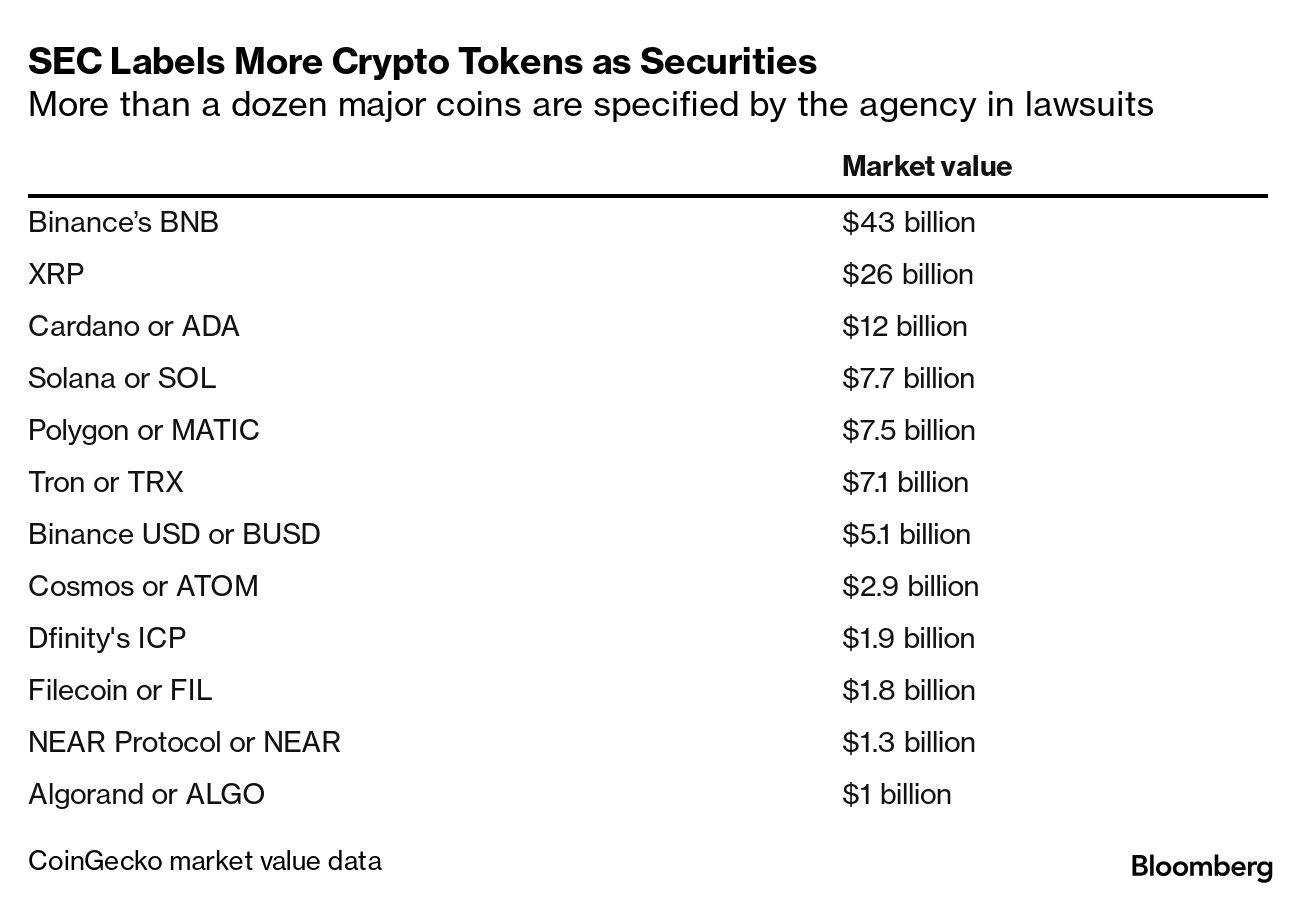
The SEC’s lawsuits against Coinbase and Binance target a combined $120 billion in tokens, a figure that captures the market capitalization of nearly every major altcoin traded on U.S. exchanges. The agency argues these tokens are unregistered securities under the Howey test, a position that if upheld would force exchanges to delist them or register as national securities exchanges. Coinbase has already signaled it will fight the classification in court, but the legal uncertainty is freezing institutional capital flows into the sector. The suits name specific tokens, including those issued by projects that have no U.S. presence, creating jurisdictional questions that will take years to resolve. Binance’s parallel legal battle is complicated by its EU exit planning, with local licenses in limbo across multiple member states. The SEC’s strategy appears designed to force a binary outcome: either exchanges comply with securities law or they exit the U.S. market entirely. The $120 billion figure represents the total market cap of the tokens under scrutiny, not the value of tokens held by the exchanges themselves, but the liquidity impact is immediate. Trading volumes on Coinbase and Binance have already contracted as market makers reduce exposure to listed tokens. The lawsuits also create a precedent problem for other exchanges like Crypto.com and Kraken, which list many of the same tokens. The SEC is effectively using the two largest exchanges as test cases to define the regulatory perimeter for the entire industry.
How the money flows through exchange P&Ls

The SEC’s enforcement action directly threatens the revenue models of Coinbase and Binance, which generate the bulk of their income from trading fees on the $120 billion in contested tokens. Coinbase reported that a significant portion of its transaction revenue comes from tokens the SEC now labels securities, meaning a delisting would wipe out a core profit center. The company’s pivot to tokenized stocks is a hedge against this revenue risk, but the economics are different. Tokenized stocks backed 1:1 by U.S. equities generate fee income from issuance, trading, and dividend processing, but the volumes are a fraction of spot crypto trading. Coinbase’s announcement that users can own, trade, hold, and redeem securities onchain with automatic dividend payments positions the exchange as a competitor to traditional brokerages, but the addressable market is limited by regulatory approval. Binance faces a more acute problem: its EU exit, driven by license issues, will cut off one of its largest regional revenue streams. The exchange has been preparing for this by shifting operations to jurisdictions with lighter oversight, but the loss of EU market access reduces its global trading volume share. The $5.5 billion debut of Kalshi’s perpetual futures market shows there is demand for regulated derivatives, but that platform operates under CFTC oversight, not SEC jurisdiction. For Coinbase, the tokenized stock initiative requires building a new custody and settlement infrastructure, which carries upfront costs that will depress near-term margins. The net effect is that both exchanges are being forced to diversify away from their core spot trading businesses at a time when regulatory costs are rising and trading volumes are falling.
The competitive reshuffle: winners and losers
The SEC’s enforcement action creates clear winners and losers across the crypto ecosystem. Coinbase’s move into tokenized stocks positions it to capture market share from traditional brokerages like State Street and BlackRock, which are also exploring onchain securities but moving more slowly. BlackRock’s launch of a Bitcoin income ETF shows the asset manager is committed to crypto, but its focus remains on institutional products, not retail tokenization. Ripple is taking an equity stake in Flutterwave, valuing the African fintech at $3.3 billion, a bet that cross-border payments will drive blockchain adoption in emerging markets. This deal gives Ripple access to Flutterwave’s payment infrastructure across Africa, bypassing the SEC’s focus on U.S. token markets. Uniswap and Hyperliquid, which operate decentralized exchanges, benefit from the regulatory crackdown on centralized platforms as traders seek non-custodial alternatives. However, DeFi’s total value locked has fallen to $70 billion from $180 billion, indicating that liquidity is fleeing the entire ecosystem, not just centralized exchanges. VanEck and other asset managers are positioning their crypto products as regulated alternatives, but the SEC’s broad token classification creates uncertainty about which assets are safe to offer. Crypto.com and Kalshi face regulatory probes over Super Bowl wagers, adding to the compliance burden for exchanges that want to operate in the U.S. The biggest winner may be the Wyoming stablecoin, the first state-issued crypto, which offers a government-backed alternative to private stablecoins that face their own regulatory risks. The GENIUS Act at the federal level could provide a framework for stablecoin issuance, but the SEC’s enforcement action suggests a fragmented regulatory landscape will persist.
Downstream effects on hyperscalers, fabs, and enterprise buyers
The SEC’s token crackdown has second-order effects that ripple through the broader technology and financial infrastructure. The collapse in DeFi TVL from $180 billion to $70 billion reduces demand for blockchain compute resources, hitting cloud providers like AWS and Google Cloud that sell node-hosting and validator services. The race to turn AI compute into a commodity, which Bloomberg reports is spurring a new crypto boom, creates a countervailing force as tokenized compute markets attract capital that might otherwise flow to DeFi. This shift benefits GPU manufacturers and data center operators, but the regulatory uncertainty around tokenized assets could slow adoption. Enterprise buyers of blockchain services, including banks and payment processors, are delaying integration plans as they wait for legal clarity. The XRP Ledger and Rootstock, which support tokenized asset issuance, face reduced developer activity as projects relocate to jurisdictions with clearer rules. Europe’s push to loosen America’s grip on payment systems, driven by the MiCA regulatory framework, creates an alternative venue for tokenized securities, but the liquidity is thinner. Chinese developers are hitting snags in tokenized asset fundraising, according to Bloomberg, as the SEC’s actions create a chilling effect on global capital formation. The $3.3 billion Flutterwave valuation shows that fintech deals outside the U.S. can still attract capital, but the premium is on payments infrastructure, not token trading. For hyperscalers, the net effect is a shift from general-purpose blockchain workloads to specialized compute markets tied to AI, which offer clearer revenue models and less regulatory exposure.
Policy signal: what the SEC’s move says about market direction
The SEC’s decision to target $120 billion in tokens through lawsuits against Coinbase and Binance signals that the agency views the entire crypto market structure as operating outside securities law. This is not a narrow enforcement action against a few bad actors; it is a systemic challenge to the business model of every major U.S. exchange. The timing, coming as Binance prepares to exit the EU and as DeFi TVL collapses, suggests the SEC believes it has maximum leverage. The agency is betting that the market will adapt to its interpretation of the law rather than fight it through years of litigation. Coinbase’s tokenized stock initiative is a direct response: if the SEC will not allow spot crypto trading under existing rules, Coinbase will build a regulated onchain securities market that complies with the Howey test from day one. The Wyoming stablecoin and the GENIUS Act represent state and federal efforts to create a parallel regulatory track for stablecoins, but the SEC’s enforcement action suggests it will not wait for Congress to act. The $5.5 billion Kalshi perpetual futures debut shows that regulated derivatives markets can attract volume, but those products fall under CFTC jurisdiction, not SEC. The signal for the market is clear: the SEC will use enforcement to define the boundaries of digital asset regulation, and exchanges must either comply with securities law or exit the U.S. market. This creates a bifurcated market where compliant tokenized securities thrive while unregistered tokens face delisting and liquidity evaporation.
The next 12 months will determine whether the SEC’s enforcement strategy succeeds in bringing the crypto market under its regulatory umbrella or whether it drives innovation offshore. Coinbase’s tokenized stock initiative will be the first major test of whether onchain securities can attract retail and institutional demand in a regulated environment. If it succeeds, it will create a template for other exchanges to follow, potentially splitting the market into a compliant tokenized securities segment and a gray-market spot trading segment that operates outside U.S. jurisdiction. The DeFi TVL collapse from $180 billion to $70 billion suggests that liquidity is already voting with its feet, moving to jurisdictions with clearer rules. The race to commoditize AI compute through tokenization offers a new growth vector, but it will face the same regulatory questions if tokens are classified as securities. The Wyoming stablecoin and the GENIUS Act provide a potential off-ramp for stablecoin issuers, but they do not address the core question of whether tokens like those listed on Coinbase and Binance are securities. The outcome of the SEC’s lawsuits will set the legal precedent that defines the crypto industry for the next decade, and the market is pricing in a long and uncertain legal battle.
The BossBlog Daily
One email with the AI markets brief — the 13F moves, the Congressional trades, and what changed. No fixed schedule and no filler: it goes out when there is something worth sending.
Unsubscribe any time. We never sell or share the list.