
Benchmark has issued a stark warning: the Clarity Act, formally the Blockchain Regulatory Certainty Act (BRCA), must include robust protections for software developers or the United States will lose its competitive edge in crypto to other jurisdictions. The venture capital firm, a major Solana backer, argues that developers who build decentralized protocols (entities that do not hold user funds or have the ability to freeze accounts) should not be classified as money transmitters under federal law. While the FinCEN 2019 guidance already recognizes that providing software does not automatically make a developer a money transmitter, Benchmark contends that statutory clarity is essential. The warning comes as the broader crypto market shows signs of maturation: combined spot and derivatives exchange volumes fell 3.45% in May to $4.41 trillion, the lowest since September 2024, even as real-world asset (RWA) perpetual futures volumes bucked the trend, rising 10.4% to a new all-time high. Why this matters now: the SEC is simultaneously advancing its own National Market System (NMS) proposal to rescind Rules 611 and 610(e), which Benchmark has called the "most consequential" U.S. crypto rule this year, creating a regulatory fork in the road that will determine whether America fosters or chokes off its developer ecosystem.
Where the Clarity Act's developer shield fits in the regulatory stack
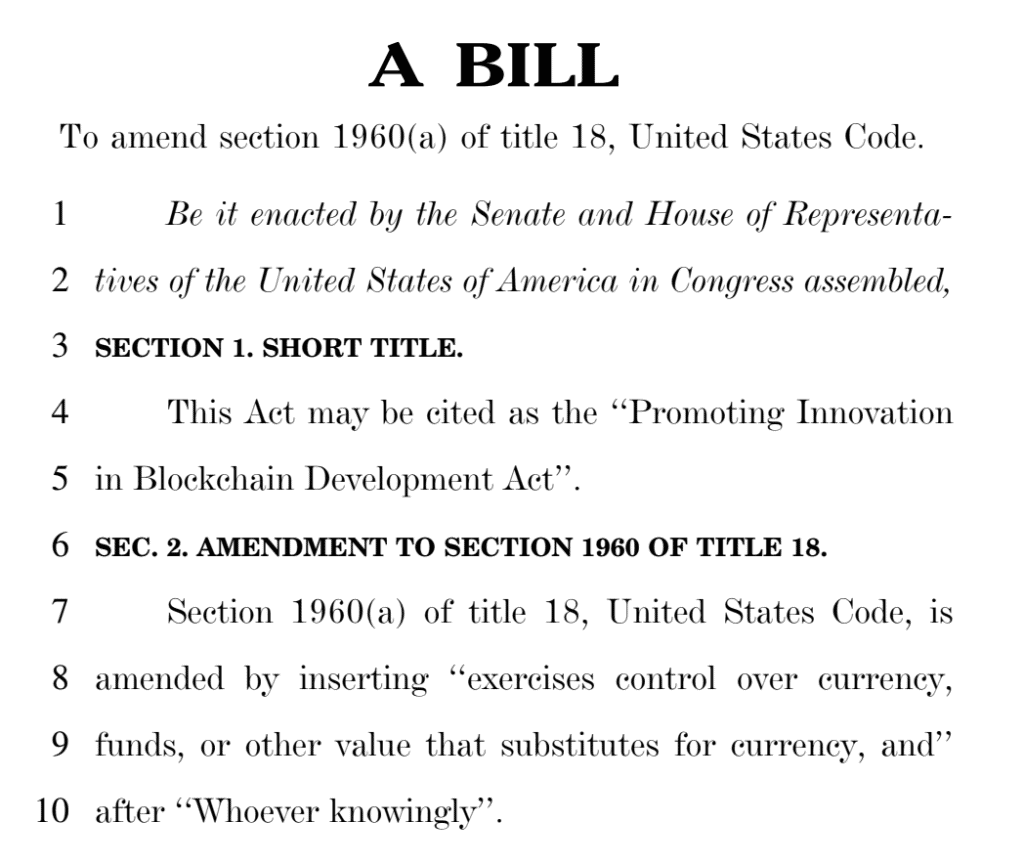
The Clarity Act aims to resolve a fundamental ambiguity that has hung over the crypto industry since the early days of Bitcoin: when does writing and publishing open-source software constitute money transmission? Under current law, any entity that "accepts and transmits" currency or value must register with FinCEN as a money services business (MSB), a designation that carries burdensome compliance obligations, including anti-money laundering programs, recordkeeping, and reporting. Developers of decentralized protocols (whether they build a DEX, a lending platform, or a wallet) have long argued that they fall outside this definition because they never take custody of user assets. The FinCEN 2019 guidance provided some relief by stating that a person who "merely provides software" is not a money transmitter, but the guidance is non-binding and subject to reinterpretation by a future administration. The Clarity Act would codify this principle into law, creating a statutory safe harbor that developers can rely on. Benchmark's core argument is that without this protection, the U.S. will drive its most innovative builders offshore, mirroring the pattern seen in the early 2010s when regulatory uncertainty pushed many Bitcoin startups to Europe and Asia. The BRCA is currently the best legislative vehicle for achieving predictable rules, and any weakening of the developer protections during the markup process would be a strategic error.
How the $4.41T volume drop and RWA surge reshape the market narrative

The May exchange volume data tells a story of a market in transition. Combined volumes across centralized exchanges fell 3.45% to $4.41 trillion, marking the lowest monthly figure since September 2024. This decline reflects a broader risk-off sentiment among retail and institutional traders, who have pulled back from speculative trading amid ongoing regulatory uncertainty and a lack of clear catalysts. However, the RWA perpetual futures market tells a different story. Volumes in this segment rose 10.4% against the broader trend, hitting a new all-time high. This divergence is significant: it shows that sophisticated traders are increasingly using perpetual futures to gain exposure to tokenized real-world assets (such as Treasuries, private credit, and commodities) rather than trading volatile cryptocurrencies. The shift has direct implications for the regulatory debate. If the Clarity Act protects developers of RWA protocols, it will accelerate the tokenization of traditional assets on U.S.-based blockchains like Solana. Conversely, if developers remain exposed to money transmitter liability, the RWA market will migrate to jurisdictions with clearer rules, such as Singapore or the UAE. The volume data also underscores the urgency of the SEC's NMS proposal, which Benchmark has identified as the most consequential crypto rule of the year. Rescinding Rules 611 and 610(e) would fundamentally alter the structure of crypto trading markets, potentially consolidating liquidity and reducing fragmentation, but only if the underlying developer ecosystem remains intact.
Solana, Benchmark, and the competitive stakes for Layer 1 platforms
Benchmark's warning is not disinterested. The firm is a major investor in Solana, the Layer 1 blockchain that has become a hub for decentralized applications, including RWA protocols and perpetual futures exchanges. Solana's architecture (high throughput, low fees, and a developer-friendly programming model) makes it a natural home for the kind of innovative protocols that the Clarity Act seeks to protect. If the Act passes with strong developer shields, Solana stands to benefit disproportionately, as its ecosystem of builders will have legal certainty to launch new products without fear of regulatory reprisal. Conversely, if the protections are weakened, Solana's developer community will face the same headwinds as every other U.S.-based blockchain project. The competitive dynamics extend beyond Solana. Ethereum, which hosts the largest DeFi ecosystem by total value locked, also relies on a global developer base that includes many U.S.-based teams. However, Ethereum's regulatory posture has been more ambiguous, with the SEC's classification of ETH as a commodity providing some comfort but leaving the status of DeFi protocols unresolved. Other Layer 1s, such as Avalanche and Sui, are also watching the Clarity Act closely. The Act's developer protections would apply uniformly across all blockchains, creating a level playing field for U.S.-based developers regardless of which chain they build on. The alternative (a patchwork of state-level money transmitter laws and federal guidance) would favor incumbents with large legal budgets and disadvantage smaller teams, exactly the kind of innovation that Benchmark argues the U.S. cannot afford to lose.
Downstream effects on exchange liquidity, market structure, and enterprise adoption
The downstream consequences of the Clarity Act's developer protections ripple through the entire crypto ecosystem. If developers are shielded from money transmitter liability, the cost of launching new decentralized applications drops significantly. Legal fees for compliance reviews, which can run into the hundreds of thousands of dollars for a single protocol, would be reduced or eliminated for truly non-custodial projects. This cost reduction would accelerate the pace of innovation, particularly in areas like tokenized assets, decentralized identity, and cross-chain interoperability. For exchanges, the impact is more nuanced. Centralized exchanges like Coinbase and Kraken already operate as licensed money transmitters and would not be directly affected by the developer shield. However, they would benefit from a larger and more vibrant ecosystem of decentralized applications that generate trading volume and liquidity. The rise in RWA perpetual futures volumes is a case in point: these products are typically traded on decentralized exchanges (DEXs) that rely on non-custodial smart contracts. If the developers of those DEXs face legal uncertainty, the entire RWA perpetual futures market could stall, depriving centralized exchanges of a growing source of arbitrage and hedging activity. On the enterprise side, the Clarity Act's developer protections would make it easier for traditional financial institutions to experiment with blockchain-based solutions. Banks and asset managers have been hesitant to deploy capital into DeFi protocols because of the legal risk to the developers they would be relying on. Statutory clarity would remove that barrier, potentially unlocking billions of dollars in institutional capital that is currently sitting on the sidelines.
The SEC's NMS proposal and the policy signal it sends about crypto's future
Benchmark's characterization of the SEC's NMS proposal as the "most consequential" U.S. crypto rule this year underscores the high stakes of the current regulatory moment. The proposal to rescind Rules 611 and 610(e) would fundamentally alter the structure of crypto trading markets. Rule 611, the "order protection rule," requires trading centers to establish policies to prevent trade-throughs, while Rule 610(e) governs access to quotations. Rescinding these rules would reduce fragmentation in the crypto spot market, potentially consolidating liquidity on a smaller number of platforms and reducing the complexity of best-execution analysis. However, the NMS proposal and the Clarity Act are not in conflict: they address different parts of the regulatory stack. The NMS proposal focuses on market structure and trading venues, while the Clarity Act focuses on the legal status of developers. Together, they represent two prongs of a coherent regulatory strategy: one that modernizes trading infrastructure and one that protects the builders who create the assets being traded. The policy signal is clear: the SEC and Congress are moving toward a framework that recognizes crypto as a distinct asset class requiring tailored rules, rather than shoehorning it into existing securities or commodities regulations. The risk is that the two efforts move at different speeds or with different priorities. If the NMS proposal advances while the Clarity Act stalls, the U.S. will have modernized its trading infrastructure but lost the developer talent needed to populate it with innovative products. Benchmark's warning is a reminder that regulatory coherence matters as much as regulatory speed.
The next six months will determine whether the United States capitalizes on its current advantages (a deep capital market, a strong venture capital ecosystem, and a concentration of world-class engineering talent) or squanders them through regulatory fragmentation. The Clarity Act is the best opportunity to provide the predictable rules that developers need, but its passage is not guaranteed. The SEC's NMS proposal, while consequential, addresses only the trading layer of the stack. Without the developer protections in the BRCA, the U.S. risks replicating the pattern of the 1990s, when the best internet companies were built in America but the best crypto companies of the 2020s are being built in Singapore, Switzerland, and the UAE. Benchmark's message is that the window of opportunity is closing, and that Congress must act to shield the builders before the next wave of innovation moves offshore. The market data (falling exchange volumes and rising RWA perpetual futures) shows that the industry is already voting with its feet, and the direction of travel depends on the regulatory outcome.
The BossBlog Daily
One email with the AI markets brief — the 13F moves, the Congressional trades, and what changed. No fixed schedule and no filler: it goes out when there is something worth sending.
Unsubscribe any time. We never sell or share the list.