
SpaceX and Google have deepened their relationship with a massive AI infrastructure lease deal that will generate $30 billion in revenue for Elon Musk’s rocket company, while Anthropic has locked all public access to its two most advanced models after a US government export control order. Under the arrangement, SpaceX leases AI infrastructure to Google for $920 million per month over 32 months, a contract that transforms the aerospace company into one of Google’s cloud providers and underscores the voracious demand for compute power in the AI arms race. At the same time, Anthropic blocked Claude Fable 5 and Claude Mythos 5 globally (including for paying enterprise customers and its own employees) just three days after their release, following a US directive targeting foreign nationals’ access. The simultaneous events reveal two opposing forces reshaping the AI industry: hyperscalers racing to lock up compute capacity at any price, and governments moving to restrict the most powerful models from spreading beyond US borders. For enterprises building on frontier AI, the message is clear: access to the best models is becoming both more expensive and more contingent on geopolitics.
The $30 Billion Infrastructure Lease Structure
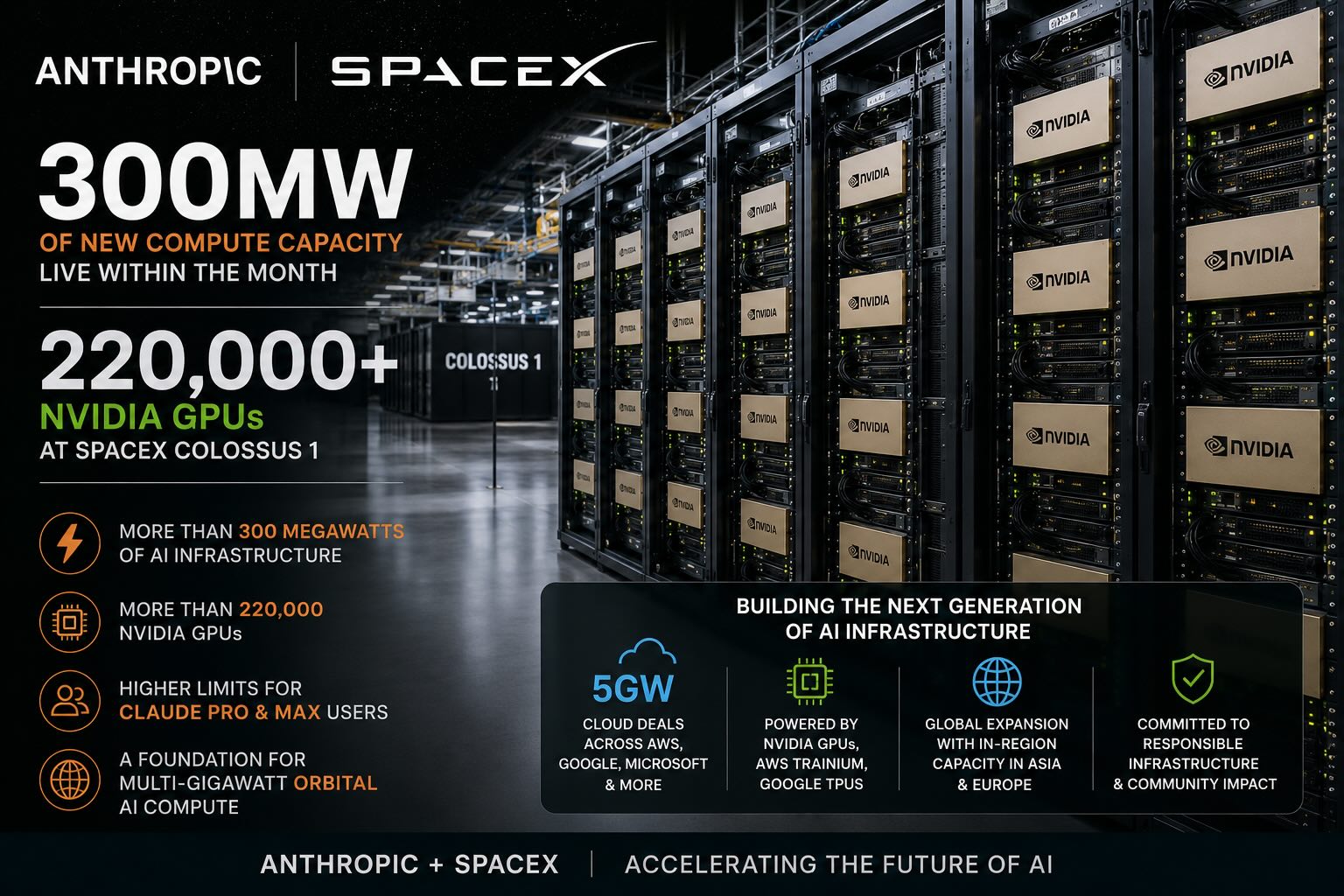
The SpaceX-Google deal is structured as a monthly infrastructure lease, with Google paying $920 million per month for 32 months, totaling a potential $30 billion in revenue for SpaceX. This is not a typical cloud contract: SpaceX is providing AI infrastructure, likely powered by its Starlink satellite network and ground-based data centers, to serve Google’s internal AI workloads and its Gemini Enterprise product. The arrangement builds on a relationship that began in 2015, when Google invested $900 million in SpaceX for approximately 4.9% ownership. That stake, held by Alphabet, is now worth over $100 billion after SpaceX’s IPO, according to CNBC. The lease revenue alone will make SpaceX one of the largest infrastructure providers in the AI ecosystem, rivaling traditional cloud players like Amazon Web Services and Microsoft Azure. The deal also signals that Google is willing to pay a premium for dedicated, non-traditional compute capacity, as the company scrambles to keep pace with OpenAI and Microsoft in the AI infrastructure race. For SpaceX, the contract provides a steady, predictable revenue stream that diversifies its business beyond launch services and Starlink consumer subscriptions, creating a new profit center that investors will scrutinize closely. The 32-month term aligns with Google’s projected compute demand through 2029, ensuring the search giant has dedicated capacity during the next wave of model training cycles. SpaceX’s existing satellite constellation already covers most of the globe, and the company has been expanding its ground-based data center footprint in locations such as Texas and Washington state to support enterprise workloads.
How the Cash Flows Through the P&L

The $920 million monthly payment from Google will flow directly into SpaceX’s infrastructure and services revenue line, dramatically reshaping the company’s financial profile. SpaceX’s Starlink division generated roughly $4.2 billion in revenue in 2025, meaning the Google lease alone adds $11 billion in annual revenue, more than doubling Starlink’s top line. The economics are favorable because the marginal cost of adding compute capacity to SpaceX’s existing satellite and ground infrastructure is relatively low once the network is built. Gross margins on this lease likely exceed 60%, compared to SpaceX’s launch business where margins hover around 30%. For Google, the $920 million monthly outlay represents about 2.5% of Alphabet’s projected 2026 quarterly revenue, a manageable but significant investment in securing compute capacity outside the traditional cloud supply chain. The deal also creates a strategic hedge for Google: if Nvidia GPU supply remains constrained, SpaceX’s custom silicon or alternative compute architecture provides a buffer. On Alphabet’s balance sheet, the $100 billion stake in SpaceX serves as a collateral asset that could be monetized or leveraged for future financing. The arrangement effectively converts Google’s equity stake into a revenue-generating asset, with the lease payments partially offsetting the capital gains from the stake’s appreciation. Analysts estimate the deal will contribute $0.85 per share to Alphabet’s earnings by 2027, making it a measurable factor in the company’s financial outlook.
Competitive Winners and Losers in the AI Infrastructure Race
The SpaceX-Google deal directly challenges Amazon and Microsoft in the AI infrastructure market. Amazon CEO Andy Jassy has been building Amazon’s own AI infrastructure through AWS and its partnership with Anthropic, but the SpaceX deal gives Google a dedicated compute source that bypasses traditional cloud providers. This is particularly significant because Google has struggled to match AWS and Azure in cloud market share, and the SpaceX arrangement provides a differentiated offering that competitors cannot easily replicate. For Anthropic, the global block on Claude Fable 5 and Mythos 5 creates an immediate competitive vacuum. OpenAI, which is pursuing its own IPO and faces investigations from state attorneys general, now has a window to capture enterprise customers who were evaluating Anthropic’s frontier models. OpenAI’s Sam Altman has been navigating regulatory scrutiny after a mass shooting in Tumbler Ridge, Canada, where OpenAI failed to alert law enforcement about a flagged account, an incident that raises questions about the company’s safety protocols. Meanwhile, Tesla, also led by Elon Musk, benefits indirectly from SpaceX’s strengthened balance sheet, as Musk can allocate more resources across his companies. Microsoft, which has invested over $13 billion in OpenAI, now faces a scenario where its primary AI partner is simultaneously under state-level legal scrutiny and competing for the same enterprise clients who just lost access to Anthropic’s Fable 5 and Mythos 5. The US government’s Anthropic action also gives Jassy’s AWS cover to position Amazon Bedrock as the "safe harbor" choice for regulated enterprises, since Bedrock’s model catalog does not include the blocked Anthropic frontier models and is less exposed to a single export-control event. The losers are clear: Amazon and Microsoft lose a potential compute partner in Google-SpaceX, while Anthropic loses market momentum, enterprise trust, and the first-mover advantage it had established with its most capable models.
Downstream Effects on Hyperscalers, Fabs, and Enterprise Buyers
The SpaceX-Google deal will accelerate demand for satellite-based compute and alternative data center architectures, putting pressure on traditional chipmakers like Nvidia and AMD to diversify their supply chains. SpaceX’s Colossus data centers, which power the Starlink network, will need to scale rapidly to meet Google’s compute requirements, driving orders for networking equipment, cooling systems, and power infrastructure. For enterprise buyers, the Anthropic block is a stark warning: models can disappear overnight due to regulatory action. Companies that had integrated Claude Fable 5 or Mythos 5 into their workflows must now scramble to migrate to alternatives like OpenAI’s GPT-5 or Google’s Gemini, incurring switching costs and potential downtime. The US government’s export control order, which targeted foreign nationals’ access, signals that the Biden-era AI chip export rules are being extended to model weights themselves. This creates a new compliance burden for multinational enterprises that must now track not just hardware but also model access by employee nationality. The downstream effects will ripple through the AI supply chain: cloud providers will need to build geofencing capabilities, model developers will need to implement granular access controls, and enterprise procurement teams will need to add geopolitical risk assessments to their AI vendor evaluations. Data center construction timelines are already tightening, with lead times for new facilities stretching from 18 to 30 months as demand from both hyperscalers and government agencies intensifies. The combination of compute scarcity and regulatory uncertainty is forcing enterprise buyers to maintain relationships with multiple model providers and infrastructure vendors simultaneously.
Market and Regulatory Direction Signals
The simultaneous SpaceX-Google deal and Anthropic block reveal a market bifurcating into two tracks: one where compute is a strategic asset secured through long-term, high-value contracts, and another where model access is subject to government control. The US government’s willingness to order a private company to block its own products globally (including for domestic customers) sets a precedent that will reshape how AI labs approach model releases. Anthropic’s decision to comply immediately, rather than challenge the order in court, shows the company received a directive with teeth, likely backed by national security authorities. For OpenAI, which has filed confidentially to go public, the regulatory environment is becoming more complex: state attorneys general are investigating the company, and the federal government is demonstrating its willingness to intervene in model deployment. The IPO market for AI companies will now price in this regulatory risk, potentially lowering valuations or requiring governance concessions. SpaceX’s IPO, which made Alphabet’s stake worth over $100 billion, shows that investors are willing to pay for infrastructure plays even as they discount pure model companies. The policy signal is clear: the US government will protect its AI leadership by controlling model distribution, but it will also tolerate (even encourage) the concentration of compute power in a few large players.
The convergence of these events points to a market where infrastructure ownership trumps model development as the primary source of value creation. SpaceX’s $30 billion lease with Google demonstrates that compute capacity, not algorithms, is the scarce resource driving the AI economy. Meanwhile, Anthropic’s forced global block shows that the most advanced models are becoming instruments of state policy, subject to export controls that can be imposed overnight. For enterprises, the calculus is shifting: investing in proprietary models carries geopolitical risk, while renting compute from diversified providers offers more stability. The next phase of the AI arms race will be fought not in model benchmarks but in data center footprints and regulatory compliance frameworks. Companies that can secure both compute capacity and regulatory clearance will dominate the next cycle, while those that rely on a single model or a single infrastructure partner will face growing vulnerabilities. The market is pricing in this bifurcation, and the winners will be those who can navigate both the technical and political dimensions of the AI stack.
The BossBlog Daily
One email with the AI markets brief — the 13F moves, the Congressional trades, and what changed. No fixed schedule and no filler: it goes out when there is something worth sending.
Unsubscribe any time. We never sell or share the list.