
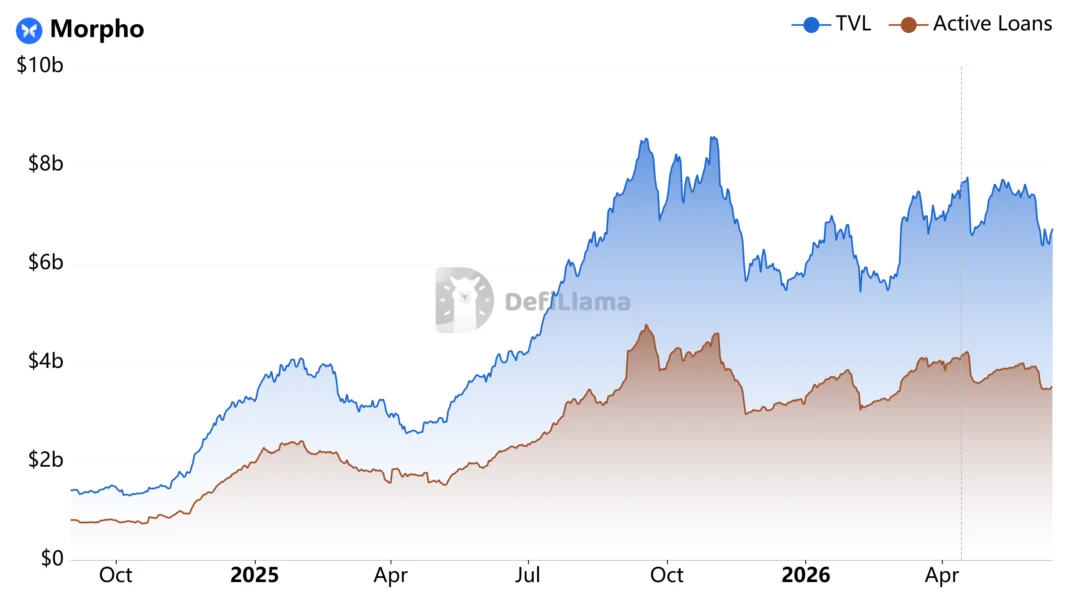
Morpho Labs has raised $175 million in a round led by Paradigm, a16z crypto, and Ribbit Capital to build a credit infrastructure layer that lets banks, asset managers, and fintechs originate loans using decentralized finance smart contracts. The raise, one of the largest in crypto venture capital this year, signals that onchain credit is moving from a niche DeFi experiment to a serious competitor to traditional syndicated lending and repo markets. Coinbase has already deployed the technology at scale: the exchange used Morpho smart contracts to originate over $2.17 billion in corporate USDC loans, proving that regulated institutions will borrow and lend on permissionless rails when the economics work. Morpho currently holds $6.72 billion in total value locked and $3.47 billion in active loans, according to DeFiLlama. The round validates a thesis that stablecoins, which have largely sat idle as a payments medium, can become productive capital, earning yield from Treasuries, money market funds, and corporate bonds rather than simply settling transactions. This matters now because the regulatory landscape is shifting: the CLARITY Act in the U.S. would allow crypto firms to offer interest-like rewards on stablecoins without being classified as banks, while JPMorgan CEO Jamie Dimon has publicly criticized the bill, setting up a clash that will determine whether onchain credit becomes mainstream infrastructure or remains a crypto-native niche.
Capital Allocation and Institutional Product Buildout

Morpho will use the capital to build out its institutional-facing product suite, hire compliance and business development staff, and deepen integrations with traditional finance middleware. The company's core innovation is a set of smart contracts that match borrowers and lenders directly, bypassing the pooled liquidity model used by most DeFi lending protocols. This architecture allows Morpho to offer more competitive rates than Aave or Compound because it eliminates the spread between depositors and borrowers that those protocols capture. For institutional clients, Morpho provides a permissioned layer on top of its permissionless contracts: banks can whitelist counterparties, set collateral requirements, and enforce know-your-customer checks without sacrificing the efficiency of onchain settlement. The $175 million will also fund expansion into new asset classes beyond USDC, including tokenized Treasuries and corporate bonds, which would allow Morpho to compete directly with prime brokerage desks and repo desks at firms like Goldman Sachs and JPMorgan. Sam MacPherson, Morpho's founder, has described the company's ambition as becoming "the AWS of credit" — a reference to Amazon Web Services' role as infrastructure that other companies build on top of. The round's size reflects investor conviction that this infrastructure play will capture a meaningful share of the $4 trillion institutional lending market over the next decade. Morpho plans to open a New York office dedicated to institutional sales and regulatory affairs, and it has already hired a former Goldman Sachs managing director to lead that effort.
How the $2.17 Billion Coinbase Deal Works
Coinbase's use of Morpho to originate $2.17 billion in USDC loans provides a concrete case study for how onchain credit infrastructure operates in practice. Coinbase deposits USDC into Morpho smart contracts, which then match those deposits with borrowers, primarily market makers, hedge funds, and other crypto-native institutions that need dollar-denominated leverage. The loans are overcollateralized, typically at 110% to 130%, and the collateral is held in smart contracts that automatically liquidate positions if the loan-to-value ratio breaches a threshold. This eliminates the need for Coinbase to maintain a credit underwriting team or negotiate bilateral agreements with each borrower. For Coinbase, the economics are straightforward: it earns yield on USDC that would otherwise sit in a bank account earning near-zero interest, while borrowers get access to dollar liquidity at rates that are often 50 to 100 basis points cheaper than traditional prime brokerage. The deal also demonstrates that Morpho's smart contracts can handle institutional-scale volume without the congestion or front-running issues that have plagued other DeFi protocols. Merlin Egalite, Morpho's head of growth, told CoinDesk that the Coinbase integration required "months of security audits, stress testing, and legal review" before going live, a process that any bank or asset manager would replicate. The success of this deal has opened doors at other major exchanges and fintechs, several of which are now in discussions with Morpho to launch similar programs.
The Competitive Reshuffle in Institutional Lending
Morpho's raise and Coinbase's adoption are reshaping the competitive dynamics of institutional lending, putting pressure on both traditional prime brokers and other DeFi protocols. On the traditional side, firms like JPMorgan and Goldman Sachs have spent years building internal digital asset lending desks, but they remain constrained by balance sheet costs and regulatory capital requirements that make it expensive to offer dollar loans to crypto-native counterparties. Morpho's smart contract model bypasses these constraints entirely: the lending is peer-to-peer, so no bank balance sheet is required, and the overcollateralization means credit risk is minimal. This creates a structural cost advantage that traditional prime brokers will struggle to match. Among DeFi protocols, Morpho is pulling ahead of competitors like Aave, Compound, and Spark, which use pooled liquidity models that are less capital-efficient and harder to integrate with institutional compliance workflows. Aave's total value locked has declined 15% over the past six months as institutional volume has shifted to Morpho, according to DeFiLlama data. Sentora, a smaller DeFi lending protocol, has also lost market share. The competitive threat extends to stablecoin issuers themselves: Circle, which issues USDC, could theoretically build its own lending infrastructure, but doing so would put it in competition with its own partners. For now, Circle has chosen to remain neutral, letting Morpho and other protocols build on top of USDC.
Downstream Effects on Hyperscalers, Fabs, and Enterprise Buyers
Morpho's growth is creating second-order effects across the crypto supply chain, from blockchain infrastructure providers to enterprise software vendors. Avalanche, the blockchain on which Morpho's smart contracts primarily run, has seen transaction volumes increase 40% since the Coinbase deal went live, according to Ava Labs data. This drives demand for Avalanche validators, node operators, and the cloud infrastructure that supports them, a boon for Amazon Web Services and Google Cloud, which both offer managed validator services. On the hardware side, the increased onchain activity is pushing up demand for high-performance servers and GPUs used in transaction processing, though the effect is modest compared to the AI-driven boom. More significantly, the institutional adoption of onchain credit is forcing enterprise software vendors like FTI Consulting and LMAX Digital to build compliance and reporting tools specifically for DeFi lending. FTI Consulting has launched a practice focused on auditing smart contract-based loan portfolios, while LMAX Digital has integrated Morpho's pricing feeds into its institutional trading platform. These downstream effects reinforce the thesis that onchain credit is not a replacement for traditional finance but an overlay that requires new middleware, audit frameworks, and risk management tools. The $175 million raise will accelerate this ecosystem buildout, with Morpho planning to launch a developer grant program and a certification course for institutional integrators.
The Regulatory Signal: CLARITY Act and JPMorgan's Opposition
Morpho's raise and the broader push for onchain credit infrastructure are unfolding against a contentious regulatory backdrop that will determine the market's ultimate size. The CLARITY Act, currently before Congress, would allow crypto firms to offer interest-like rewards on stablecoins without being regulated as banks, a change that would dramatically expand the addressable market for products like Morpho's USDC loans. JPMorgan CEO Jamie Dimon has publicly criticized the bill, arguing that it would create a regulatory arbitrage that undermines traditional banking. In a recent earnings call, Dimon warned that "stablecoins that pay yield are deposits by another name" and should be subject to the same capital and liquidity requirements as bank deposits. O'Connor, a partner at FTI Consulting, told CoinDesk that the CLARITY Act has "roughly a 40% chance of passing this session" given the current political landscape. If it does pass, Morpho and similar platforms would be able to offer yield-bearing stablecoin products directly to retail and institutional clients without needing a banking charter, potentially pulling hundreds of billions of dollars out of traditional bank deposits and into onchain credit markets. If it fails, the market will remain limited to institutional players that can navigate the existing regulatory framework, a smaller but still substantial opportunity. Either way, Morpho's $175 million raise signals that the largest crypto venture capital firms are betting that onchain credit will become a permanent part of the financial infrastructure, regardless of the near-term regulatory outcome.
The next 18 months will determine whether Morpho becomes the AWS of credit or a cautionary tale about regulatory overreach. If the CLARITY Act passes, the company will have a direct line to the $4 trillion institutional lending market, with banks and asset managers able to originate loans on Morpho's infrastructure without the balance sheet constraints that have limited their crypto exposure. If the bill fails, Morpho will still have a viable business serving crypto-native institutions like Coinbase, but the total addressable market will be an order of magnitude smaller. The company's $6.72 billion in total value locked and $3.47 billion in active loans provide a strong foundation, but the real test will be whether Morpho can onboard a major traditional bank as a client within the next 12 months. Paradigm, a16z, and Ribbit Capital are betting that the answer is yes and that the convergence of stablecoin adoption, institutional DeFi, and regulatory clarity will create a new credit infrastructure that sits alongside, rather than inside, the traditional banking system. For investors, the signal is that onchain credit is no longer a speculative thesis: it is a live market generating billions in loan volume with audited smart contracts, regulated institutional clients, and a clear path to compliance. The question is not whether this infrastructure will exist, but who builds, owns, and ultimately controls it at scale.
The BossBlog Daily
One email with the AI markets brief — the 13F moves, the Congressional trades, and what changed. No fixed schedule and no filler: it goes out when there is something worth sending.
Unsubscribe any time. We never sell or share the list.