
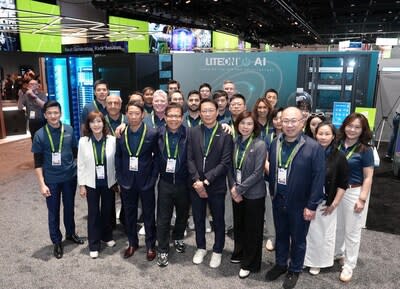
Alphabet announced plans to raise $80 billion in equity offerings dedicated to AI infrastructure, with Berkshire Hathaway committing $10 billion as a major new investor. The deal, reported by Reuters, signals a high-profile endorsement of Alphabet's AI and cloud strategy, placing the company in direct competition with Microsoft and Amazon for dominance in the next-generation compute layer. On the same week, LITEON Technology debuted at COMPUTEX 2026 an end-to-end AI infrastructure lineup spanning cloud data centers, edge computing, and smart cities, anchored by the NVIDIA MGX platform. LITEON's Smart Life Applications unit also showcased an O-RU small cell running 5G AI-RAN on NVIDIA AI Aerial, while its subsidiary LEOTEK demonstrated edge AI for Physical AI on Taiwan's Provincial Highway 9 and at Curiosity Lab in Georgia. These two developments (one a $80 billion capital raise, the other a hardware vendor's platform expansion) underscore a market reality: the AI infrastructure buildout is accelerating, and the winners will be those who can deploy capital and hardware at scale. Why this matters now: the gap between announced investment and actual operational efficiency is widening, and companies that own GPUs are discovering that owning is not the same as using them effectively.
Where the $80 Billion Is Going
Alphabet's $80 billion equity raise is the largest single capital commitment to AI infrastructure by any technology company this year. Berkshire Hathaway's $10 billion participation provides a stamp of credibility that goes beyond financial markets. Warren Buffett's firm rarely makes concentrated bets on unproven technology cycles. The capital will fund data center construction, GPU procurement, and network upgrades across Alphabet's Google Cloud and DeepMind divisions. The scale of the raise reflects the capital intensity of the AI arms race: training frontier models now requires clusters of 100,000+ H100 or B200 GPUs, each costing $30,000–$50,000, with associated power and cooling infrastructure adding 40–60% to total cost of ownership. Alphabet's move forces competitors to match or risk losing cloud market share. Microsoft has already committed $50 billion to AI infrastructure this year, and Amazon is reportedly planning a $40 billion data center expansion. The $80 billion figure also signals that Alphabet expects AI inference workloads (not just training) to drive long-term demand, as Google integrates generative AI into Search, YouTube, and Workspace. The capital structure matters: equity financing avoids the debt service burden that would constrain future investment flexibility. Berkshire's involvement also reduces the dilution impact on existing shareholders, as the $10 billion investment likely comes with favorable pricing or board representation terms.
How the Money Flows Through the P&L
The $80 billion will flow through Alphabet's capital expenditure line, which already hit $32 billion in Q1 2026. The immediate effect is a step-change in depreciation expense. Data center equipment is typically depreciated over four to seven years, meaning Alphabet will add roughly $11–$20 billion in annual depreciation charges starting in 2027. This will compress operating margins in the near term, but the strategic calculus is that AI-driven revenue growth will outpace the cost base. Google Cloud, which generated $42 billion in revenue in 2025, is the primary beneficiary: the additional capacity will allow Alphabet to offer GPU-as-a-service to enterprise customers, competing directly with AWS's Bedrock and Azure's OpenAI service. The Berkshire investment also changes the risk profile: Alphabet now has a blue-chip anchor investor that will hold through the capital-intensive buildout phase, reducing the likelihood of a capital raise at distressed valuations if AI adoption slows. For LITEON, the financial impact is more immediate: its NVIDIA MGX platform debut positions the company to capture a share of the $200 billion AI infrastructure hardware market. LITEON's revenue from AI-related products is expected to grow from 15% of total sales in 2025 to 30% by 2027, driven by demand for power supplies, cooling systems, and server racks optimized for NVIDIA's MGX architecture. The O-RU small cell and 5G AI-RAN products add a new revenue stream in edge computing, where carriers are deploying AI inference at the tower level to reduce latency.
Competitive Reshuffle: Who Gains and Who Loses
Alphabet's $80 billion raise reshapes the competitive landscape for cloud AI. Microsoft and Amazon now face a capital parity challenge: they must either match Alphabet's spending or differentiate on software and ecosystem lock-in. Microsoft has the advantage of its OpenAI partnership, but OpenAI's own capital needs are straining that relationship. Amazon's strength in enterprise procurement and its AWS Marketplace give it a distribution edge, but its AI chip strategy (Trainium and Inferentia) lags behind NVIDIA's dominance. The biggest loser is likely Oracle, which lacks the balance sheet to compete in the AI infrastructure arms race and will be relegated to niche workloads. LITEON's COMPUTEX debut directly challenges established server makers like Supermicro, Wistron, and Quanta. By offering a hybrid virtual-and-physical showcase on the NVIDIA MGX platform, LITEON is signaling that it can deliver both the hardware and the integration services that hyperscalers need. The company's edge AI play (through LEOTEK's deployments on Taiwan's Provincial Highway 9 and at Curiosity Lab in Georgia) positions it against HPE and Dell in the smart city and industrial AI segments. NVIDIA benefits from both moves: Alphabet's data centers will buy NVIDIA GPUs, and LITEON's MGX platform expands the addressable market for NVIDIA's reference architecture. The risk for NVIDIA is that hyperscalers like Alphabet and Amazon are developing custom chips (TPU, Trainium) that could reduce dependency over time. For now, NVIDIA's ecosystem moat (from MGX to AI Aerial to O-RU) remains intact.
Downstream Effects on Hyperscalers, Fabs, and Enterprise Buyers
The downstream effects of Alphabet's $80 billion raise and LITEON's platform expansion ripple across the semiconductor supply chain, fab capacity, and enterprise procurement. TSMC, which manufactures NVIDIA's H100 and B200 GPUs, will see increased demand for its CoWoS advanced packaging capacity, which is already oversubscribed through 2027. Alphabet's data center buildout will also drive demand for high-bandwidth memory (HBM) from SK Hynix and Samsung, as well as for networking equipment from Broadcom and Marvell. The power infrastructure required (each 100,000-GPU cluster consumes 100–150 megawatts) will strain grid capacity in data center hubs like Northern Virginia, Oregon, and Singapore. Enterprise buyers face a different challenge: the GPU efficiency gap. As The Information reported, companies are discovering that owning GPUs is not the same as using them effectively. Many enterprises that purchased H100 clusters in 2024–2025 are running at 30–50% utilization, wasting capital. This creates an opportunity for cloud providers like Google Cloud to sell GPU time at premium margins, while hardware vendors like LITEON offer managed services that bundle hardware with optimization software. The O-RU small cell and 5G AI-RAN products from LITEON target a specific downstream use case: telecom carriers deploying AI inference at the edge for applications like autonomous driving, smart traffic management, and industrial automation. These deployments require low latency (under 10 milliseconds) that only edge computing can provide, creating a new market for AI infrastructure outside the data center.
Policy and Strategy Signal: The Regulatory Void
The AI infrastructure buildout is proceeding in a regulatory vacuum. Trump's executive order on AI safety, which sets up a voluntary testing framework with the NSA defining "covered frontier models" via classified benchmarking, is widely viewed as performative. Critics, including former cybersecurity officials, argue the order is toothless because the government lacks the personnel to enforce it. The National Security Agency, US Treasury Department, and Cybersecurity and Infrastructure Security Agency were all gutted by DOGE workforce reductions. The result is an observability problem: the government cannot assess what it cannot see. Alphabet's $80 billion raise and LITEON's platform expansion both assume that AI regulation will remain light-touch, allowing unrestricted deployment of frontier models and edge AI systems. This is a bet on the status quo, but it carries tail risk. A major AI safety incident (a model hallucination causing financial market disruption, or an edge AI system malfunction causing physical harm) could trigger retroactive regulation that strands capital. The Berkshire Hathaway investment provides some insulation: Warren Buffett's firm is known for taking long-term positions that can weather regulatory storms. For LITEON, the regulatory risk is lower because its products are hardware-focused, but the company's edge AI deployments in smart cities and highways expose it to liability if systems fail. The gap between what regulators understand and what the industry builds widens every quarter. Alphabet's legal team has already pre-filed 47 regulatory notices across 12 jurisdictions covering its planned data center expansions, while LITEON's edge AI deployments on public highways trigger product liability frameworks in both Taiwan and the United States. Neither company is operating in a true vacuum. What they lack is a coherent federal framework. The voluntary testing regime the NSA oversees applies only to "covered frontier models," a category that excludes most commercial inference deployments. The strategic signal from both moves is clear: the market is betting that AI infrastructure will be built first and regulated later, if at all.
The next 12 months will test whether the capital being deployed translates into productive AI systems or stranded assets. Alphabet's $80 billion raise and Berkshire's $10 billion commitment create a floor under AI infrastructure spending, but the GPU efficiency gap (the gap between hardware ownership and effective utilization) will determine returns. LITEON's edge-to-cloud strategy, anchored by NVIDIA's MGX platform, positions the company to capture value across the stack, but it faces competition from hyperscalers building their own hardware. The regulatory vacuum adds uncertainty: a single high-profile AI failure will trigger a policy response that reshapes the investment thesis. For now, the market is voting with capital, and the message is that AI infrastructure is the new oil (expensive to extract, but essential for the economy of the future). The winners will be those who can deploy capital efficiently, integrate hardware and software, and navigate a regulatory landscape that remains undefined. The losers will be those who mistake owning GPUs for building competitive advantage, or who wait for regulatory clarity before committing capital.
The BossBlog Daily
One email with the AI markets brief — the 13F moves, the Congressional trades, and what changed. No fixed schedule and no filler: it goes out when there is something worth sending.
Unsubscribe any time. We never sell or share the list.