
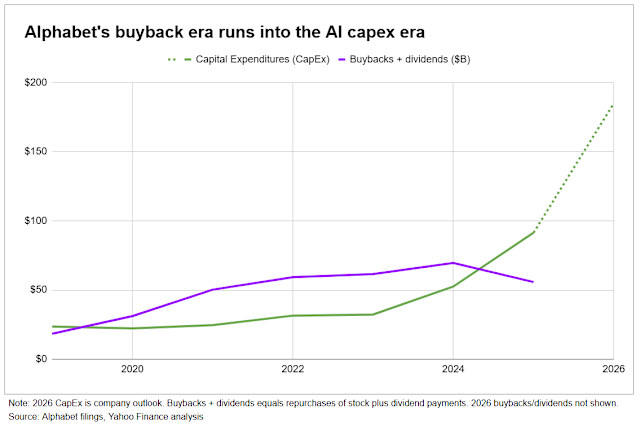
Alphabet plans to spend between $180 billion and $190 billion on capital expenditures this year, predominantly directed at AI infrastructure and data centers, according to the company's latest financial disclosures. The tech giant raised $85 billion through a stock sale to fund Google's AI business, underscoring the scale of its commitment. This spending sits atop a staggering nearly $8 trillion in AI-related capital commitments across the industry over the next five years. Google's Q1 revenue rose 22% year-over-year, providing cover for the outlays, but the sheer magnitude of the buildout is forcing investors to confront a fundamental question: can public equity and debt markets absorb this level of spending without triggering a capital allocation crisis? The answer will determine not just Alphabet's stock price but the viability of the entire AI infrastructure thesis.
The $85 billion stock sale and its role in the capital stack
Alphabet's $85 billion equity raise is the largest single stock sale in corporate history, designed to finance the most aggressive capital expenditure plan ever disclosed by a technology company. The proceeds directly support the $180-190 billion capex target for this year, with the balance coming from operating cash flow and debt. Google's Q1 revenue growth of 22% year-over-year provides a strong foundation, but the capex-to-revenue ratio is climbing to levels that would have been unthinkable in the pre-AI era. The company is effectively betting that AI-driven revenue growth will materialize quickly enough to keep leverage ratios in check. Sundar Pichai has signaled that the spending is non-discretionary, a strategic necessity to maintain leadership in search, cloud, and AI services. The $85 billion raise also serves as a signal to bond markets that Alphabet will not stretch its balance sheet too thin, preserving its AAA credit rating while funding the buildout. This capital structure move is a template that other hyperscalers are watching closely as they contemplate their own funding needs. The equity raise provides a cushion against rising interest rates, ensuring that Alphabet's debt servicing costs remain manageable even if the Federal Reserve keeps borrowing costs elevated through 2027.
How $180-190 billion flows through the AI supply chain
The $180-190 billion in Alphabet's capex flows directly to a concentrated set of semiconductor and infrastructure providers. NVIDIA remains the primary beneficiary, supplying the GPUs that power Google's AI training and inference workloads. But the spending also cascades to connectivity specialists like Astera Labs, which recently expanded its Taiwan operations and Cloud-Scale Interop Lab to accelerate rack-scale AI infrastructure deployment. Astera Labs collaborates with AI platform providers including AMD, Arm, Intel, and NVIDIA, as well as original design manufacturers such as GIGABYTE, Ingrasys (Foxconn), Inventec, Quanta Cloud Technology, and Wiwynn. The connectivity layer, encompassing CXL, Ethernet, NVLink Fusion, PCIe, and UALink, is becoming a critical bottleneck as GPU clusters scale to tens of thousands of units. Alphabet's spending ensures that these interconnect companies have the demand visibility to invest in their own capacity expansions. The capex also funds Google's custom TPU designs, which compete with NVIDIA's offerings and give Alphabet leverage in pricing negotiations. Each TPU generation requires retooling at Taiwan Semiconductor Manufacturing Company's advanced packaging facilities, locking in multiyear capacity reservations that competitors cannot easily replicate. Beyond silicon, Alphabet's buildout demands a parallel investment in custom networking hardware. Google's Jupiter networking fabric, purpose-built to connect tens of thousands of TPUs and GPUs within a single data center, requires ongoing capital commitments that rival the chip spend itself. Optical interconnects, power distribution units, and cooling systems designed for 300-watt-per-chip GPU racks add another layer of spending that rarely appears in headline capex figures but represents a substantial share of total infrastructure cost. Smaller AI infrastructure vendors building rack-scale cooling and power delivery systems report 18-to-24-month order backlogs tied directly to hyperscaler procurement cycles, with Alphabet's volume commitments driving the bulk of their forward revenue visibility.
The competitive reshuffle: Meta, Microsoft, and the hyperscaler arms race
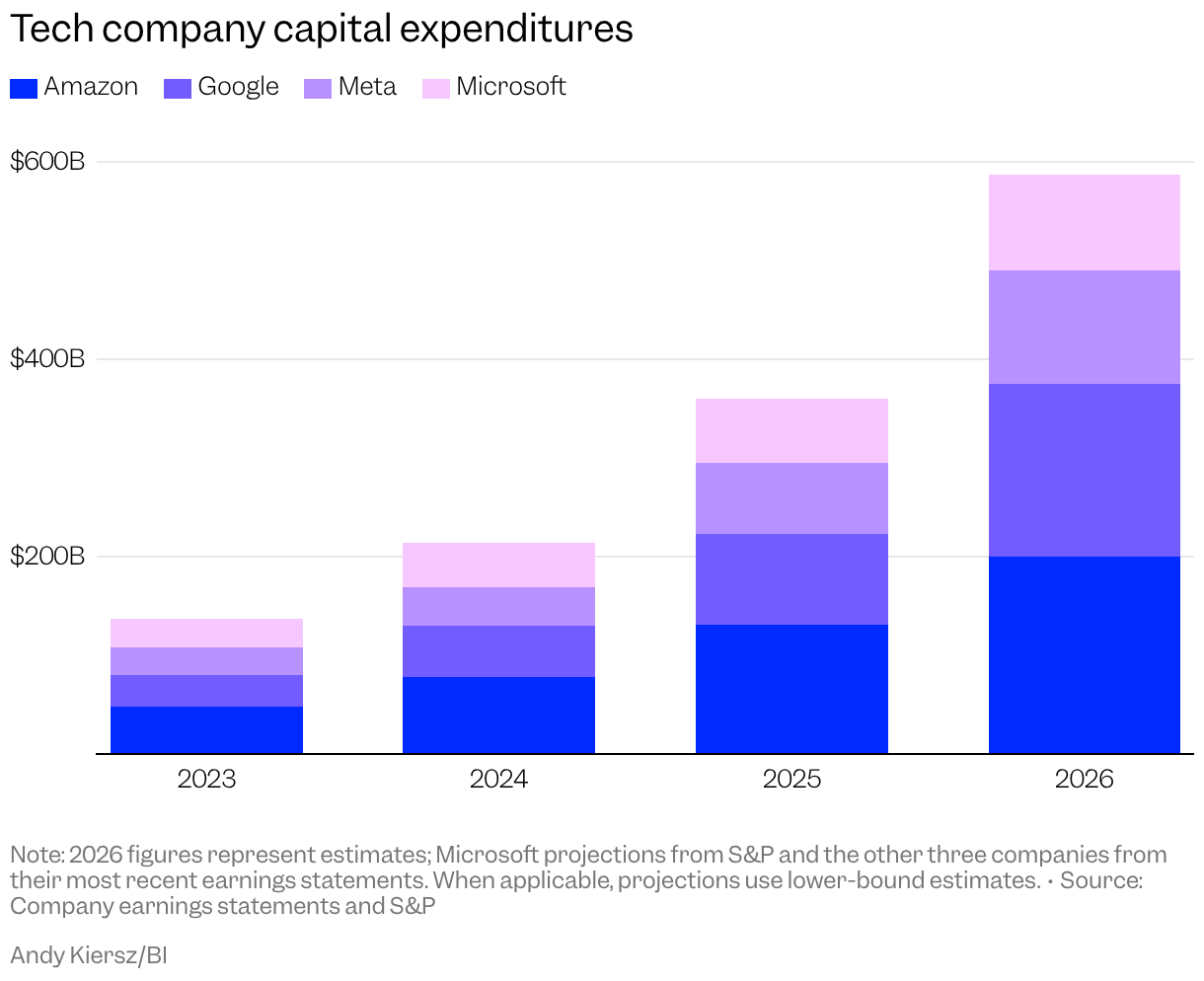
Alphabet's spending spree forces every major hyperscaler to match or justify a different trajectory. Meta, under Mark Zuckerberg, has committed to a $100 billion AI gamble, including massive pay deals for AI researchers that sometimes reach hundreds of millions of dollars in total compensation. This talent war is driving up costs across the industry, as companies like Anthropic and OpenAI also compete for the same pool of PhDs and engineers. Microsoft, through its partnership with OpenAI, is spending heavily on Azure infrastructure, though its exact capex figures remain less transparent. The competitive dynamic is shifting from a race to deploy AI products to a race to control the underlying compute infrastructure. Alphabet's $180-190 billion capex creates a moat that smaller players cannot replicate, potentially consolidating AI development among the top three hyperscalers. However, it also raises the stakes: if AI revenue growth disappoints, the overhang of underutilized data centers will pressure margins across the sector. The spending is a bet that demand for AI inference will dwarf training costs over time, justifying the upfront investment. Amazon Web Services is also accelerating its own data center expansion, though its capex plans remain more conservative than Alphabet's disclosed targets. Compensation inflation is a second-order cost that rarely appears in capex disclosures but is reshaping the economics of AI development. Senior ML researchers at the top hyperscalers now command total compensation packages that rival Wall Street's highest earners, with signing bonuses, equity grants, and retention awards designed to lock in talent for three-to-five-year periods. Alphabet's Google DeepMind division has been particularly aggressive, recruiting from OpenAI, Anthropic, and leading academic institutions with packages that smaller AI companies structurally cannot match. This pay dynamic concentrates frontier model development at the hyperscalers, reinforcing the infrastructure moat with a talent moat that operates independently of capital spending cycles.
Downstream effects on Taiwan, fabs, and enterprise buyers
The AI infrastructure buildout is reshaping the geography of semiconductor manufacturing and data center construction. Astera Labs' expansion in Taiwan deepens the island's role as a critical node in the AI supply chain, linking chip designers with ODMs that assemble rack-scale systems. Taiwan's concentration of advanced packaging capacity, essential for NVIDIA's HBM-integrated GPUs and Google's TPUs, makes it a strategic bottleneck. Any disruption to Taiwan's semiconductor ecosystem would ripple through Alphabet's entire capex plan. On the fab side, Intel's foundry business is positioning to capture some of this spending, though its manufacturing roadmap remains unproven at scale. Enterprise buyers of AI infrastructure face a different challenge: as hyperscalers consume the bulk of GPU supply, lead times for enterprise-grade AI hardware are stretching, pushing smaller companies toward cloud services rather than on-premise deployments. This dynamic reinforces the hyperscalers' pricing power and creates a virtuous cycle where more enterprise spending flows back into their AI clouds. Data center construction firms like Turner Construction and DPR Construction are reporting record backlogs, with power substation lead times extending beyond 36 months in key markets such as Northern Virginia and Phoenix. The energy implications are equally significant. A single large-scale AI data center complex consumes between 500 megawatts and 1 gigawatt of power, equivalent to the output of a mid-size power plant. Alphabet's buildout is accelerating demand for grid interconnection agreements across the United States, Europe, and Asia, driving up power purchase agreement prices and pushing the company into long-term contracts with nuclear and renewable energy providers. Grid operators in Virginia and Georgia have flagged that interconnection queues for new data center load now stretch five years, creating a physical infrastructure constraint that threatens to slow the buildout regardless of capital availability.
Policy and strategy signal: the market's capacity to absorb $8 trillion
The nearly $8 trillion in AI spending committed over five years represents a structural shift in how capital markets allocate resources. This is not a cyclical uptick but a multiyear reallocation of investment from software and services to physical infrastructure. The signal from Alphabet's $85 billion stock sale is that even the most cash-rich companies recognize the need to tap public markets to fund the buildout. The question is whether the equity and debt markets can absorb this volume without crowding out other sectors or triggering a correction. Historically, technology capex cycles have ended in overcapacity and write-downs, and the telecom bust of 2000-2002 is the cautionary tale. However, AI infrastructure differs in that it serves a rapidly growing demand pool rather than speculative bandwidth. The policy implication is clear: regulators and central banks will need to monitor the concentration of AI infrastructure spending, as a pullback by any one hyperscaler will have outsized effects on semiconductor supply chains, data center construction, and energy markets. The Federal Reserve's extended higher-for-longer rate posture adds a direct cost of capital headwind to the buildout, raising the hurdle rate for each incremental data center project. At a 5% risk-free rate, a $10 billion data center investment requires meaningfully higher AI revenue per rack than it did in the zero-rate environment of 2021. Alphabet's AAA credit rating insulates it from the worst of this pressure, but mid-tier AI infrastructure companies without investment-grade ratings face a structurally different funding environment. The bifurcation between hyperscaler and non-hyperscaler AI infrastructure spending will widen further if rates remain elevated through 2027, accelerating consolidation among the smaller players that serve as the innovation periphery of the AI ecosystem.
The next 18 months will test whether Alphabet's $180-190 billion bet is the foundation of a new computing paradigm or the peak of an investment cycle that markets cannot sustain. If AI revenue growth accelerates in line with Pichai's projections, the spending will look prescient and the $8 trillion industry commitment will prove justified. If growth disappoints, the overhang of underutilized data centers and the pressure on balance sheets will trigger a consolidation wave that reshapes the competitive landscape. Either way, the scale of capital committed ensures that the AI infrastructure buildout is the defining economic story of the decade, with consequences for semiconductor supply chains, energy grids, and the balance of power among the world's largest technology companies.
The BossBlog Daily
Essential insights on AI, Finance, and Tech. Delivered every morning at 06:00 Asia/Shanghai. No noise.
Unsubscribe anytime. No spam.