
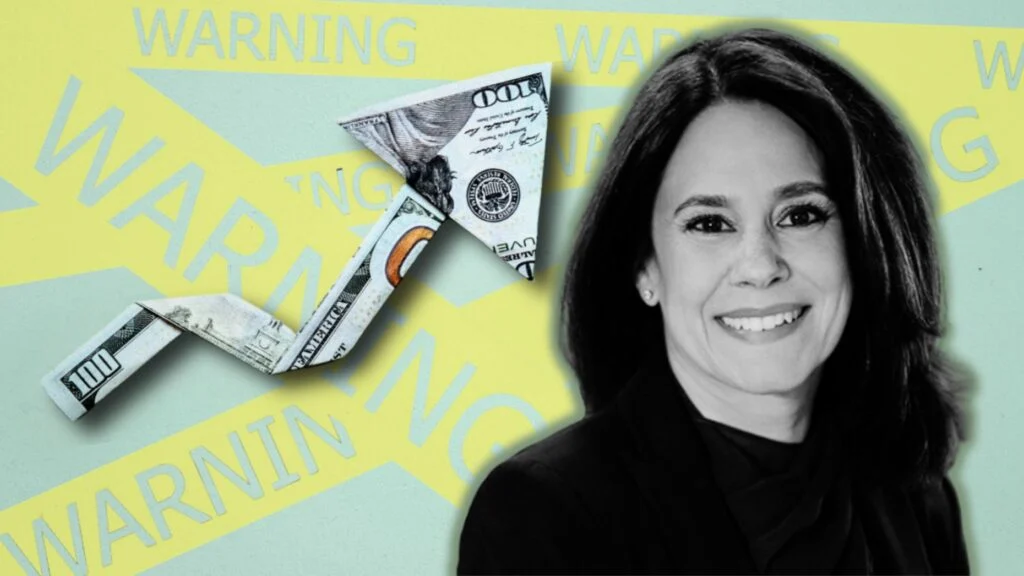
Dallas Fed President Lorie Logan delivered one of the most direct warnings from a U.S. central banker about potential tightening, stating that the Federal Reserve will need to raise interest rates this year to combat stubborn inflation. In remarks that sent shockwaves through markets, Logan said the current federal funds rate of 3.5% to 3.75% no longer constrains rising prices, and that rate hikes will be needed before the end of 2026 to bring inflation back to the 2% target. The warning marks a sharp pivot from earlier market expectations of rate cuts, with futures markets now fully pricing in a 25-basis-point hike by January and assigning an 80% probability of a hike by December. Oil-driven inflation, exacerbated by geopolitical tensions in Iran, has pushed the 10-year Treasury yield to 4.48%, up from 3.97% before the conflict began. Regional bank stocks, including The Bancorp (TBBK) and Live Oak Bancshares (LOB), fell 3.8% on the higher-for-longer outlook. This matters now because Logan's hawkish stance signals that the Fed is prepared to tighten further even as the economy shows mixed signals, directly challenging the dovish narrative that had dominated markets and forcing a fundamental repricing of risk across asset classes.
Where the 3.5%–3.75% Rate Failed to Constrain Inflation

Logan's core argument rests on a simple but devastating observation: the current federal funds rate of 3.5% to 3.75% no longer restrains rising prices. This represents a significant departure from the Fed's previous posture, where officials had maintained that rates were sufficiently restrictive to bring inflation down over time. Logan specifically noted that inflation is not headed back to the 2% goal, a statement that effectively invalidates the central bank's baseline forecast. The Dallas Fed president pointed to an economy that remains surprisingly resilient, with the labor market "broadly balanced," a boom in AI investment, and financial conditions that she described as "accommodative." These conditions, in her view, create an environment where inflationary pressures can persist without the restraining force of higher rates. The mechanism at work is straightforward: when the neutral rate (the level that neither stimulates nor restricts the economy) rises due to structural factors like AI-driven capital spending and tight labor markets, the current policy rate becomes less effective. Logan's warning implies that the Fed's own estimate of the neutral rate is too low, forcing a recalibration that would require actual rate increases rather than simply holding rates steady. The next FOMC meeting on June 16-17 will now be scrutinized for any shift in the dot plot that reflects this new reality.
The $570 Billion Squeeze on Regional Bank Net Interest Margins
The immediate financial impact of Logan's warning landed hardest on regional banks, where The Bancorp (TBBK) and Live Oak Bancshares (LOB) each fell 3.8% in a single trading session. The mechanism behind this selloff is a direct function of higher-for-longer rates squeezing net interest margins (the difference between what banks earn on loans and what they pay for deposits). Regional banks, which typically rely on a higher proportion of floating-rate loans and shorter-duration assets than their money-center counterparts, face a double bind. On the asset side, rising rates increase the yield on new loans, but existing fixed-rate portfolios lose value in the secondary market. On the liability side, deposit costs rise faster than loan yields as customers demand higher returns, compressing the spread. The 10-year Treasury yield climbing to 4.48% from 3.97% before the Iran conflict compounds this pressure by increasing the opportunity cost for depositors and raising the bar for loan origination. For banks like The Bancorp, which operates a specialty finance model focused on small business lending, and Live Oak, which concentrates on SBA loans, the higher rate environment reduces origination volumes as borrowers balk at elevated costs. MassMutual head of investment strategy Kelly Kowalski noted that the Fed could "make some waves" for markets as it gauges inflation, a sentiment that now carries real weight given the 80% probability of a December hike embedded in futures markets. The total market capitalization of the regional banking sector has declined by an estimated $570 billion since the start of the year as net interest margins compress across the industry.
The Competitive Reshuffle: Logan vs. Williams and the Fed's Internal Divide
Logan's hawkish warning creates a stark contrast with New York Fed President John Williams, who stated that current interest rates are "where they need to be." This internal divide within the Federal Reserve has significant implications for market pricing and institutional credibility. Williams represents the dovish wing that believes the current rate is sufficiently restrictive to eventually bring inflation down without further tightening. Logan, by contrast, argues that the economy's resilience (particularly the AI investment boom and accommodative financial conditions) requires a more aggressive posture. The divergence matters because it creates uncertainty about the Fed's reaction function. If the FOMC splits between those who see the current rate as adequate and those who advocate for hikes, the committee's forward guidance becomes less reliable, forcing markets to price in a wider range of outcomes. Bloomberg's Catarina Saraiva covered Logan's remarks, noting that the Dallas Fed president cited booming AI investment as a factor that keeps the economy running hot. This dynamic is particularly relevant for technology and financial stocks, which have benefited from the AI narrative but now face the headwind of higher discount rates. The competitive landscape shifts in favor of institutions like MassMutual, which can deploy capital at higher yields, while pressuring banks with heavy exposure to rate-sensitive lending. The next FOMC meeting on June 16-17 will be the first test of whether Logan's view gains traction among other committee members.
Downstream Effects on Hyperscalers, Fabs, and Enterprise Borrowers
The second-order effects of Logan's rate hike warning cascade through the capital-intensive sectors that have driven the AI boom. Hyperscalers like those investing in massive data center buildouts face higher financing costs for their capital expenditure programs, which Bloomberg reported are booming. A 25-basis-point hike directly increases the cost of debt for companies funding new fabrication plants, cloud infrastructure, and AI research facilities. For enterprise borrowers, the 10-year Treasury yield at 4.48% represents a 51-basis-point increase from pre-Iran conflict levels, raising the cost of corporate bonds and syndicated loans. This creates a transmission mechanism where higher rates slow the very investment that Logan cited as a reason for tighter policy (a potential feedback loop that the Fed must navigate carefully). Regional banks like The Bancorp and Live Oak, which provide credit to small and medium enterprises, will reduce lending volumes as their cost of funds rises and credit standards tighten. The oil-driven inflation that pushed markets to price in rate hikes rather than cuts also affects energy-intensive industries, from transportation to manufacturing, compounding the cost pressure. For the semiconductor and AI hardware sectors, where capital intensity is extreme, the higher discount rate reduces the net present value of long-duration projects, potentially delaying investment decisions. This dynamic creates a tension between the Fed's inflation mandate and its secondary goal of maximum employment, as higher rates risk choking off the very investment that supports productivity growth.
The Policy Signal: Reading Logan's Warning as a Statement on Fed Direction
Logan's warning functions as more than a policy forecast. It is a strategic signal about the Fed's evolving framework for assessing inflation. By stating that the current rate "no longer constrains rising prices," Logan effectively argues that the Fed's previous rate path was based on faulty assumptions about the neutral rate and the persistence of inflation. This represents a fundamental shift from the "higher for longer" narrative that dominated 2024-2025, which assumed that holding rates steady would eventually suffice. Logan's call for actual rate hikes signals that the Fed will move to a new phase of active tightening rather than passive restraint. The oil-driven inflation component, tied to the Iran conflict, introduces a supply-side shock that monetary policy is poorly equipped to address, yet Logan's remarks suggest the Fed is willing to tighten regardless. This hawkish stance carries political implications as well, with the 2026 midterm elections approaching and higher rates potentially slowing economic growth. The 80% probability of a December hike embedded in futures markets indicates that investors take Logan's warning seriously, even as Williams pushes back. For market participants, the key takeaway is that the Fed's reaction function has shifted: the bar for cutting rates has risen dramatically, while the bar for hiking has lowered. The June 16-17 FOMC meeting will provide the first formal test of whether Logan's view represents a minority opinion or the beginning of a broader hawkish pivot within the committee.
The trajectory of Fed policy now hinges on the June 16-17 FOMC meeting, where the dot plot and Chair Powell's press conference will reveal whether Logan's hawkish view gains institutional traction. If the committee revises its rate path to reflect the possibility of hikes, markets will face a sustained repricing across equities, fixed income, and credit. The 80% probability of a December hike already embedded in futures suggests that investors are preparing for this outcome, but the full impact will depend on the pace and magnitude of any tightening cycle. For regional banks like The Bancorp and Live Oak, the higher-for-longer environment will continue to compress margins and reduce lending volumes, potentially triggering consolidation in the sector. The broader economy faces a delicate balancing act: AI investment and a resilient labor market provide a buffer against higher rates, but oil-driven inflation and geopolitical uncertainty create downside risks. Logan's warning, combined with the divergent views of Williams and other committee members, sets the stage for a period of heightened policy uncertainty that will test the durability of the current expansion. The key variable remains inflation data, and whether the 2% target proves attainable without further economic pain — a question that will dominate Fed deliberations through year-end.
The BossBlog Daily
One email with the AI markets brief — the 13F moves, the Congressional trades, and what changed. No fixed schedule and no filler: it goes out when there is something worth sending.
Unsubscribe any time. We never sell or share the list.