
The Federal Reserve held the federal-funds rate steady at 3.5%–3.75% at its last meeting, Jerome Powell's final as chair, as officials signaled a cautious stance on future rate moves amid persistent economic uncertainty. The hold leaves the top-yielding 1% of 1-year CDs averaging 4.29% as of June 3, 2026, according to DepositAccounts.com, near the peak for short-term deposit yields. New York Fed President John Williams said rates are "where they need to be," while San Francisco Fed President Mary Daly told a Bloomberg Tech conference on June 4 that the central bank is prepared to respond "either way" depending on the economy's trajectory. The next FOMC meeting on June 16-17 will be the first under a new chair, and the split among policymakers matters directly for the $4.5 trillion in retail deposits and money-market funds currently earning near-peak yields. For savers and bank treasury desks alike, the question is whether the 4.29% top-tier CD rate has already peaked or can hold through the summer. Kelly Kowalski, head of investment strategy at MassMutual, noted that persistent inflation uncertainty makes the Fed's next move genuinely unpredictable, adding weight to the case for locking in current yields now.
Where the 4.29% Top-Tier CD Yield Comes From

The 4.29% figure represents the average annual percentage yield across the top 1% of 1-year certificates of deposit tracked by DepositAccounts.com as of June 3, 2026. That is more than 2.7 percentage points above the national average of 1.55% reported by the FDIC, a spread that reflects the aggressive competition among online banks and credit unions for retail deposits. The 1-year CD has become the highest-yielding deposit account category in the current rate environment, outpacing high-yield savings accounts and money-market deposit accounts. The federal-funds rate range of 3.5%–3.75% provides the floor for these yields; banks price CDs at a premium to the policy rate to attract depositors, and the 4.29% top-tier rate implies a roughly 60-basis-point spread over the top of the Fed's target range. That spread has narrowed from over 100 basis points earlier in the tightening cycle, indicating that deposit competition is moderating as the Fed holds steady. For a depositor placing $100,000 into a top-tier 1-year CD, the 4.29% yield generates $4,290 in interest over twelve months, versus $1,550 at the national average. That $2,740 gap drives the search for yield among retail investors. The rate also sits just below the 4.35% peak reached in late 2025, suggesting the ceiling is in place unless the Fed resumes hiking. The 4.29% yield is the highest short-term risk-free return available to retail depositors since the early 2000s, and it has drawn inflows from money-market funds and savings accounts into CDs.
How the Fed Hold Flows Through Bank P&Ls
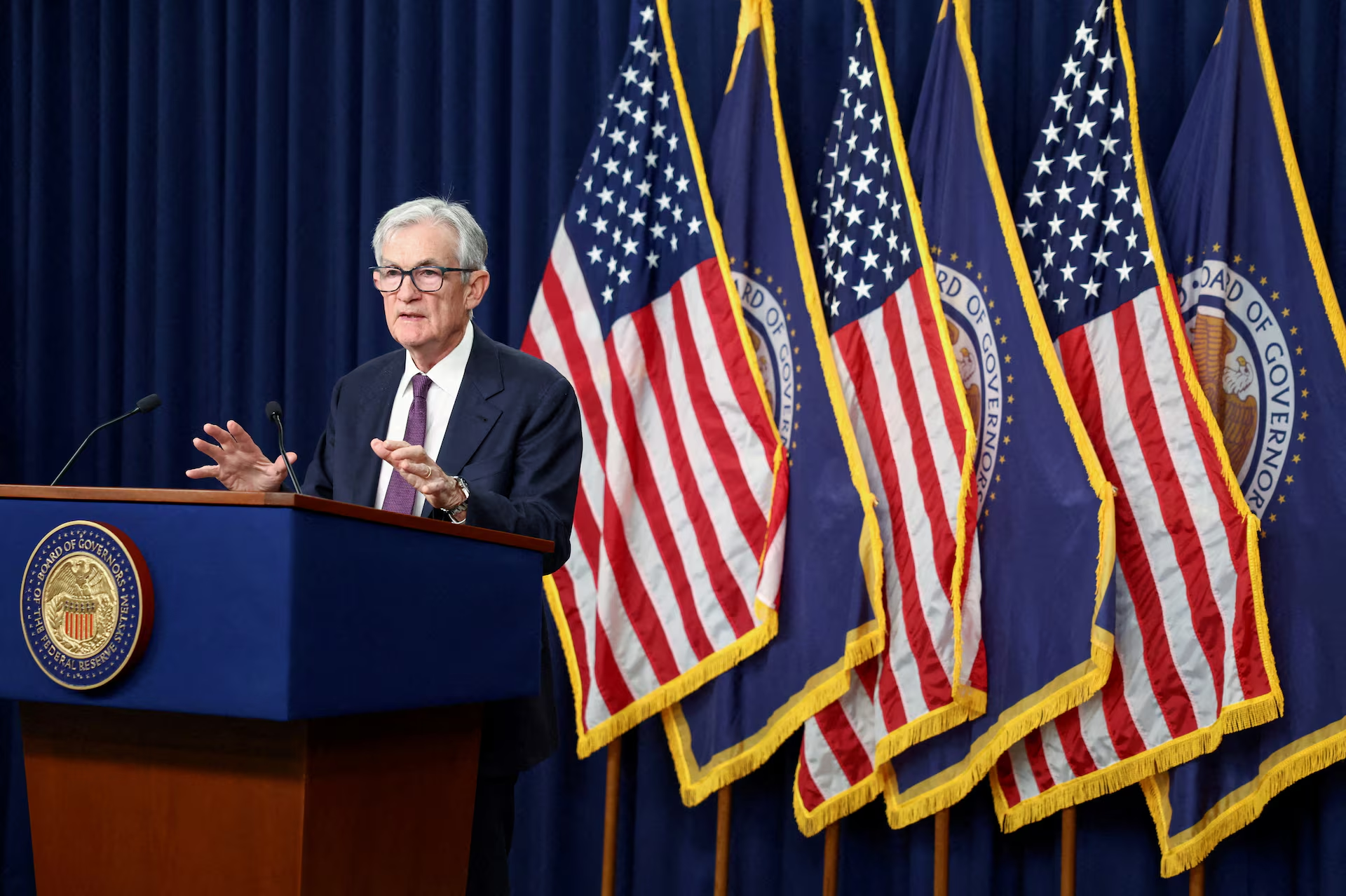
The steady policy rate directly influences bank net interest margins, which had compressed during the rapid hiking cycle as deposit costs rose faster than loan yields. With the Fed on hold at 3.5%–3.75%, banks gain a stable window to reprice their deposit bases downward without triggering a mass exodus of rate-sensitive depositors. The top-tier CD rate of 4.29% is already 6 basis points below its late-2025 peak, and bank treasury teams are watching the June 16-17 FOMC meeting for signals on whether to extend duration on their wholesale funding. For a regional bank with $50 billion in deposits, every 25-basis-point reduction in average deposit costs adds roughly $125 million in annual pre-tax income, assuming static volume. The hold also benefits the $6.2 trillion money-market fund industry, which has seen assets under management swell as retail investors chase yields; the stable rate environment reduces the risk of sudden redemptions that would force funds to sell short-term paper at a loss. MassMutual head of investment strategy Kelly Kowalski noted the Fed's inflation outlook creates uncertainty, but the hold itself provides a known baseline for asset-liability management. Banks that locked in longer-term fixed-rate CDs at 4.5% or higher during the peak now face negative carry if short-term rates decline, but the hold delays that reckoning. The stable rate environment also allows bank CFOs to model deposit beta assumptions with greater confidence, reducing the need for expensive wholesale funding alternatives.
The Competitive Reshuffle Among Online Banks and Credit Unions
The 4.29% top-tier 1-year CD rate creates a clear dividing line between institutions that compete aggressively for deposits and those that rely on relationship-based, low-cost funding. Online banks such as Ally, Marcus by Goldman Sachs, and Discover have historically led the top-yielding lists, but credit unions and smaller regional banks have closed the gap in recent months to attract funding. The spread between the top 1% and the national average of 274 basis points is the widest since the 2023 banking crisis, reflecting a two-tier market where rate-sensitive depositors chase yield while inertia keeps the majority at low-paying institutions. For a credit union offering a 4.29% 1-year CD, the cost of funds is roughly 100 basis points above the average jumbo mortgage rate, compressing lending margins. The competitive pressure is most acute for institutions that rely on brokered deposits, which now cost more than 4% on a one-year basis. The Fed hold removes the immediate threat of another rate hike that would force banks to raise CD rates further, but it also removes the urgency for depositors to lock in rates now. The result is a stable but competitive deposit market where the top-tier rate acts as a ceiling rather than a floor, and institutions that cannot match 4.29% will see deposit outflows accelerate. Smaller community banks that lack the balance-sheet scale to offer competitive CD rates are losing deposit share to online competitors at an accelerating pace. The Federal Insurance Deposit Corporation data shows that non-interest-bearing checking balances have declined by roughly 8% year-over-year at community banks as depositors rotate into yield-bearing products, a structural shift that the stable rate environment will sustain through the summer. Credit unions with membership-based funding models are also under pressure, since their dividend rates on share accounts now need to approach 4% to retain members who can easily open an online CD from a smartphone. The competitive equilibrium has shifted permanently toward yield transparency, with deposit aggregators and rate-comparison platforms driving more than 30% of new CD openings at top-tier institutions.
Downstream Effects on Hyperscalers, Enterprise Borrowers, and Housing
The steady rate environment at 3.5%–3.75% provides a predictable cost of capital for hyperscalers and enterprise borrowers that have been delaying capex decisions due to rate uncertainty. For cloud providers and data-center operators, the 1-year CD rate of 4.29% serves as a benchmark for the risk-free rate plus a liquidity premium, influencing the discount rates used to evaluate multi-year infrastructure projects. A 25-basis-point change in the discount rate can shift the net present value of a $1 billion data-center investment by $15 million to $20 million, so the hold removes one variable from capital-budgeting decisions. For the housing market, the 1-year CD yield competes directly with mortgage rates for household savings; a 4.29% risk-free return makes homeownership relatively less attractive as an investment, particularly in markets where price appreciation has slowed. The Fed hold also stabilizes the Treasury yield curve, with the 2-year note trading near 3.80% and the 10-year near 4.10%, a positively sloped curve that supports bank lending. Enterprise borrowers with floating-rate debt tied to SOFR benefit from the hold, as their interest costs remain at current levels rather than rising further. The next FOMC meeting will test whether the new chair maintains the current stance or signals a shift that would ripple through these downstream markets. The stable rate environment also supports corporate bond issuance, as investment-grade borrowers can price new debt with greater certainty about the risk-free rate floor.
The Policy Signal Behind the Fed's Cautious Hold
The decision to hold rates at 3.5%–3.75% represents a deliberate pause rather than a peak, with Fed officials divided on the next move. Williams' statement that rates are "where they need to be" suggests a bias toward maintaining the current level, while Daly's comment that the Fed is "ready either way" leaves the door open for both hikes and cuts. This split matters because the 1-year CD rate of 4.29% is priced off expectations for the policy rate over the next twelve months; if the market prices in a cut, the top-tier CD rate will decline in anticipation. The next FOMC meeting on June 16-17 will be the first under a new chair, and the tone of the statement and press conference will signal whether the committee leans toward the Williams camp of satisfaction or the Daly camp of optionality. Inflation uncertainty remains the key variable; the Fed's preferred core PCE measure is running at 2.7%, above the 2% target, but the labor market is cooling. The hold buys time for the committee to gather more data without committing to a direction. For depositors, the signal is clear: the 4.29% top-tier CD rate is the peak for this cycle, and locking in now captures near-maximum yield before any potential cuts. For bank treasuries, the hold extends the window to manage deposit costs before the next rate move, whichever direction it takes. The split between Williams and Daly reflects a broader uncertainty about the economy's trajectory, and the next set of inflation and employment data will tip the balance.
The Fed hold at 3.5%–3.75% creates a stable plateau for short-term yields, but the June 16-17 FOMC meeting will determine whether that plateau becomes a peak or a launching pad. If the new chair signals a willingness to cut, the 4.29% top-tier 1-year CD rate will decline within weeks as banks reprice deposit products lower. If the committee holds firm or signals a potential hike, the rate could push above its late-2025 peak of 4.35%. For investors, the optimal strategy is to lock in the current top-tier rate for twelve months, capturing the 4.29% yield before any potential decline. For bank executives, the hold provides a precious window to optimize funding costs and extend liability duration before the next policy move. The era of rapid rate changes is over, but the era of uncertainty about the destination is just beginning.
The BossBlog Daily
One email with the AI markets brief — the 13F moves, the Congressional trades, and what changed. No fixed schedule and no filler: it goes out when there is something worth sending.
Unsubscribe any time. We never sell or share the list.