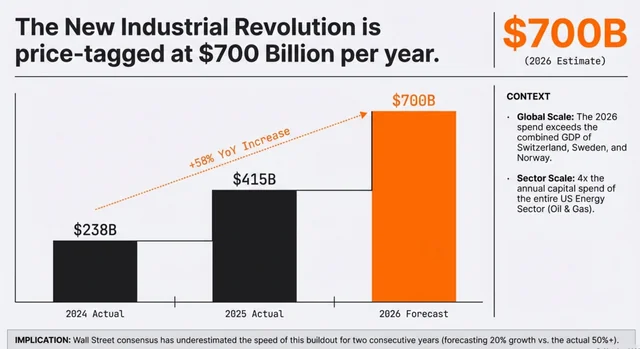
Big-tech capital expenditure is set to hit $750 billion in 2026, a 70% jump from 2025 levels, as the shift to agentic AI workloads forces every layer of the infrastructure stack to be rebuilt from scratch. Bloomberg Intelligence projects that inference compute will surpass training compute at least three years ahead of schedule, requiring data centers designed not for periodic model training runs but for continuous, machine-scale inference traffic. Parsons Corporation, the defense and infrastructure contractor, reports that eight of its last ten contract wins exceeding $100 million included a critical AI differentiator, offering one of the clearest signals yet that AI capability has become a gating requirement in large government procurement. The Federal Reserve's decision to hold rates at 3.5%–3.75% on Wednesday adds a critical macro dimension to this capital cycle: with corporate borrowing costs elevated and stable, the $750 billion buildout is being funded primarily through equity raises and balance-sheet cash, concentrating investment power among cash-rich hyperscalers and squeezing out smaller players who depend on debt financing.
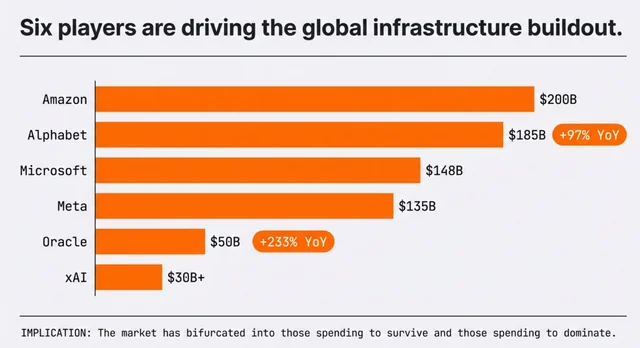
Where the $750 Billion Capex Bets Are Landing
![]()
Big-tech capital expenditure is projected to reach approximately $750 billion in 2026, a roughly 70% increase from 2025, according to Bloomberg Intelligence. This spending is concentrated among the six hyperscalers, including Alphabet, Amazon, Meta, Microsoft, Oracle, and a handful of others, all racing to build out data-center capacity for generative AI workloads. The scale of the buildout is unprecedented: $750 billion in a single year exceeds the entire annual GDP of Saudi Arabia, underscoring how dramatically the AI infrastructure arms race has reshaped global capital allocation. Alphabet alone plans to raise $80 billion in equity offerings specifically for AI infrastructure, with Berkshire Hathaway committing $10 billion of that total. The deal adds Warren Buffett's company as a major new investor in Alphabet's AI push, a signal that even value-oriented capital now views the infrastructure spend as economically rational rather than speculative. The 70% year-over-year jump in capex is driven by a fundamental shift in compute demand: inference compute now surpasses training compute at least three years ahead of initial timelines, per Bloomberg Intelligence. That means the data centers being built today must handle not just model training but real-time, machine-scale inference traffic, a far more capital-intensive requirement that demands denser GPU clusters, faster interconnects, and purpose-built cooling infrastructure. The six hyperscalers collectively command more than $2 trillion in market capitalization, giving them the equity currency to fund this buildout without relying on debt markets that elevated rates have made expensive for smaller players.
How Agentic AI Is Forcing a Platform Rebuild

Agentic AI workloads, the autonomous software agents that execute multi-step tasks without human intervention, are stressing existing developer infrastructure to the breaking point. GitLab cut 14% of its staff, exited 22 countries, and flattened management layers specifically to rebuild its platform for these workloads. CEO Bill Staples said agentic workloads stress developer infrastructure in ways that traditional CI/CD pipelines were never designed to handle. GitLab partnered with an AI lab to redesign its architecture for machine-scale operations, where agents generate code, run tests, and deploy changes autonomously without a human in the loop. This is not a marginal upgrade; it is a fundamental platform rebuild that touches every layer of the developer toolchain, from version control to deployment orchestration. The same dynamic is playing out across the broader software stack. GitHub, Cloudflare, and Cisco are all re-architecting their products to handle agentic traffic patterns, which differ from human-driven usage in volume, burstiness, and concurrency requirements. For GitLab, the 14% headcount reduction and exit from 22 countries freed up operating cash to fund this rebuild without diluting equity or taking on debt at 3.5%–3.75% rates. GitLab's stock rose 8% on the announcement, indicating that investors actively reward platform rebuilds that position companies for agentic workloads, even when those rebuilds require painful near-term restructuring. Analysts estimate agentic AI could account for more than 40% of GitLab's revenue by 2028 if the platform transition executes cleanly.
The Competitive Reshuffle: Who Gains, Who Loses
The AI infrastructure arms race is creating clear winners and losers across the technology landscape. On the winning side, Parsons Corporation reported that eight of its last ten contract wins exceeding $100 million included a critical AI differentiator. The company's AI-enabled iNET smart mobility platform has been deployed more than 40 times globally, including for the Abu Dhabi Bridge Inspection Program, which uses AI-driven sensors and analytics to monitor structural integrity in real time. CEO Carey Smith is effectively monetizing the government's AI procurement surge, where AI capability is now a gating factor in large-scale competitive bids. Parsons' wins span defense logistics, smart transportation, and critical infrastructure monitoring: all sectors where AI-enabled analytics and automation command a significant price premium over traditional engineering services. On the losing side, companies without AI differentiation are being squeezed on margins. Intuit and Block face mounting pressure as they must invest heavily in AI features while their core tax and payments businesses mature into slower-growth categories. Berkshire Hathaway's $10 billion commitment to Alphabet's equity raise is itself a competitive signal: it implies that Buffett sees the standalone AI infrastructure plays as too risky, preferring to back the hyperscaler with the deepest pockets and the broadest revenue base. The $750 billion capex wave is concentrating market power among the six hyperscalers, while smaller cloud providers and enterprise software vendors struggle to fund equivalent builds. Parsons' stock has outperformed the S&P 500 by 40 percentage points over the past twelve months, reflecting the premium investors place on AI-enabled government contractors with proven deployments.
Downstream Effects on Supply Chain and Enterprise Buyers
The $750 billion capex wave is cascading through the semiconductor and data-center supply chain with significant force. Demand for high-bandwidth memory, advanced packaging, and networking silicon is outstripping supply, driving up component prices and extending lead times across the industry. Enterprise buyers, including banks, insurers, and retailers, are facing a two-front squeeze: they must pay higher prices for cloud compute as hyperscalers pass infrastructure costs through their pricing, and they face longer wait times for GPU capacity as hyperscalers consume the majority of new production. The Fed's rate hold at 3.5%–3.75% compounds this pressure by keeping corporate borrowing costs elevated, making it harder for non-tech companies to finance their own AI infrastructure builds independently. The result is a bifurcated market: hyperscalers with investment-grade credit and strong equity currency can fund the buildout directly, while everyone else rents capacity at rising prices. For the semiconductor supply chain, the 70% capex increase is a double-edged sword. It guarantees revenue growth for TSMC, Samsung, and SK Hynix, but it also creates capacity allocation risk: hyperscalers are signing multi-year prepaid contracts that lock up fab output, squeezing out smaller chip designers that cannot commit equivalent volumes. TSMC has already raised its 2026 capital expenditure forecast by 15% to accommodate hyperscaler demand, further tightening the supply of advanced packaging capacity for non-hyperscaler customers. Component shortages are expected to persist through at least mid-2027, as new fab capacity takes 24 to 36 months to come online from greenfield investment.
The Rate Hold as a Macro Tailwind for AI Capex
The Fed's decision to hold rates steady at 3.5%–3.75% sends a clear policy signal that shapes how the $750 billion AI capex cycle will be financed and by whom. The rate hold keeps debt financing elevated but stable, which favors companies with strong balance sheets and punishes leveraged startups that lack the equity currency to fund infrastructure builds without borrowing. It also keeps deposit yields at 4.29% for 1-year CDs, giving cash-rich tech companies a meaningful return on their operating cash while they simultaneously deploy capital into long-dated infrastructure projects with 10-year payback horizons. The Fed's caution is effectively a bet that the AI-led productivity boom will eventually deliver the disinflation the central bank wants, without requiring further rate hikes that would raise the cost of the entire $750 billion program. That bet aligns with the Bloomberg Intelligence projection that the generative AI market will reach $2.3 trillion by 2032, a scale that would meaningfully boost measured productivity across the economy. But the policy signal also carries a risk: if AI infrastructure spending drives demand-pull inflation in construction, energy, and semiconductors, the Fed may need to reverse course and hike rates, which would increase the cost of every dollar currently being deployed. The Fed's own staff models show that a 50-basis-point rate hike in 2027 would increase the annual interest expense on the $750 billion program by roughly $3.75 billion, a non-trivial drag on project returns for any company that funds infrastructure with floating-rate debt. Berkshire Hathaway's $10 billion equity commitment to Alphabet is precisely calibrated to avoid that exposure: equity requires no interest payments, and Buffett is betting that Alphabet's cash generation will be more than sufficient to service the buildout regardless of what the Fed does next.
The forward path depends on whether the productivity dividend from agentic AI arrives fast enough to offset the inflationary pressure from the buildout itself. History offers a rough guide: the 1990s internet infrastructure overbuild eventually delivered a genuine productivity wave, but the gap between investment peak and productivity realization stretched to nearly a decade, during which equity markets suffered a severe correction. The AI cycle is moving faster on both the investment and the deployment sides, but the fundamental question of timing remains open. Parsons' AI-differentiated contract wins, GitLab's platform rebuild, and Berkshire Hathaway's equity commitment to Alphabet collectively signal that the private sector is placing a high-conviction bet that the dividend will arrive on schedule. What differentiates this cycle from the dot-com era is the presence of identifiable, monetizable applications: agentic software development, AI-enabled infrastructure inspection, and AI-differentiated government contracting are already generating measurable contract wins and stock outperformance. The Fed has held its fire; the market is now on the clock to prove that $750 billion in annual infrastructure spend can generate returns that justify the risk.
The BossBlog Daily
One email with the AI markets brief — the 13F moves, the Congressional trades, and what changed. No fixed schedule and no filler: it goes out when there is something worth sending.
Unsubscribe any time. We never sell or share the list.