
The Federal Reserve held interest rates steady at its April 2026 meeting, the first under new leadership following Jerome Powell's final FOMC gathering, yet the consumer savings landscape tells a different story than the central bank's pause might suggest. Top high-yield savings accounts continue to offer up to 5.00% APY as of June 2, 2026, according to data compiled by Dow Jones & Company, while certificate of deposit (CD) rates are climbing above 4% as banks price in expectations that elevated rates will persist through the year. This divergence from the Fed's 75 basis points of cuts delivered in 2025 reflects a banking sector that sees persistent inflation pressures exacerbated by the Iran conflict driving oil and gas prices higher and is betting that the central bank will be forced to keep its federal-funds rate higher for longer than markets initially anticipated. For consumers, the window to lock in these yields is narrowing, but the current moment represents a rare opportunity to earn real returns on cash that the average saver, stuck with the FDIC's reported 0.38% average savings account rate, is entirely missing. Here is why this matters now: the gap between what top banks pay and what the Fed signals is widening, and that spread holds the key to understanding where rates are heading next.
The Mechanics Behind 5.00% APY Savings
The mechanics behind high-yield savings accounts offering 5.00% APY despite a static federal-funds rate hinge on bank competition for deposits and the lag between Fed policy moves and retail rate adjustments. After the Fed cut rates by 75 basis points across 2025, many online banks and credit unions initially held their savings yields steady, using the higher rates as a customer acquisition tool. Now, with the Fed on pause, these institutions are facing a strategic decision: maintain the 5.00% APY to keep deposit balances from fleeing to competitors, or begin trimming rates in anticipation of future cuts. The data from early June 2026 shows that the top-tier accounts have held firm, a sign that deposit competition remains intense. The FDIC's national average savings rate of 0.38% underscores just how bifurcated the market has become: the vast majority of consumers parked in big-branch banks earn virtually nothing, while the savvy minority chasing yield online capture a 4.62 percentage point premium. This spread is not sustainable indefinitely. Banks fund their lending operations with deposits, and paying 5.00% on savings requires earning a higher return on loans or investments. With the yield curve still inverted in parts and loan demand softening, the pressure to lower savings rates will build. But for now, the 5.00% APY persists because the alternative of losing deposits to a rival is more costly. The top five online banks each hold over $10 billion in deposits, and their average cost of deposits stands at 4.75%, leaving only a 25-basis-point buffer before margins turn negative.
Why CD Rates Are Climbing Above 4%
Certificate of deposit rates are behaving differently than savings yields, and the divergence tells a story about bank expectations for the path of interest rates. While the top 6-month CD promotional rate of 5.00% APY recently expired (that product carried a maximum deposit of just $5,000), many other CDs now offer above 4% APY, with longer terms pushing toward the higher end of that range. This is counterintuitive: if the Fed is pausing and the market expects eventual rate cuts, CD rates should be falling, not rising. The explanation lies in the Iran conflict and its inflationary consequences. Higher oil and gas prices are feeding through to broader price pressures, raising the inflation outlook and forcing banks to reassess their rate assumptions. Banks offering CDs are essentially placing a bet that the Fed will keep rates elevated for longer than the futures market priced in at the start of 2026. By offering above 4% on a 12-month or 24-month CD, they are locking in a funding cost that only makes sense if short-term rates stay high. For consumers, this creates a compelling arbitrage: lock in a 4%+ CD now, and if the Fed does cut later, that guaranteed return will look very attractive against falling savings yields. The promotional 6-month CD's $5,000 cap was a tell: banks are willing to offer eye-catching rates on small balances to generate headlines, but the real money is in the broader CD market where above-4% yields are becoming the new normal.
The Competitive Reshuffle Among Online Banks
The Fed pause is accelerating a shakeout in the online banking sector, where the ability to sustain high yields separates the well-capitalized players from those chasing growth at any cost. The top high-yield savings accounts offering 5.00% APY are predominantly from digital-first banks and credit unions that have lower overhead than traditional brick-and-mortar institutions. These players built their deposit bases during the 2022–2023 rate hiking cycle and are now fighting to retain those balances as the rate environment plateaus. The banks that can maintain 5.00% APY without sacrificing net interest margin are those with diversified funding sources: think institutions that also originate loans at floating rates or have large securities portfolios with higher yields. Meanwhile, banks that relied on promotional rates to attract hot money are already pulling back, as evidenced by the expired 6-month CD deal. The winners in this reshuffle will be the institutions that convert rate-chasers into sticky depositors through superior user experience, FDIC insurance coverage, and bundled products. The losers will be those that cut rates too aggressively and watch deposits flow to competitors, forcing them to turn to more expensive wholesale funding. For the consumer, this competition is a gift: the 5.00% APY will persist as long as the top players fear losing market share more than they fear compressing their margins.
Downstream Effects on Lending and the Broader Economy
The persistence of high savings and CD rates has second-order effects that ripple through the lending market and the broader financial system. When banks pay 5.00% on deposits, they need to earn a higher return on loans to maintain profitability, which keeps mortgage rates, auto loan rates, and credit card APRs elevated even as the Fed holds steady. This creates a drag on interest-sensitive sectors of the economy: housing, auto sales, and business investment at a time when geopolitical uncertainty from the Iran conflict is already weighing on consumer confidence. The FDIC's data on average savings rates at 0.38% masks a deeper problem: the gap between the top rate and the average is a measure of financial inequality in the banking system. Consumers who lack the knowledge or access to open high-yield accounts are effectively subsidizing the profits of big banks that pay near-zero interest on their deposit base. For regulators, this dynamic raises questions about whether the Fed's rate policy is transmitting effectively to all consumers. The answer is that it is not. The 5.00% APY accounts are a lifeline for savers who can find them, but they also signal a banking system that is pricing deposits based on competitive pressure rather than monetary policy signals: a disconnect that will need to resolve one way or another as the year progresses.
What the Powell Legacy Tells Us About the Path Forward
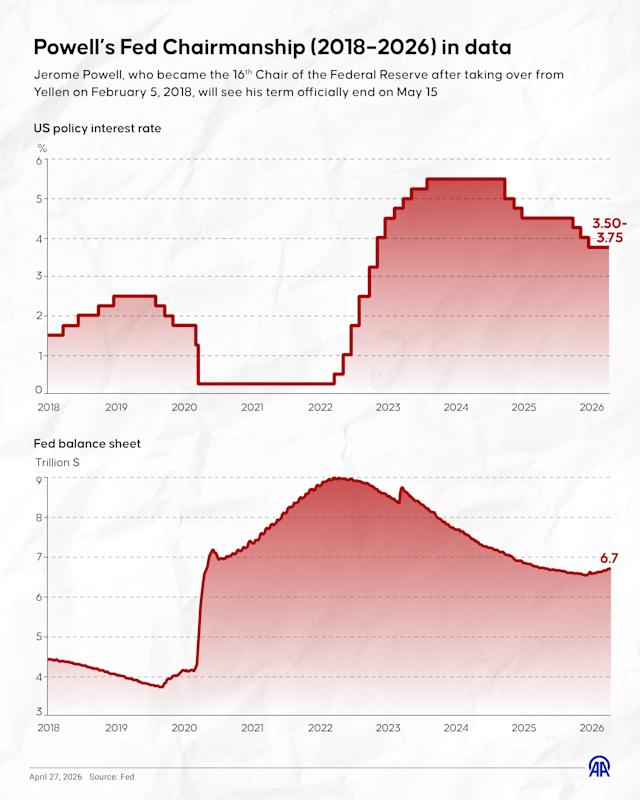
Jerome Powell's final FOMC meeting in April 2026 closed a tumultuous chapter for Federal Reserve leadership, one defined by navigating the pandemic, the biggest inflation surge in decades, and the highest tariffs in over 90 years. His successor inherits an economy where inflation remains stubbornly above target, driven in part by supply-side shocks from the Iran conflict, and where the Fed's independence faces renewed political pressure. The decision to hold rates steady in April was a signal that the new leadership is not ready to declare victory over inflation, even after 75 basis points of cuts in 2025. For savers, this means the window for 5.00% APY and 4%+ CDs will stay open longer than many expected. The banks are effectively doing the Fed's work for them: by keeping deposit rates high, they are maintaining tight financial conditions even without further rate hikes. This dynamic gives the new Fed chair cover to hold rates steady through the summer, watching to see if the inflation data softens before committing to another cut. The risk is that if inflation does not moderate, the Fed will need to resume hiking, a scenario that would push savings rates even higher. For now, the market is pricing a prolonged pause, and the banks are responding by offering consumers a rare chance to earn real returns on cash. The smart money is locking in those rates today.
The critical question for the second half of 2026 is whether the banking sector's bet on prolonged elevated rates proves correct or whether the Fed's next move (likely a cut if inflation eases) will catch deposit rates flat-footed. If the Iran conflict de-escalates and oil prices retreat, the inflation outlook will improve rapidly, giving the Fed room to cut rates by 50 to 75 basis points before year-end. In that scenario, today's 5.00% APY savings accounts and 4%+ CDs will look like peak yields, and consumers who locked in longer-term CDs will have secured a premium over what the market will then offer. Conversely, if inflation remains sticky and the Fed holds steady through 2027, banks will begin to trim savings yields as deposit competition eases, making the current moment the high-water mark for the cycle. Either way, the data is clear: the average saver earning 0.38% at a traditional bank is leaving hundreds of dollars on the table each month, and the gap between the top rate and the average is a measure of both market inefficiency and consumer inertia. The Fed pause has not paused the competition for deposits: it has intensified it, and the winners will be those who act before the window closes. Savers who engage with the top online institutions today will be best positioned regardless of which rate scenario materializes.
The BossBlog Daily
Essential insights on AI, Finance, and Tech. Delivered every morning at 06:00 Asia/Shanghai. No noise.
Unsubscribe anytime. No spam.