
SageOX emerged from stealth Tuesday with a $15 million seed round led by Canaan, unveiling a hardware-and-software system designed to solve the AI agent drift problem that plagues enterprise deployments. The startup, founded by veterans who built AWS EC2 and EBS infrastructure, targets a critical bottleneck: AI agents lose context and memory as they operate, causing them to miss the ongoing discussions, document updates, and Slack threads that define real business workflows. SageOX’s system uses hardware recording devices and integrates with existing enterprise applications (Slack, email, and document repositories) to keep agents continuously in-the-loop. The round also included A.Capital, Pioneer Square Labs, and Founders’ Co-op. The funding arrives alongside a new F5 report showing that 78% of organizations now run AI inference as a core production operation, not an experimental project. AI has left the lab, and the infrastructure to support it is scrambling to catch up. Why this matters now: as inference becomes a standard enterprise workload, the next competitive frontier is not raw model performance but the reliability and context-awareness of the agents that run on top of it.
Where the $15M seed round targets the agent memory gap
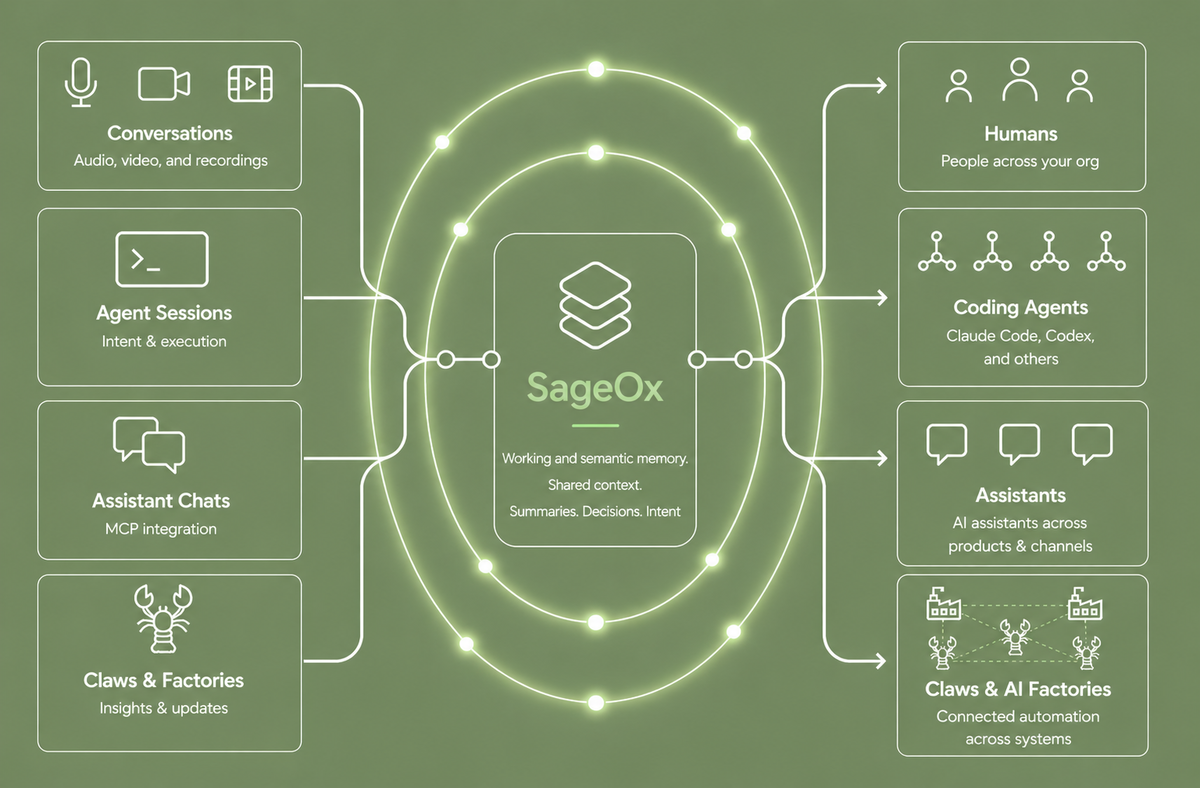
SageOX’s core technical insight is that existing AI agents suffer from a fundamental architectural flaw: they operate in stateless isolation, disconnected from the continuous flow of information inside an enterprise. When an agent is triggered by a user query, it typically has no awareness of the Slack conversation that happened five minutes ago, the email thread that was just updated, or the document revision that was made overnight. This drift causes agents to produce stale, irrelevant, or contradictory outputs. This problem becomes exponentially worse as organizations deploy multiple agents across different teams and functions. SageOX’s solution combines a hardware recording layer that captures ambient workplace activity with software that indexes and structures that data for agent consumption. The system does not require companies to change their existing tool stack; it plugs into Slack, email, and document repositories as passive listeners. For enterprises running inference at scale (and the F5 report confirms that 78% now do), this context infrastructure becomes as essential as the compute infrastructure itself. The F5 data also frames the moment precisely: AI delivery is now a traffic management challenge, while AI security is a governance and control challenge. SageOX’s context layer sits squarely at that intersection. The $15 million seed round will fund product development and early customer deployments, with Ajit Banerjee leading engineering. Canaan’s lead investment signals that venture capital sees agentic context as a distinct category, separate from the model training and inference layers that have dominated AI infrastructure spending to date.
How the money flows through enterprise AI budgets

The $15 million seed round is small relative to the billions flowing into AI model training, but it targets a line item that is growing faster than compute spend: the middleware and orchestration layer for production AI workloads. As enterprises shift from experimental AI to core operations (the F5 report marks this transition as complete for 78% of organizations), the budget allocation is shifting. Companies are discovering that inference costs are only part of the total cost of ownership. The hidden costs include agent maintenance, output validation, context management, and the engineering time required to keep agents aligned with changing business data. SageOX’s pitch to CFOs and CTOs is that its context infrastructure reduces these downstream costs by preventing agent drift before it requires human intervention — and by providing an auditable record of what each agent knew at each decision point. The startup’s founders, having built AWS EC2 and EBS, understand infrastructure economics at scale. They know that the most expensive compute is wasted compute, and a drifting agent that produces incorrect outputs consumes inference cycles, triggers human review, and erodes trust in the entire AI deployment. For the investors (Canaan, A.Capital, Pioneer Square Labs, and Founders’ Co-op), the bet is that context infrastructure will become a standard line item in enterprise AI budgets, much as monitoring and observability tools became mandatory during the cloud migration era.
The competitive reshuffle: who wins and loses as agents get context
The emergence of SageOX’s agentic context infrastructure reshapes the competitive dynamics across several layers of the AI stack. The biggest losers are the AI platform vendors that have treated context as an afterthought. These companies sell agent frameworks that assume stateless, query-response architectures. These platforms will face pressure as enterprise buyers demand agents that maintain persistent awareness of business operations. The winners include the hyperscalers that already own the data and application layers: AWS, Microsoft Azure, and Google Cloud. SageOX’s integration with Slack (owned by Salesforce) and enterprise document repositories positions it as a neutral layer that works across clouds, but the hyperscalers have the distribution advantage. The startup’s AWS heritage gives it credibility with cloud-native enterprises, but it will need to navigate the tension between being platform-agnostic and being absorbed into a larger ecosystem. For Anthropic and xAI, the implications are indirect but significant. Anthropic’s public concerns about AI safety (including worries about the feelings of AI models themselves) create a philosophical alignment with context-aware systems that reduce agent unpredictability. xAI, meanwhile, is pitching its fast and cheap data center build-out as a competitive advantage for its upcoming IPO, but fast compute without reliable context infrastructure produces agents that are fast and wrong. SageOX’s solution addresses the reliability gap that cheap compute alone cannot fix.
Downstream effects on hyperscalers, enterprise buyers, and regulators
The second-order effects of SageOX’s approach ripple through the entire AI supply chain. For hyperscalers building out data center capacity (including xAI’s fast-and-cheap build-out that SpaceX touts as a major advantage), the implication is that raw compute speed is not the only metric that matters. Enterprise buyers deploying inference at scale will evaluate agents on uptime, accuracy, and context retention, not just latency and throughput. This shifts the competitive advantage toward infrastructure providers that can offer integrated context management, potentially driving hyperscalers to acquire or build their own context layers. For enterprise buyers, the 78% figure from the F5 report means that AI inference is now a core operation with the same reliability requirements as databases, payment systems, and customer-facing applications. SageOX’s hardware recording devices introduce a new physical infrastructure requirement: enterprises must deploy on-premises recording hardware to capture ambient workplace activity. This creates a new category of enterprise IT procurement and raises privacy and governance questions that regulators will eventually address. The F5 report already identifies AI security as a governance and control challenge, and context infrastructure that records workplace communications will face scrutiny under data protection regimes like GDPR and CCPA. SageOX’s founders, with their AWS infrastructure pedigree, are betting that the value of context outweighs the compliance burden.
What the SageOX raise signals about the AI market’s next phase
The $15 million seed round and the F5 report’s 78% inference adoption figure together signal that the AI market is entering a new phase: the infrastructure layer is shifting from training to inference, and from inference to reliability. The first wave of AI spending went to GPU clusters, model training, and foundational research. The second wave is going to inference deployment, traffic management, and security (the F5 report frames AI delivery as a traffic management challenge and AI security as a governance challenge). The third wave, which SageOX is betting on, will go to the middleware that makes agents trustworthy in production. This is the same pattern that played out in cloud computing: first the raw compute, then the orchestration, then the observability and management tools. SageOX’s founders built the infrastructure that enabled the cloud era (AWS EC2 and EBS), and they are now building the infrastructure that enables the agent era. The involvement of Canaan, A.Capital, Pioneer Square Labs, and Founders’ Co-op reflects a conviction that agentic context infrastructure will be a standalone category, not a feature of existing platforms. The bet is that enterprises will pay for a dedicated layer that keeps agents honest, just as they paid for dedicated monitoring and security tools during the cloud migration. If SageOX succeeds, it will define a new standard for what production AI requires: not just fast inference, but continuous, reliable context.
The trajectory for SageOX depends on whether agentic context infrastructure becomes a must-have or a nice-to-have as enterprises scale their AI deployments. The F5 report’s 78% figure suggests that inference is already a core operation, and the next logical step is making that inference reliable and context-aware. SageOX’s hardware-and-software approach gives it a defensible moat: building a recording layer that integrates with existing enterprise tools is harder than it sounds, and the AWS infrastructure pedigree of its founders gives it credibility with the CTOs who will make the buying decision. The risk is that hyperscalers or major SaaS platforms build context management as a native feature, compressing SageOX’s market window. But the startup’s timing is strong: enterprise buyers are discovering agent drift now, and they need a solution that works across clouds and applications. The $15 million seed round gives SageOX 12 to 18 months to prove its thesis with early customers. If it succeeds, it will have defined the infrastructure category that makes AI agents actually useful in the messy, continuous reality of enterprise operations. The F5 report also notes that 78% of organizations now treat AI inference as a core operation, meaning the demand for reliable context infrastructure is immediate rather than speculative. SageOX’s hardware recording devices, which capture ambient workplace activity without requiring tool stack changes, give early adopters a concrete path to reducing agent drift today.
The BossBlog Daily
One email with the AI markets brief — the 13F moves, the Congressional trades, and what changed. No fixed schedule and no filler: it goes out when there is something worth sending.
Unsubscribe any time. We never sell or share the list.