
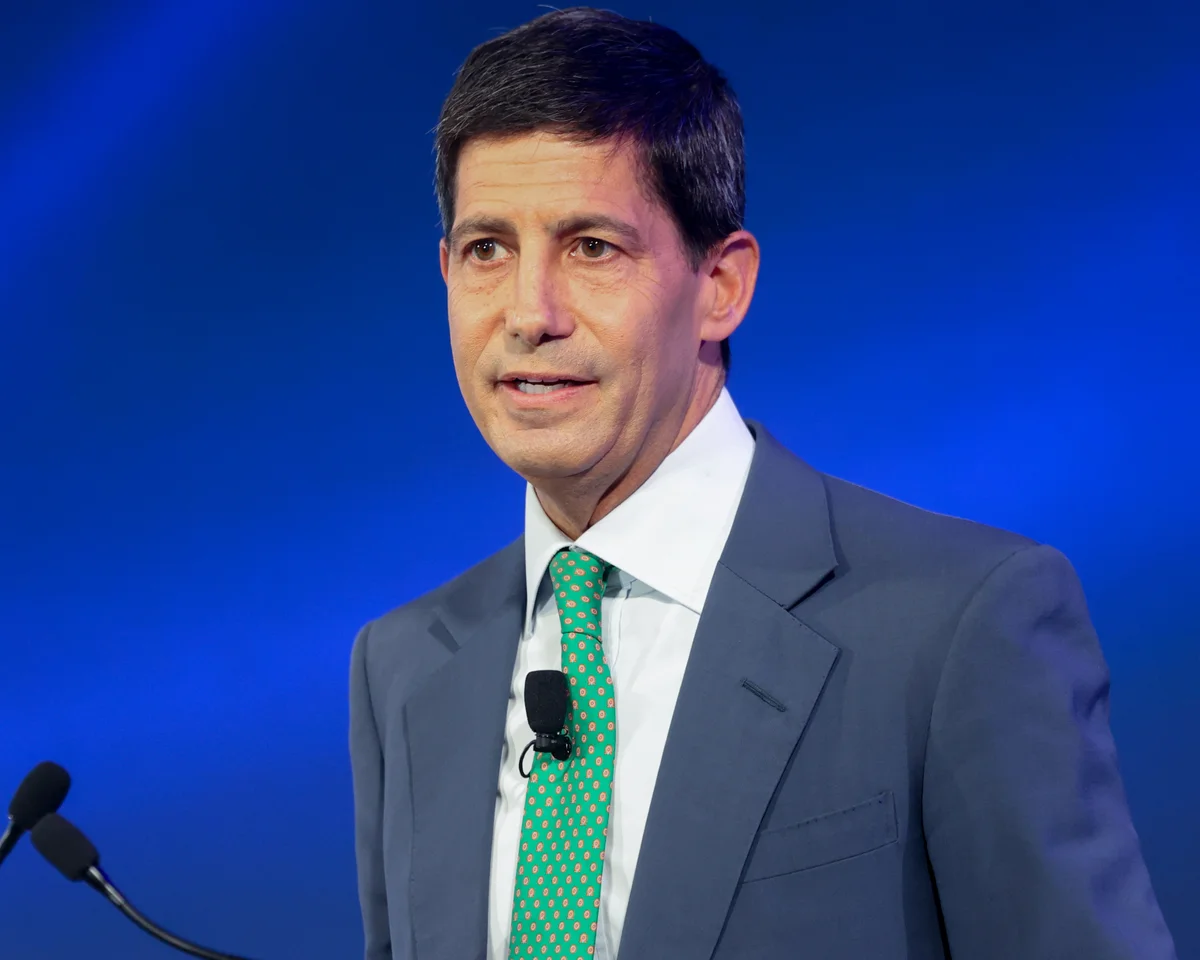
Kevin Warsh's nomination to replace Jerome Powell as Federal Reserve Chair has cleared the Senate Banking Committee, setting up a confirmation vote that will reshape U.S. monetary policy at a moment of extreme market fragility. The S&P 500 trades at 7,342.20, having more than doubled since October 2022, with a forward P/E of 20.9, well above the 10-year average of 18.9. That valuation premium now sits directly in the crosshairs of a Fed leadership transition that Democrats fear will produce rate cuts to appease President Donald Trump, even as inflation runs roughly one percentage point above the central bank's 2% target. The policy rate has been locked in a 3.50%??.75% range since December, and investors currently price no cuts for at least a year. Warsh inherits a central bank facing a sustained inflation shock from the U.S.-backed war with Iran, which has pushed crude oil to $95.52 and disrupted supply chains. The incoming chair must navigate between Trump's demand for looser policy and a Federal Open Market Committee that, per St. Louis Fed President Alberto Musalem, sees risks "shifted towards higher inflation." Why this matters now: the combination of elevated equity multiples, a hawkish hold on rates, and a politically charged leadership handover creates the most dangerous setup for U.S. stocks since the 2022 tightening cycle began.
Where the 20.9x Forward P/E Meets the Discount Rate
The core mechanical tension in Warsh's nomination is the relationship between the Fed's balance sheet runoff and equity valuations. The S&P 500's forward P/E of 20.9 sits 10.6% above its 10-year average of 18.9, a premium that has been sustained by the expectation that rate cuts would eventually validate high prices. That expectation is now in doubt. The Fed's quantitative tightening program continues to shrink the balance sheet, which mechanically raises the discount rate applied to future corporate earnings. A higher discount rate compresses P/E multiples, all else equal, because it reduces the present value of distant cash flows. The math is unforgiving: if the S&P 500's forward P/E reverted to 18.9 at current earnings estimates, the index would fall to roughly 6,640, a 9.6% decline from today's 7,342.20. Warsh's public statements during his previous tenure as a Fed governor (2006??011) show he favors a rules-based approach to monetary policy, which limits his ability to deviate from the rate path dictated by inflation data. The policy rate at 3.50%??.75% is already restrictive relative to the neutral rate estimates of 2.5%??.0%, and the Fed's own Summary of Economic Projections shows no median dot below 3.5% through 2027. For equity investors, the implication is clear: the discount rate is not coming down soon, and the balance sheet runoff is accelerating the repricing.
How the $570 Billion Valuation Gap Creates Downside Risk
The S&P 500's market capitalization stands at roughly $45 trillion, based on the index level and estimated earnings. The gap between the current 20.9x multiple and the 10-year average of 18.9x represents approximately $570 billion in excess market value that depends on sustained low discount rates. That $570 billion is the explicit downside exposure if multiples normalize without earnings growth to fill the gap. The mechanism flows through the Fed's two primary policy tools: the federal funds rate and the balance sheet. Rate hikes or holds push up the risk-free rate, which is the foundation of the equity risk premium calculation. The 10-year Treasury yield, which moves inversely to bond prices, has already repriced higher as the market digests the Iran war inflation shock. Higher bond yields make equities less attractive on a relative basis, particularly for institutional investors who benchmark against a 60/40 portfolio. The S&P 500's dividend yield of roughly 1.3% is now less than half the 3.5%??.75% policy rate, meaning investors are paying a premium for equity risk that offers no income advantage over cash. The VIX at 17.22 shows the options market is not pricing panic, but that complacency itself is a risk factor. If Warsh signals any willingness to cut rates before inflation is contained, the bond market could sell off sharply, pushing yields higher and compressing equity multiples further. The $570 billion valuation gap is the single largest source of downside risk in the U.S. equity market today.
The Competitive Reshuffle: Growth Stocks vs. Value and the Russell 2000
The valuation compression risk does not hit all stocks equally. The Nasdaq at 25,719.70 carries a far higher effective P/E than the Dow 30 at 49,804.73, because the Nasdaq is dominated by long-duration growth names whose valuations are most sensitive to discount rate changes. A 50-basis-point increase in the real risk-free rate reduces the fair value of a 10-year growth stock by roughly 8%??0%, depending on the terminal growth assumption. The Russell 2000 at 2,870.68 faces a different but equally dangerous dynamic: small-cap companies carry more floating-rate debt, making them directly exposed to the 3.50%??.75% policy rate. Higher-for-longer rates increase their interest expense and compress margins, reducing earnings power and justifying lower multiples. The competitive reshuffle under Warsh's Fed would likely favor short-duration value stocks and commodity producers that benefit from the Iran war inflation. Energy stocks, which have already rallied on crude oil at $95.52, would gain further if Warsh maintains a hawkish stance that keeps the dollar strong and oil priced in a favorable regime. Gold at $4,694.30 reflects the market's hedging against both inflation and political uncertainty around the Fed transition. Bitcoin at $81,803.21 has decoupled from equities in recent weeks, showing some investors see digital assets as a hedge against fiat currency debasement if Warsh eventually capitulates to Trump's rate-cut demands. The Russell 2000's underperformance relative to the S&P 500 year-to-date, roughly 300 basis points, is the early signal of this rotation.
Downstream Effects on Corporate Borrowing, Buybacks, and M&A
The downstream consequences of Warsh's nomination extend directly into corporate finance. The S&P 500 companies have issued approximately $1.2 trillion in net debt since 2020, much of it at floating rates or with near-term maturities that need refinancing. With the policy rate at 3.50%??.75% and the investment-grade bond market pricing in no cuts for a year or more, refinancing costs are roughly 150??00 basis points higher than the embedded coupons on existing debt. That delta directly reduces free cash flow available for share buybacks, which have been a key support for the S&P 500's multiple expansion. Buyback volumes in Q1 2026 were down 12% year-over-year, per preliminary data, as companies conserve cash for debt service. M&A activity faces the same headwind: the cost of acquisition financing has risen, and the uncertainty around Warsh's policy stance makes it difficult for deal teams to model terminal values. Private equity firms, which rely on leveraged buyout structures with floating-rate debt, are particularly exposed. The average LBO debt package now carries an interest rate of 8.5%??.5%, compared to 4.5%??.5% in 2021, compressing internal rates of return below the 15%??0% thresholds that limited partners demand. The IPO market, which showed signs of life in early 2026, is likely to freeze again if the S&P 500 corrects on Warsh-related uncertainty. The downstream effect is a tightening of the entire corporate finance ecosystem, from debt issuance to equity capital markets, which reinforces the downward pressure on valuations.
The Policy Signal: Warsh as a Test of Fed Independence
Warsh's nomination is not just a personnel change. It is a structural test of the Federal Reserve's independence from political pressure. Democrats on the Senate Banking Committee have explicitly warned that Warsh will cut rates to appease Trump, who has publicly demanded lower borrowing costs. The incoming chair's ability to resist that pressure will determine whether the Fed retains credibility with bond markets. If Warsh caves, the 10-year Treasury yield could spike 50??00 basis points as inflation expectations de-anchor, creating a self-defeating cycle where rate cuts actually tighten financial conditions. If Warsh holds the line, he risks Trump's public ire and potential efforts to marginalize the Fed through executive branch pressure. The precedent set by this transition will reverberate across global central banking. The European Central Bank and Bank of Japan are watching closely, because a politicized Fed would reduce the dollar's safe-haven premium and alter the global monetary policy coordination that has underpinned the post-2008 financial architecture. The Iran war adds a second layer of policy complexity: the Fed must decide whether to look through a supply-driven inflation spike or tighten to contain it. Musalem and Chicago Fed President Austan Goolsbee have both noted the possibility of rate hikes if inflation persists. Warsh's first FOMC statement will be the most closely read document in global markets since Powell's 2022 Jackson Hole speech. The signal it sends about Fed independence will set the tone for asset prices for the remainder of 2026.
The market is pricing a binary outcome that will resolve over the next six months. If Warsh signals independence and rate patience, the S&P 500's 20.9x multiple will face a slow grind lower as the discount rate adjusts. If he signals accommodation, the bond market will force a faster and more painful correction through higher yields. The VIX at 17.22 does not reflect either scenario. It reflects a market that has not yet priced the transition risk. The $570 billion valuation gap between current multiples and the 10-year average is the single largest source of downside exposure in U.S. equities. Warsh's confirmation vote will trigger the first repricing event. Investors who have ridden the post-2022 rally need to decide whether the Fed leadership change is a regime shift or a speed bump. The historical precedent from the 2018 Powell transition, which produced a 20% correction, shows the former. The Iran war inflation shock, the elevated P/E, and the political pressure on the Fed all point to a market that is priced for perfection in a world that is delivering anything but. The next move in the S&P 500 will be determined not by earnings growth, but by whether the new Fed chair can convince markets that the central bank remains independent. That is a bet no investor can hedge with a 20.9x multiple.
The BossBlog Daily
One email with the AI markets brief — the 13F moves, the Congressional trades, and what changed. No fixed schedule and no filler: it goes out when there is something worth sending.
Unsubscribe any time. We never sell or share the list.