
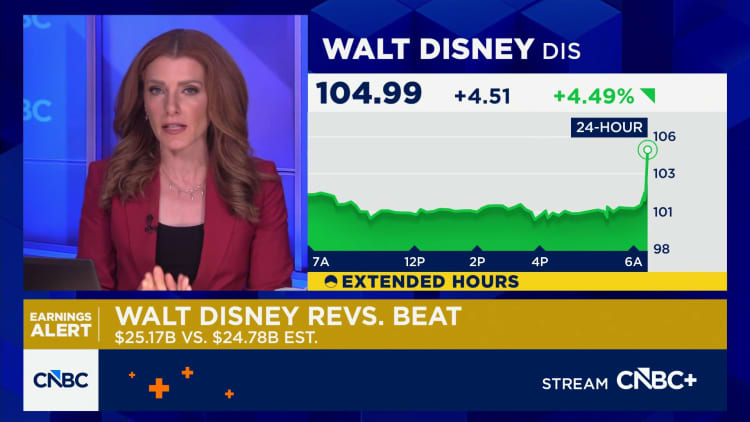
The Walt Disney Company delivered a decisive earnings beat in its first quarterly report under new CEO Josh D'Amaro, posting $25.17 billion in revenue for the fiscal second quarter, up 7% year-over-year and above the $24.78 billion consensus estimate compiled by LSEG. Adjusted earnings per share of $1.57 topped the $1.50 analyst forecast, even as net income fell 31% to $2.25 billion on a higher tax bill. The headline number that captured the market's attention was streaming: operating income from Disney+ and Hulu surged 88% to $582 million, pushing the entertainment streaming operating margin to 10.6%, the first double-digit quarter for the segment. Shares jumped roughly 7% in early trading as investors rewarded a clean beat across revenue, profit, and forward guidance. The report marks the first public test of D'Amaro, who succeeded Bob Iger on March 18 and has signaled continuity with the former CEO's strategic direction. With consumer spending proving resilient despite a national average gas price of $4.54 per gallon and ongoing geopolitical tensions, Disney's results offer a critical signal about the health of the American consumer and the durability of the streaming turnaround thesis.
The $582 million streaming profit breakdown

The streaming turnaround that Bob Iger set in motion is now producing hard numbers. Disney+ and Hulu generated $5.49 billion in revenue during the quarter, up 13% year-over-year, while operating income soared 88% to $582 million. That translated to a 10.6% operating margin for the entertainment streaming segment, a milestone that puts Disney on a trajectory toward sustainable profitability after years of heavy investment. The improvement came from a combination of higher average revenue per user, reduced content spending on unprofitable titles, and the integration of Hulu into the Disney+ platform, which lowered customer acquisition and retention costs. Disney no longer reports subscriber numbers, a shift that allows management to focus on revenue and profit rather than the quarterly churn drama that once dominated earnings calls. The streaming segment now includes the ESPN direct-to-consumer app, which is benefiting from the NFL Network partnership and helped offset continued declines in the traditional TV bundle. CFO Hugh Johnston told analysts that the operating income beat exceeded the company's own prior guidance, reflecting better-than-expected ad revenue and lower churn. The $582 million figure is not a one-time artifact. The company expects streaming margins to expand further as the content slate strengthens with upcoming releases like "The Mandalorian & Grogu" and "Toy Story 5." The segment's revenue growth also came from higher pricing on ad-supported tiers and improved retention among annual subscribers. Disney no longer breaks out subscriber counts, allowing management to frame the business entirely on profitability metrics rather than raw user growth.
How the $8 billion buyback changes capital allocation
Disney's board authorized at least $8 billion in share repurchases for fiscal 2026, up from the $7 billion target set earlier in the year, a $1 billion increase that underscores management's confidence in the earnings trajectory. That is a significant capital allocation signal: the company is betting that its stock remains undervalued relative to the earnings trajectory it sees ahead. With adjusted EPS growing roughly 12% this fiscal year (excluding the benefit of a 53rd week) and double-digit growth expected again in fiscal 2027, the buyback math works in Disney's favor. At current valuations, $8 billion in repurchases would reduce the share count by roughly 3% to 4%, compounding per-share earnings growth for remaining holders. The buyback also serves as a confidence signal to a market that has been skeptical about Disney's ability to sustain its streaming turnaround while managing the capital intensity of its parks and content businesses. The company generated $2.47 billion in net income during the quarter, down from $3.4 billion a year earlier, but operating cash flow remains healthy enough to support both the buyback and continued investment in the experiences segment. For investors, the $8 billion target replaces the old debate about whether Disney should prioritize debt reduction or dividends with a clear answer: the company sees its own stock as the best use of excess capital. The buyback also reduces the share count, which boosts EPS growth even if net income remains flat.
Winners and losers in the streaming reshuffle
Disney's streaming profit surge reshapes the competitive landscape in two ways. First, it validates the bundling strategy that Iger pushed through, combining Disney+, Hulu, and ESPN+ into a single offering that reduces churn and increases average revenue per user. That puts pressure on Netflix, which has no live sports or linear TV assets, and on Warner Bros. Discovery and Paramount, which are still burning cash on their streaming operations. Disney's 10.6% streaming margin compares favorably to Netflix's roughly 20% margin, but Disney is growing from a lower base and has more levers to pull, including theme park cross-promotion and theatrical windowing. Second, the ESPN direct-to-consumer app is now a meaningful contributor to streaming revenue, which threatens traditional cable operators and sports leagues that depend on the linear bundle. The NFL Network partnership gives Disney a differentiated live sports product that competitors like Peacock and Apple TV+ cannot easily replicate. On the losing side, traditional TV networks continue to bleed: Disney's linear networks segment saw operating income decline as cord-cutting accelerated. The company laid off 1,000 employees in April, primarily in marketing and distribution roles tied to the legacy TV business. For investors, the message is clear: Disney is willing to cannibalize its own linear profits to win in streaming, and the Q2 numbers suggest that bet is paying off.
What the parks data reveals about consumer resilience
Disney's experiences segment, which includes theme parks, cruise lines, and consumer products, generated nearly $9.5 billion in revenue, up 7% year-over-year, even as domestic park attendance declined 1%. Global attendance grew 2%, driven by international parks, but the domestic dip is notable given that Disney raised ticket prices and introduced dynamic pricing during the quarter. The revenue growth despite lower foot traffic means per-capita spending increased, driven by higher-priced tickets, Genie+ and Lightning Lane purchases, and food and beverage sales. CFO Hugh Johnston told analysts that bookings for the second half of the fiscal year are "quite strong," suggesting that the attendance softness is not a demand problem but a capacity and pricing optimization. The resilience of Disney's parks business mirrors what Uber CEO Dara Khosrowshahi described on his own earnings call: "consumers are spending... we don't see any signs of that weakening." Uber's delivery revenue jumped 34% to $5.07 billion and ride-hailing revenue rose 5% to $6.8 billion, both signs that the American consumer is absorbing higher gas prices, with the national average hitting $4.54 per gallon, up 52% since the war began, without cutting discretionary spending. For Disney, the parks data matters because the experiences segment is the company's largest profit center and the primary cash generator funding the streaming investment. If consumer spending holds, Disney can continue to invest in new attractions, cruise ships, and international park expansions without tapping debt markets. The parks segment also benefits from higher spending on merchandise and food per guest visit.
D'Amaro's first report signals continuity and confidence
Josh D'Amaro's first earnings call as CEO was notable for what it did not contain: any major strategic departure from Bob Iger's playbook. D'Amaro, who previously ran the parks division, emphasized continuity in the streaming turnaround, the capital allocation framework, and the focus on cost efficiency. The 1,000-person layoff in April was positioned as a normal course of business optimization rather than a restructuring. The forward guidance, which includes Q3 total segment operating income of approximately $5.3 billion, up 16% year-over-year, and fiscal 2026 adjusted EPS growth of roughly 12%, suggests management sees no reason to reset expectations. The ESPN direct-to-consumer app now sits at the center of Disney's streaming expansion plan, with the service broadening its content offering beyond live sports to drive subscriber retention across all tiers. Disney's entertainment segment, which houses both streaming and the traditional TV networks, saw improved operating leverage as fixed content costs are spread over a larger revenue base. The bigger strategic signal is the decision to lean into the theatrical window as a streaming feeder system. Disney called out the strong box office performance of "The Devil Wears Prada 2" and positioned upcoming releases like "The Mandalorian & Grogu" and "Toy Story 5" as catalysts for both theatrical revenue and streaming subscriber engagement. That is a bet that the theatrical recovery is durable and that Disney's IP library remains the most valuable in Hollywood. For regulators and competitors, D'Amaro's continuity message is a statement of intent: Disney is not retreating from streaming, it is not selling ESPN, and it is not breaking up the company. The strategy is working, and the Q2 numbers give D'Amaro the credibility to stay the course.
The next catalyst for Disney stock will be the Q3 report, where management expects segment operating income of $5.3 billion, a 16% year-over-year increase that would validate the streaming margin trajectory and confirm that parks demand is not softening. The $8 billion buyback target gives the stock a floor, but the upside depends on whether Disney can sustain double-digit earnings growth into fiscal 2027 without another round of heavy content investment. The wild card is the upcoming movie slate: "The Mandalorian & Grogu" and "Toy Story 5" are high-probability hits, but Disney's theatrical pipeline beyond those titles is thinner than it was during the Marvel peak years. On the streaming side, the challenge is to push the operating margin from 10.6% toward Netflix's 20% level without alienating subscribers through price increases or ad loads. D'Amaro has the benefit of a clean first quarter and a market that wants to believe the turnaround is real. CFO Hugh Johnston's comment that second-half bookings are "quite strong" adds weight to the fiscal 2027 double-digit growth target. The question for the second half of fiscal 2026 is whether the consumer holds up, the content delivers, and the streaming margin expands, all three of which are required for Disney to trade back toward its historical multiple.
The BossBlog Daily
One email with the AI markets brief — the 13F moves, the Congressional trades, and what changed. No fixed schedule and no filler: it goes out when there is something worth sending.
Unsubscribe any time. We never sell or share the list.