
The Senate Banking Committee advanced Kevin Warsh's nomination to chair the Federal Reserve on Wednesday by a 13-11 party-line vote, the first time in committee history that a Fed chair nominee has cleared the panel without a single vote from the minority. The outcome, expected but still historically significant, sets up a full Senate floor vote in the week of May 11, with Warsh on track to be sworn in before Jerome Powell's term expires on May 15. In a single afternoon, a series of interlinked events compressed what had been a weeks-long political standoff into a crisp ledger of institutional pressure and counter-pressure: a resurrected DOJ probe, a senator's strategic capitulation, and the most divided FOMC vote in thirty-three years. What the committee approved was not merely a nomination. It was the first operational diagram of what a partisan central bank succession looks like at the level of raw procedure.
The 13-11 Arithmetic and What It Exposes About Fed Independence
The vote split cleanly along party affiliation: all 13 Republicans on the Banking Committee supported Warsh; all 11 Democrats opposed. That unanimity in both directions is itself newsworthy. Previous Fed chair confirmations produced bipartisan majorities, with Janet Yellen clearing committee 14-8 in 2014, Ben Bernanke 16-7 in 2010, and Paul Volcker, in a different era, confirmed by voice vote. The partisan crystallization of Warsh's nomination reflects a broader hardening of monetary policy as an explicit political stake rather than a technocratic appointment most members treat as above the fray.
Democrats' objections centred on two lines of attack. Sen. Elizabeth Warren argued publicly that Warsh's confirmation would erode the institutional independence the Fed has maintained as a practical condition of its inflation-fighting credibility. She flagged the DOJ episode as a precedent-setting demonstration that the executive branch is willing to wield the threat of criminal investigation to reshape the Fed's board composition. Her argument was not that Warsh is unqualified (he served as a Fed governor from 2006 to 2011 and was at the table during the 2008 financial crisis) but that the selection process itself had been corrupted by explicit political leverage.
Republicans countered that Warsh's skepticism of the Fed's post-2020 communication framework is a substantive policy improvement, not an ideological deviation. Sen. Tim Scott argued that Warsh's call for a return to strict 2% inflation targeting reflects the kind of clear mandate the Fed needs to recover credibility lost during the 2021-2022 inflation surge. For Republican members, the 13-0 intra-party alignment was a statement that monetary policy reform is party policy, not personal preference.
The DOJ Renovation Probe and Sen. Tillis's Calibrated Reversal
The most operationally important subplot in Wednesday's timeline was not the vote count but the mechanism that made it possible. Sen. Thom Tillis, Republican of North Carolina, had placed a hold on Warsh's nomination in late March after the Department of Justice opened a criminal investigation into Federal Reserve Chair Jerome Powell over cost overruns in the renovation of the Fed's main building in Washington. Tillis's stated position was that the probe was being used as political pressure against an independent Fed chair, and that he would not advance a successor nomination while a sitting chair faced what he characterized as a politically motivated criminal case.
The DOJ agreed last week to drop the probe, contingent on the Fed's inspector general not independently recommending criminal referral. With that assurance in writing, Tillis reversed his position and voted with the Republican majority. The sequence matters because it illustrates how a Senate hold (a procedural instrument that requires only one senator to block) can be deployed as a bargaining chip against the executive branch on an institutional governance question. Tillis extracted a specific outcome: the DOJ shelved a politically uncomfortable investigation. Whether that outcome represents judicial integrity or political accommodation depends on which interpretation of the probe one accepts, and there is currently no public evidence suggesting the renovation cost overruns would have generated charges in the absence of political motivation.
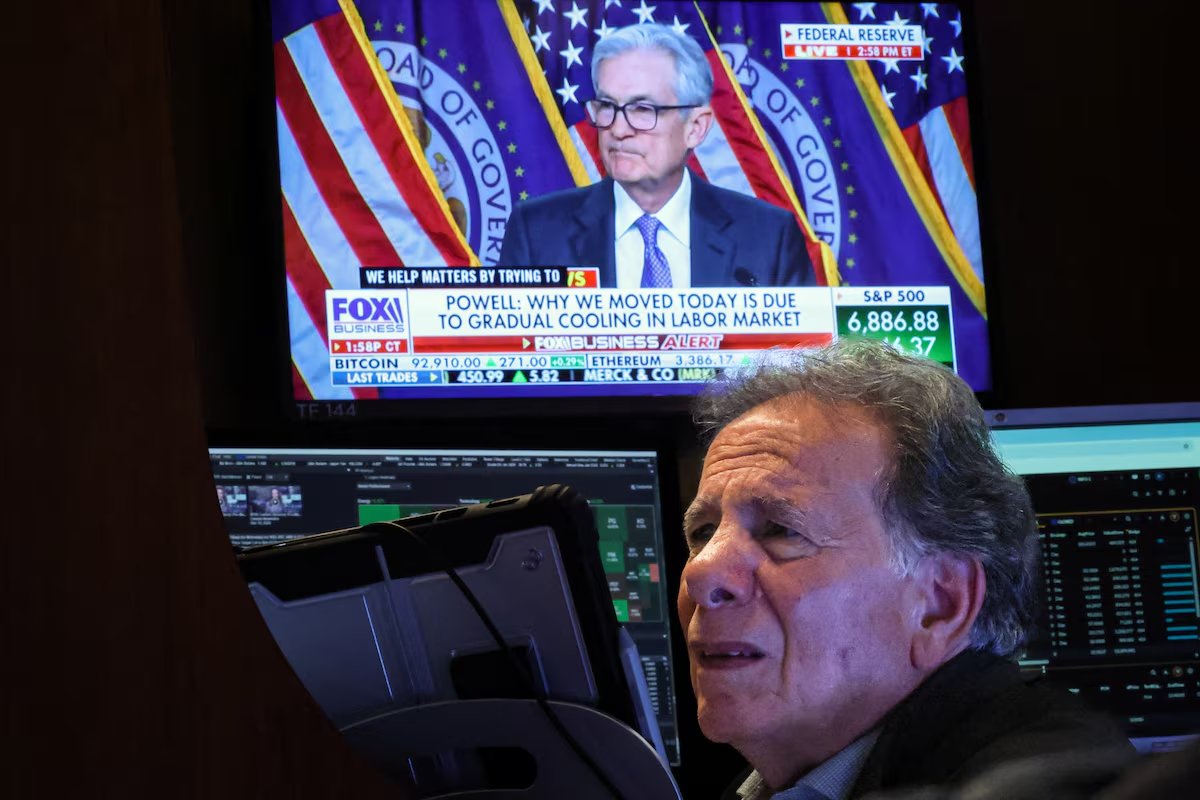
Powell, for his part, announced Wednesday that he would remain on the Federal Reserve's Board of Governors as a governor "for a period of time to be determined" after relinquishing the chair role on May 15. That decision has practical ramifications: it prevents the Trump administration from immediately filling his board seat with a second loyalist appointment, effectively maintaining a procedural buffer against a rapid ideological sweep of the Fed's seven-member board. Powell serving as governor would give him a formal vote on FOMC decisions under Warsh's leadership, an unusual arrangement with no direct post-war precedent at the Fed.
Four FOMC Dissents, the Most Since October 1992
The committee vote happened to coincide with the Federal Reserve's April 29 interest rate decision, which held the federal funds rate at 3.50% to 3.75%. What made the meeting extraordinary was the dissent count: four FOMC members broke from the majority position, the highest number since October 1992. Three reserve bank presidents (Beth Hammack of Cleveland, Neel Kashkari of Minneapolis, and Lorie Logan of Dallas) dissented in the hawkish direction, objecting to language in the policy statement that implied the committee's next move would be a rate cut. One member, Stephen Miran of the New York Fed, dissented dovishly, preferring an immediate 25-basis-point reduction.
The hawkish dissents carry particular analytical weight. Hammack, Kashkari, and Logan argued explicitly that the underlying inflation trajectory has reset higher, with core and headline PCE both running above 3% at a point when the Fed has been on hold for over two consecutive quarters. In their view, language that frames a cut as the most likely next policy direction is credibility-damaging when the data does not support that framing. Their dissent was not about the hold decision itself (all four agreed rates should remain unchanged) but about the communicative direction the policy statement sends to markets.
The CME FedWatch tool currently assigns a 99% probability to the Fed staying at 3.50% to 3.75% through its next several meetings. More striking is a developing tail in the pricing: traders are now assigning roughly a one-in-three probability of a rate hike materializing by April 2027, a scenario that would have been considered outlier positioning as recently as eight weeks ago. That shift reflects the combination of energy-driven PCE acceleration (headline PCE jumped 0.7% in March alone, driven by an 11.6% surge in energy goods) and a first-quarter GDP print of 2.0% that, while below the 2.2% consensus, does not provide the growth-scare justification for emergency easing.
What Warsh's "Regime Change" Actually Means for the Borrowing Cost Calculus
Kevin Warsh has been unusually direct about his plans for the institution he is about to lead. He used the phrase "regime change" at his April 21 Senate Banking Committee confirmation hearing, framing it as a description of what he sees as a necessary institutional reset rather than a political program. The specific policy content of that phrase is more important than the language itself.
On the inflation framework, Warsh has called for abandoning the Fed's 2020 shift to flexible average inflation targeting (FAIT), under which the committee committed to allowing inflation to run above 2% for a period after undershooting, in order to anchor long-run expectations at the target. Warsh's position is that FAIT was the proximate cause of the 2021-2022 inflation overshoot, since the Fed waited too long to tighten because its policy framework explicitly instructed patience with above-target readings. He favors a return to a point-target framework in which 2% is treated as a ceiling rather than a midpoint in a range.
On rates, Warsh has been more conditional. He has said publicly that he would move to cut rates quickly if the inflation data allows, and he has explicitly denied receiving any private commitment to the Trump White House on rate timing. "Quickly if the data allows" is doing a great deal of work in a monetary environment where core PCE is running at 3.2% annually, headline PCE hit 3.5% in March on the back of oil, and the Fed's own staff projections now assign meaningful probability to 4%-plus inflation by the third quarter if Brent crude stays elevated. The three hawkish FOMC dissents signal that the internal opposition to premature easing is organized and will not be simply overridden by a new chair's preference.
The Balance Sheet Endgame and the 2% Credibility Test
The rate path gets most of the market attention, but the balance sheet question will structurally define Warsh's Fed more than any single meeting decision. The Fed's balance sheet peaked at roughly $9 trillion in 2022 and has declined to approximately $6.7 trillion under the quantitative tightening program that began that year. Warsh has signaled he favors accelerating the drawdown, pushing toward a balance sheet more consistent with pre-2008 norms relative to nominal GDP.
The mechanism matters for financial conditions beyond the federal funds rate. Quantitative tightening removes reserves from the banking system and tends to put upward pressure on term premiums ??the compensation investors demand for holding longer-duration Treasuries. The 10-year Treasury yield at 4.39% on Thursday morning reflects both the current rate hold and some expectation of limited QT acceleration. A faster balance sheet runoff under Warsh, combined with a firm 2% point target, would structurally push long-term yields higher even without a single hike in the fed funds rate.
That configuration would matter acutely for mortgage markets. The 30-year fixed mortgage rate hit 6.432% on April 30, already elevated by the Iran war oil shock's transmission into inflation expectations. If 10-year yields rise an additional 30 to 50 basis points on balance sheet acceleration, mortgage rates would follow into the 6.7% to 7.0% range, a level at which the already distorted housing market would face a fresh affordability shock at the exact moment spring buying season is underway.
The 80% of U.S. mortgage holders currently locked below 6% represents a frozen inventory problem: those homeowners will not list unless the replacement rate creates acceptable terms. Higher QT-driven yields would extend that freeze, constraining housing supply precisely when new household formation is absorbing available inventory. The downstream consequence is a layered demand drag tied to energy and housing simultaneously, which is exactly the macro scenario the Hammack-Kashkari-Logan dissent is pre-positioning against.
Whatever rate decisions Warsh makes in his first months, the inherited inflation problem he faces is structural and co-authored by policy choices extending across multiple administrations. Inflation has run above the Fed's 2% target for six consecutive years. Restoring a 2% terminal state while navigating a war-driven energy shock, a frozen housing market, and an economy in an election-cycle political context is not a technical exercise that a regime-change mantra will resolve. The committee of twelve that Warsh will chair beginning May 15 already contains at least three members prepared to use their formal FOMC votes to resist any relaxation of anti-inflation discipline. That internal constraint is, paradoxically, the strongest available guarantee that the Fed's credibility will survive the transition.
The BossBlog Daily
One email with the AI markets brief — the 13F moves, the Congressional trades, and what changed. No fixed schedule and no filler: it goes out when there is something worth sending.
Unsubscribe any time. We never sell or share the list.