OpenAI's financial trajectory hit a significant speed bump on April 28 when the Wall Street Journal reported the company missed its own internal projections for revenue and weekly active users during the first months of 2026. The immediate market reaction was severe: Oracle, the company sitting atop a $300 billion, five-year computing partnership with OpenAI, dropped 4%. Chipmakers Broadcom, AMD, Nvidia, and CoreWeave fell between 1% and more than 5%. SoftBank Group, one of OpenAI's largest investors, sank roughly 10%. The message from markets was direct — if OpenAI's growth engine is sputtering, the entire AI infrastructure trade needs repricing.
OpenAI's response arrived within hours. CEO Sam Altman and CFO Sarah Friar issued a joint statement calling the WSJ reporting "ridiculous" and insisting both the consumer and enterprise divisions are "firing on all cylinders." The defiant pushback did little to arrest the sell-off, which revealed how thinly the AI infrastructure bull case rests on OpenAI's assumed growth trajectory. This is not a small company managing its narrative — OpenAI closed a $122 billion funding round at an $852 billion post-money valuation just weeks ago. A growth stumble at this valuation is a structural event, not a quarterly wobble.
Why the WAU Miss Signals More Than a Slow Quarter
The internal target OpenAI reportedly failed to hit was a milestone of one billion weekly active ChatGPT users by year's end. The company also missed monthly revenue goals on multiple occasions in early 2026, with competition from both Anthropic's enterprise push and Google Gemini's expanding market share eating into what had been a near-monopoly on consumer AI interaction.
That detail matters: OpenAI is not being squeezed only at the margin. Anthropic has built an enterprise sales motion on Claude's coding performance — Anthropic reached $30 billion in annualized revenue run-rate this month, a number that would have seemed implausible two years ago. Gemini's integration into Google Workspace, combined with Google's massive existing enterprise relationships, is converting at rates that predate any significant OpenAI enterprise sales effort. The competitive dynamics that Wall Street assumed would remain favorable for three to five years are converging within 12 months.
Finance chief Friar added a harder edge to the picture. She raised concerns internally about OpenAI's ability to fund future compute agreements if revenue growth does not accelerate. The board began scrutinizing computing deals, a sign that the informal assumption — that AI revenue would scale to meet compute commitments — is no longer considered self-evident. OpenAI's compute obligations are staggering: a $300 billion, five-year contract with Oracle for data center capacity; an expanded $138 billion agreement with Amazon's AWS; Nvidia pledges of billions more in GPU supply. The mathematics of servicing this capex stack require revenue growth rates that the WSJ report suggests have not materialized.
The Oracle Position: $300 Billion Bet With a Wobbling Anchor
Oracle CEO Larry Ellison and the company issued a statement defending OpenAI's growth trajectory, arguing the partnership remains on track and that demand for OpenAI's models continues to grow. The defense did not stop Oracle shares from shedding 4%, a decline significant enough to constitute one of Oracle's larger single-day moves this year.
Oracle's vulnerability to OpenAI's financial health is structural. The $300 billion five-year deal is predicated on OpenAI continuing to require massive centralized compute at a time when model efficiency gains are compressing per-token costs faster than demand grows. OpenAI's compute use per query is falling — GPT-5.5, released April 23, runs inference at a fraction of the cost of its predecessors. If OpenAI's revenue is missing targets while its compute efficiency improves, the utilization of Oracle's data center infrastructure will be lower than projected. Oracle shareholders are not just exposed to OpenAI's revenue — they are exposed to the assumption that AI compute demand is bottomless and price-inelastic.
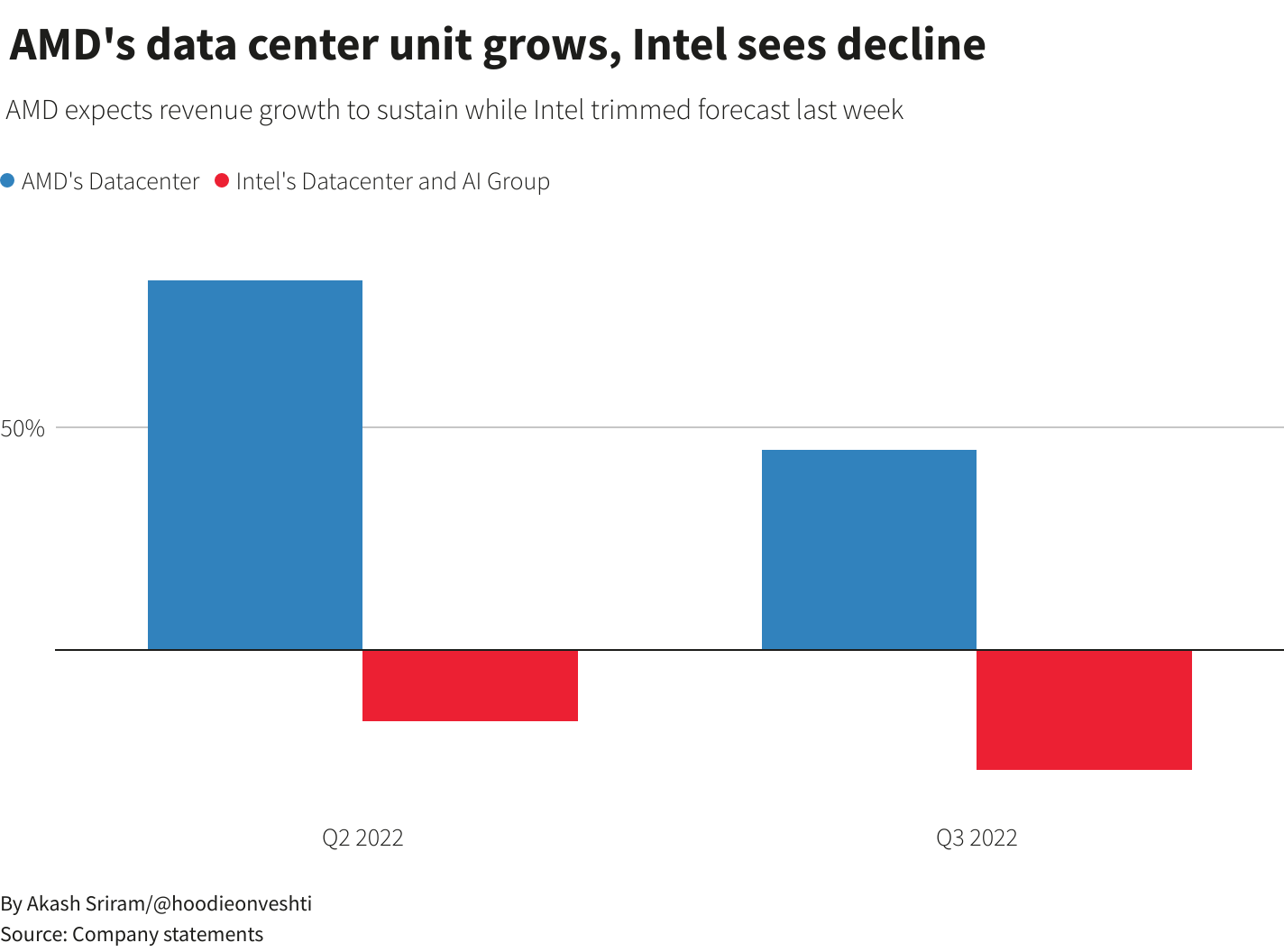
Broadcom, which supplies custom AI accelerator chips and networking for hyperscale data centers, fell 4% on the same logic. AMD dropped 3%, and Nvidia gave up more than 1% — meaningful for a company trading at the high end of its valuation range. CoreWeave, the AI cloud provider that recently went public with its own OpenAI-dependent revenue base, dropped more than 5%, the sharpest reaction in the cohort.
Anthropic's Gains and the Enterprise Margin Compression Story
OpenAI's revenue shortfall is not a standalone failure — it is a signal of a market structure shift that benefits Anthropic and to a lesser extent Google, while pressuring the incumbents and infrastructure providers who bet on OpenAI as the permanent leader.
Anthropic's advance in coding workloads has been the most consequential competitive move of 2026. Claude's performance on software development tasks drove enterprise sales at a pace that surprised even Anthropic's own projections. The $30 billion annualized revenue rate Anthropic reported this month was not built on consumer chatbot adoption — it was built on enterprise developers paying for API access and integrated coding tools. OpenAI's Codex and GPT-5.5 have not matched Claude's enterprise stickiness in those deployments, and the failure to do so is the proximate driver of the revenue miss.
The broader implication is that AI foundation model revenue is not winner-take-all at the application layer. Three vendors — OpenAI, Anthropic, and Google — can all achieve material revenue simultaneously, which changes the unit economics of the infrastructure plays that assumed a single dominant buyer would sustain demand at non-competitive pricing.
SoftBank, CoreWeave, and the Infrastructure Trade Repricing
The 10% single-day decline in SoftBank Group shares tells the most concentrated story about how the AI infrastructure trade is unwinding from OpenAI-centric assumptions. SoftBank's Vision Fund and direct holdings represent one of the largest exposures to OpenAI's equity upside globally. If OpenAI's revenue trajectory has stalled relative to targets, the private market valuation that underpins SoftBank's balance sheet carries a similar question mark — and SoftBank has been reporting its own Vision Fund performance partly on the basis of OpenAI's assumed valuation stability.
CoreWeave's more-than-5% drop is structurally meaningful. The company went public earlier in 2026 largely on the strength of its OpenAI revenue base — OpenAI is its anchor customer, and CoreWeave's capacity commitments were sized to serve OpenAI's projected compute growth. If that growth is slower than OpenAI's internal models assumed, CoreWeave's utilization rates fall below the underwriting assumptions in its IPO prospectus. Unlike Oracle, which has diversified across enterprise cloud, CoreWeave's business is narrowly concentrated. A sustained OpenAI revenue miss feeds directly into CoreWeave's forward bookings.
Broadcom's 4% decline reflects a parallel concern in the custom silicon market. The company has been building AI accelerator chips designed around specific training and inference architectures, with customer concentrations that include the large frontier model labs. Slower OpenAI revenue growth implies slower OpenAI model scaling, which implies slower demand for Broadcom's custom ASIC programs. Nvidia, the most diversified of the AI chip names, shed only 1% — a sign that market participants see Nvidia's broad demand base as insulation against any single customer's deceleration.
IPO Implications: The $852 Billion Question
OpenAI has been moving toward an initial public offering throughout 2026. The company's most recent funding round established an $852 billion post-money valuation — a number that requires extraordinary growth projections to justify at any reasonable earnings multiple. A revenue miss ahead of IPO filings is the kind of disclosure event that reprices a company's expected valuation range before the roadshow begins.
The joint statement from Altman and Friar calling the WSJ report "ridiculous" carries a specific legal weight: any material mischaracterization of the company's financial trajectory, made in public while preparing for a public offering, creates liability. That the statement was both unequivocal and quickly issued suggests OpenAI's legal and communications teams assessed the risk of silence as higher than the risk of strong denial.
What OpenAI's IPO bankers now must manage is the gap between public denial and investor perception. The stock sell-off that followed — across Oracle, SoftBank, Broadcom, and CoreWeave — is the market assigning probability that the WSJ account is at least directionally accurate. No IPO roadshow can ignore what publicly traded partners priced into their shares on the same day management called the report false.
The real question OpenAI faces heading into the second half of 2026 is whether the growth shortfall is a timing issue — revenue arriving later than projected — or a structural ceiling imposed by intensifying competition. Every quarter that passes without demonstrating the $852 billion valuation is achievable tightens the IPO window and tests the patience of the investors who funded that round expecting a near-term public market liquidity event. The underwriters who set that valuation benchmark did so on growth assumptions OpenAI is now publicly contesting. That contest will define the IPO's pricing band, its timing, and ultimately whether the company enters the public market from a position of momentum or managed expectations.
What the April 28 sell-off revealed is that the AI infrastructure trade rested on a single implicit bet: that OpenAI's revenue would scale fast enough to absorb the compute commitments it made in 2025 and early 2026. Oracle lost 4%, SoftBank lost 10%, CoreWeave lost more than 5% — not because their businesses failed, but because the revenue engine underwriting those businesses showed its first credible sign of strain. The sell-off is a calibration, not a verdict. But market calibrations at this valuation scale, with an IPO looming and competitors closing the distance, become verdicts quickly if the next quarter's numbers do not close the gap.
The BossBlog Daily
Essential insights on AI, Finance, and Tech. Delivered every morning. No noise.
Unsubscribe anytime. No spam.
Tools mentioned
AffiliateSelected partner tools related to this topic.
AI Copilot Suite
Content drafting, summarization, and workflow automation.
Try AI Copilot →
AI Model Monitoring
Track model quality, latency, and drift with alerts.
View Monitoring Tool →
Some links above are affiliate links. We earn a commission if you sign up through them, at no extra cost to you. Affiliate revenue does not influence editorial coverage. See methodology.