
BlackRock Investment Institute declared on Monday that the 60/40 portfolio's core logic has collapsed. Government bonds, the traditional hedge against equity drawdowns, no longer provide that cushion. The culprit is an oil shock that has pushed 10-year Treasury yields up 40 basis points since the Iran conflict erupted, landing them at 4.39%, the highest level in over two years. The world's largest asset manager is now explicitly underweight long-duration government bonds and overweight U.S. and emerging-market equities, betting that the AI infrastructure buildout and energy security spending will sustain corporate earnings even as fixed income bleeds.
The shift matters because BlackRock manages roughly $11 trillion in assets. When it telegraphs a regime change in bond-equity correlation, institutional allocators from sovereign wealth funds to Japanese life insurers have to reconsider their entire risk framework. The announcement lands on the same day the Federal Open Market Committee wraps its April meeting with rates locked at 3.50%??.75%, reinforcing what BlackRock's team calls a "higher-for-longer" environment that is no longer optional but structural.
The Iran War Broke the Bond Diversification Mechanism

For most of the post-2008 era, long-duration Treasuries moved inversely to equities in a risk-off episode. When stocks sold off, investors fled to bonds, yields fell, and bond prices rose, cushioning portfolios. That relationship held through COVID, through the 2022 rate shock, and through multiple regional banking stresses. The Iran conflict shattered it.
When the Strait of Hormuz effectively closed following escalating hostilities in early 2026, Brent crude crossed $110 per barrel, reigniting an energy-led inflation surge that the Fed had only partially tamed. March CPI printed at 3.3% year-on-year, nearly half a percentage point above the 2.8% consensus, driven by a 0.9% month-on-month spike. Core PCE followed at 3.1%. In that environment, a flight to bonds means buying an asset whose real yield is being eroded by the very shock causing the equity selloff. The negative correlation inverted: stocks and bonds fell together during risk-off episodes, eliminating the diversification benefit entirely.
Jean Boivin, head of BlackRock Investment Institute, described the breakdown as a "diversification mirage" in the firm's weekly commentary published Monday. The term premium (the extra yield investors demand for holding long-dated paper versus rolling short-term bills) has surged as government debt loads remain elevated and central banks cease QE. That structural bid for higher compensation at the long end transforms what was a defensive asset into a duration liability.
The Treasury Yield Curve's 27-Month Inversion Finally Ended
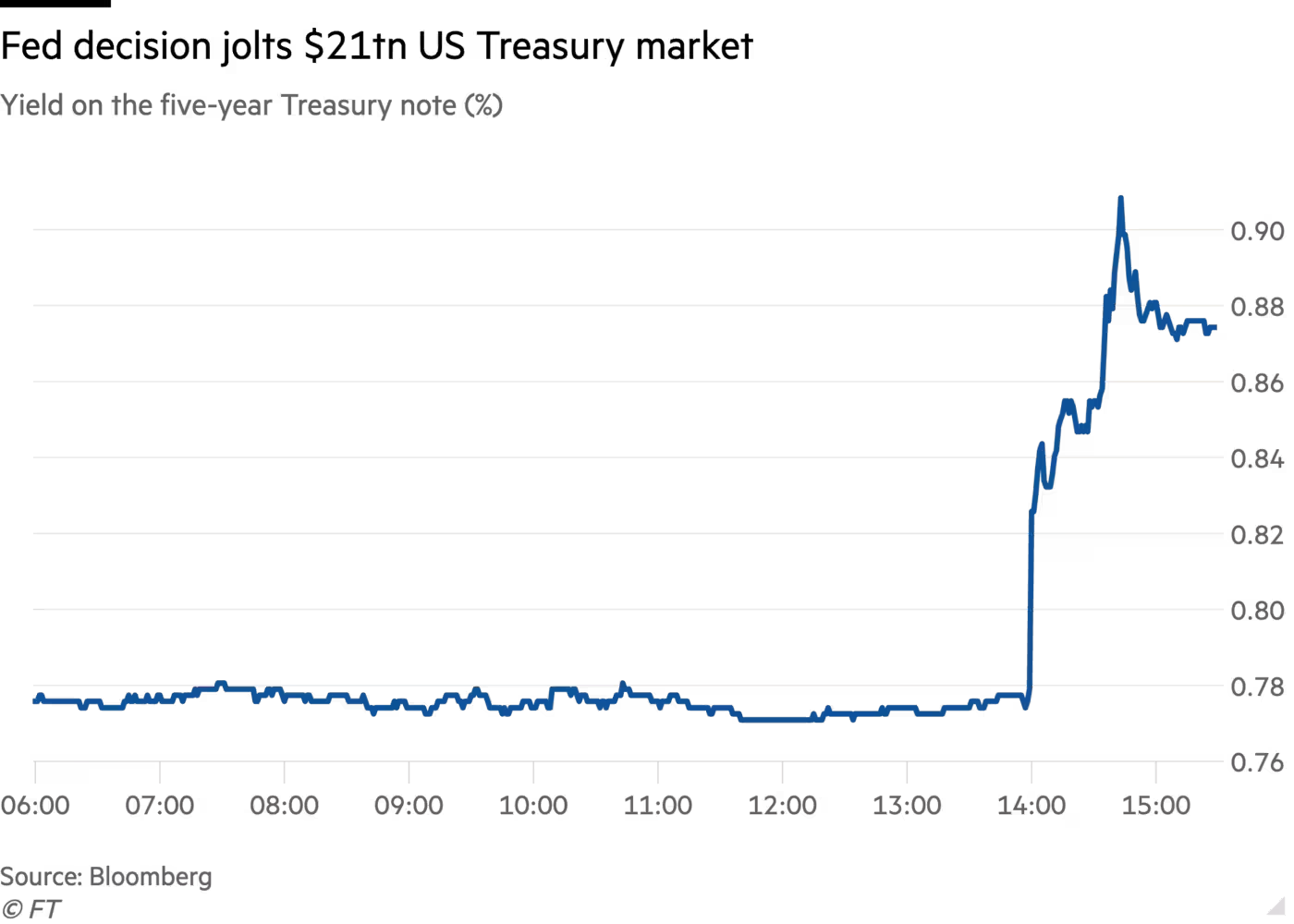
The mechanics of the yield shift are almost as consequential as the level itself. The 10-year versus 2-year spread has moved from deeply inverted to +51 basis points (4.32% versus 3.81%), ending what had been the longest yield curve inversion in modern U.S. history at 27 consecutive months. The un-inversion came not via the short end falling; the Fed cut only twice in 2025 before pausing. The move was driven instead by the long end rising sharply in what fixed-income strategists call a bear steepener.
Bear steepenings are historically associated with stagflation regimes, where inflation remains sticky even as growth decelerates. The pattern differs from the growth-driven bull steepener that typically signals the start of an economic recovery. For portfolio managers, a bear steepener means that extending duration, previously rewarded with higher income, now carries the double risk of principal loss and correlation breakdown with equities.
BlackRock's positioning reflects this: the firm holds short-duration Treasuries for income while avoiding the 10-year-and-beyond segment where the term premium risk concentrates. Wei Li, BlackRock's Global Chief Investment Officer, noted in the Monday report that the firm's equity overweight is not a pure growth bet but a hedge against the "stagflation tax" that erodes fixed-income purchasing power faster than equity cash flows.
JPMorgan AM and MFS Are Buying Shorter-Term European Debt
While BlackRock is selling long-dated U.S. Treasuries, it is simultaneously buying shorter-term European government bonds alongside JPMorgan Asset Management and MFS Investment Management. The trade is a yield lock-in play: European central banks hiked more aggressively than the ECB's pre-war trajectory suggested, driving two-year German Bund yields to their highest level in nearly two years. Managers expect ECB rates to plateau or fall faster than U.S. rates, meaning European short-duration paper is close to its yield peak while U.S. long paper still carries duration risk.
The positioning divergence between short U.S. duration and long European short-duration reflects a nuanced view that inflation regimes are not homogeneous. Europe, more directly exposed to energy import costs via the Hormuz closure, has already priced in more rate pain on the short end. Once the conflict de-escalates and Brent crude retreats, ECB rate cuts should steepen the European curve in a way that benefits short-duration holders through price appreciation.
For institutional allocators benchmarked against U.S. aggregate bond indices, this represents a meaningful basis trade that requires active permission to execute. Passive fixed-income exposures through index funds cannot capture this geographic rotation, reinforcing BlackRock's broader argument that active duration management is necessary in the current regime.
Pension Funds and the 60/40 Framework Face a Capital Allocation Reckoning
The downstream consequence of the correlation breakdown reaches every investor who has historically used bonds to dampen equity volatility. U.S. corporate pension funds, with roughly $3.5 trillion in assets under management, carry a mandated fixed-income allocation that typically anchors to 30%??0% of the portfolio. If that allocation now amplifies rather than hedges equity volatility, the funded status models underpinning liability-driven investing need to be rebuilt from scratch.
The 30-year Treasury yield, at approximately 4.55%, still provides an accounting discount rate that compresses pension liabilities on paper, but the mark-to-market volatility of holding that paper in a bear steepening environment offsets much of the funded status benefit. Actuaries at major pension consultancies are already revising their strategic allocation models, with several shifting toward private credit and real assets as substitute diversifiers. The California Public Employees' Retirement System and several large Canadian pension funds have publicly signaled they are reducing long-duration fixed income exposure by 5 to 8 percentage points in favor of infrastructure debt and real estate credit, positions that carry floating-rate or inflation-linked coupons rather than fixed ones.
Mortgage markets feel the pain more directly. The 30-year fixed mortgage rate is tracking the 10-year Treasury yield with roughly a 175-basis-point spread, pushing the national average above 6.1%. Refinancing volume has collapsed, and new purchase originations are running at their slowest pace since 2019, adding another drag on consumer spending just as the Fed watches core PCE for any sign of disinflation.
The Term Premium's Return Rewrites the Fed's Transmission Channel
For the Federal Reserve, the rise in term premium creates an unusual complication. When long-term yields rise not because of Fed action but because of term premium expansion, the traditional Fed funds rate transmission channel weakens. The Fed controls the overnight rate; it does not control the 40-basis-point risk premium that term-premium repricing adds on top of rate expectations. The result is a de facto tightening beyond what the FOMC has explicitly authorized.
Fed Chair Jerome Powell acknowledged this dynamic at the January press conference, noting that "financial conditions have tightened beyond our policy settings" in reference to the yield backup. The FOMC's April statement, released Wednesday afternoon, repeated the language about monitoring "inflation risks that remain elevated," signaling that the Fed will not cut rates to counteract term-premium-driven tightening unless growth deteriorates sharply.
BlackRock's investment thesis depends on this regime persisting. If the Iran conflict resolves quickly and oil falls back below $90, term premium collapses, the Fed resumes cuts, long bonds rally, and the equity-over-bonds trade becomes crowded. Boivin acknowledged that risk but framed the base case as a multi-quarter conflict with no near-term Hormuz reopening, keeping energy prices elevated and the inflation feedback loop intact.
The AI Infrastructure Bid Supports Equities Through the Yield Storm
The equity side of BlackRock's overweight is not indiscriminate. The firm is specifically tilting toward companies that benefit from AI infrastructure spending: hyperscalers, semiconductor suppliers, and energy providers whose power capacity is being contracted by data center operators. The investment thesis is that AI capex, running at a collective $600 billion-plus among the four largest U.S. hyperscalers in 2026, provides a private-sector demand impulse that can offset the consumer spending drag from high mortgage rates.
Alphabet, Amazon, Meta, and Microsoft all report earnings after the close on Wednesday, offering the first concrete test of whether AI capital expenditure is generating commensurate revenue growth. BlackRock is watching AWS growth above 25% and Microsoft Azure's Copilot attach rate as the key indicators that AI monetization has moved from speculative to operational. If both signal remains robust, the macro case for holding equities over bonds through a term-premium shock strengthens considerably.
The parallel between the oil-shock inflation of the 1970s and today's energy disruption is not lost on fixed-income historians. In the 1970s, equities initially underperformed as inflation eroded real returns, but companies with pricing power and real-asset exposure (energy, commodities, industrials) outperformed the bond market substantially. BlackRock's current overweight reflects a similar sector-rotation logic applied to the AI era: hold the companies that own pricing power and infrastructure, avoid the duration risk that term premium expansion punishes.
The 60/40 portfolio as a passive, set-and-forget construct has entered a period where its core assumption is empirically broken. Investors who fail to actively manage duration risk, geographic bond allocation, and equity factor exposure are running a strategy designed for a macro regime that the Iran war may have permanently closed.
Sources: BlackRock Investment Institute weekly commentary (April 28, 2026); Bloomberg terminal data on Treasury yield levels and term premium; FinancialContent markets analysis on 10-year yield un-inversion.
The BossBlog Daily
One email with the AI markets brief — the 13F moves, the Congressional trades, and what changed. No fixed schedule and no filler: it goes out when there is something worth sending.
Unsubscribe any time. We never sell or share the list.