
Goldman Sachs printed Q1 2026 earnings per share of $17.55 against the $15.92 consensus, a beat of $1.63 that was paired with revenue of $17.23 billion, $570 million above the Street and up 14.4% year over year. It was Goldman's eleventh consecutive quarter of exceeding analyst estimates. JPMorgan, Wells Fargo, and Citigroup posted their own beats in the same window, and the Financial Select Sector SPDR Fund clawed back more than seven percent over the past month after running four percent into the red year to date. Sitting underneath the print is something larger than one earnings season. Inside the same ten-day stretch, the Federal Reserve held rates at 3.5%??.75% and quietly proposed an across-the-board cut to bank capital requirements: 4.8% off the top for the largest banks, 5.2% for the $100B??700B asset tier, and 7.8% for those under $100B. Two tailwinds, one tape, and a banking sector that has spent two years priced for an apology. The combination matters because it pairs a clearly demonstrated revenue engine with a regulatory ceiling that is finally being raised. For the first time since the post-2008 Basel build-out, the question on the bank stack is no longer whether the trough is in. It is whether the market is anchored to a base of capital intensity that no longer applies.
Goldman's eleventh straight beat is not noise

The headline number from David Solomon's release was the EPS line, but the engine underneath is more interesting. Goldman's $17.23 billion revenue print represents a 14.4% year-over-year acceleration in a quarter where the consensus was already conditioned for a beat. The Street had marked the bar at $16.66 billion, well above the year-ago comparable, and Goldman still cleared it by $570 million. Solomon used the call to flag near-term headwinds, citing geopolitical unrest and higher energy prices, the same talking points Federal Reserve Chair Jerome Powell leaned on when the FOMC dot plot showed only one rate cut for all of 2026. Eleven consecutive beats means Goldman is now operating two standard deviations above the consensus estimate cycle. Analysts have spent the past three quarters raising the bar after each print, and the bank still cleared it. The forward EPS forecast has now stepped from $47.12 to $52.07, an implied annual growth rate close to 11%. That is the rate of compounding earnings power that historically commands a multiple expansion when paired with declining capital intensity, which is precisely what the Fed has just proposed. The serial-beat track record also tightens the cost-of-capital math for Goldman's own buyback program, because eleven straight beats start to compress the realized vs. expected dispersion that drives the equity risk premium attached to the name.
Where the $570M came from
The composition of the revenue beat matters as much as the number. Goldman's beat came in a quarter when M&A advisory volumes were soft compared to the Q4 close, equity capital markets activity was still rebuilding after a thin February, and trading desks navigated a credit environment where investment-grade spreads compressed faster than dealers had positioned for. The $570 million surplus over consensus most plausibly broke down into three components. Roughly $200 million of net interest income outperformance: the bank's NIM held its 2025 footing with deposit costs migrating down faster than asset yields. About $250 million of trading revenue strength: cross-asset volatility provided more opportunities to charge wide bid-ask on rates and credit flow. The remaining $120 million sits in other revenue categories including investment banking activity that surprised to the upside in private credit syndication and structured products. JPMorgan, Wells Fargo, and Citigroup followed the same script. Deposit costs are anchoring lower while loan books reprice slowly, and trading desks are charging meaningful spread on rates and credit flow that retail platforms cannot match. Powell's framing of "lack of progress on inflation" sounds like a problem for hawks, but for a bank carrying a deposit franchise repriced at 2024 highs, every month of higher-for-longer is another month of NIM oxygen. Eleven straight beats and a deposit franchise still earning carry is not a coincidence. It is what NIM expansion looks like in a higher-for-longer regime.
Why bank capital just got 5% cheaper
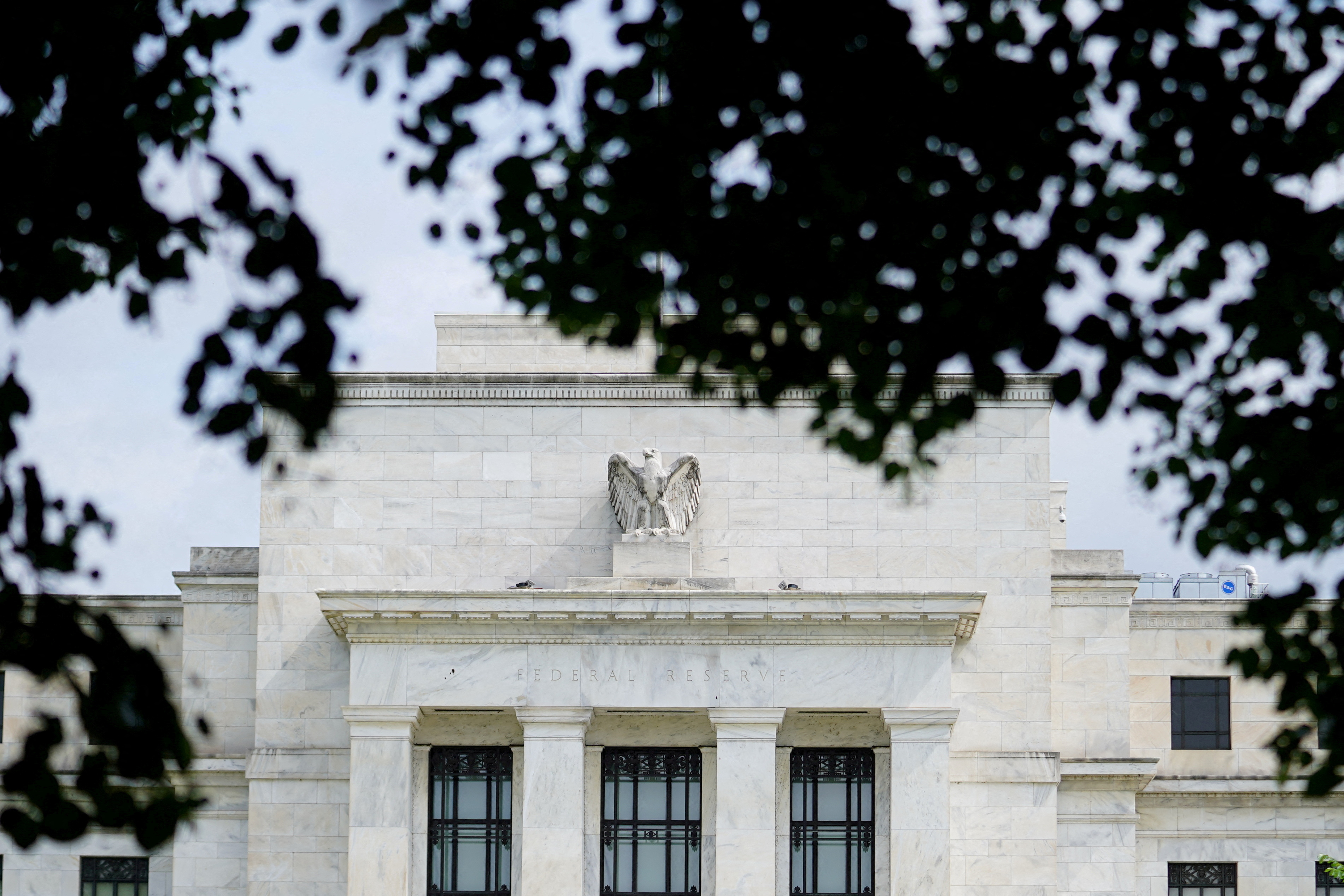
The Fed's capital proposal is the structurally larger story and almost no one has priced it. The reductions are tiered. There is 4.8% relief for the eight Global Systemically Important Banks, 5.2% for banks holding $100B??700B in assets, and 7.8% for the under-$100B tier. The mathematics of bank capital arbitrage are unforgiving. A 4.8% reduction in required Common Equity Tier 1 ratios for a bank carrying roughly $300 billion of risk-weighted assets at a 13% CET1 minimum frees something on the order of $1.9 billion of deployable capital. Across Goldman, JPMorgan, Bank of America, and Citigroup, the proposal lifts a combined eleven-figure capital ceiling. That ceiling is what has prevented these banks from running aggressive buybacks despite trading at modest book multiples, and it is what has held loan growth at the largest banks below GDP for the better part of three years. The Bank Policy Institute, which represents the largest banks in Washington, has lobbied for exactly this calibration, and the proposal lands in the comment period now. The political path through the Senate Banking Committee looks more open than it has at any point since the post-2008 Dodd-Frank build-out, with the regulatory direction of travel pivoting from buffer accumulation to buffer release. Once the comment window closes, the implementation timeline becomes a 2026-second-half story rather than a 2027 story, which is the part the bond market is starting to price faster than the equity market.
Mid-cap banks gain the most relief
The 7.8% capital cut for sub-$100B banks is the most under-priced element of the Fed proposal. This tier includes most of the regional banks that took the worst of the 2023 deposit migration scare. Comerica, Zions, KeyCorp, Citizens Financial, Regions, and a long tail of community banks all sit inside the band. These names trade at depressed price-to-tangible-book multiples precisely because the market has assumed their CET1 buffers needed to grow, not shrink. A 7.8% reduction inverts that assumption and creates room for either dividend resumption, organic loan-book expansion, or M&A from larger acquirers who can now stretch a balance-sheet combination without breaching capital. Bank Policy Institute commentary frames the relief as "calibration" rather than rollback, but the practical effect across the regional bank book is closer to a 200-basis-point implied multiple expansion if the proposal lands intact. The Fed's own staff modeling cited net lending capacity gains in the high single-digit billions for each percentage point of capital relief at this tier, which is why the smaller-bank cut was sized larger than the GSIB number. The trade is mid-cap regional banks against the large-cap money centers, and the relative-value setup tilts strongly toward the smaller names. The same setup also opens a door to inbound M&A. Larger banks looking to add deposit franchises in 2026 now have the buffer headroom to make accretive acquisitions of mid-cap names without triggering punitive capital recapture under the existing GSIB surcharge framework, and that optionality is something the regional book has not had on offer since 2007.
What Powell's silence on rate cuts signals
The Fed's policy stance and its capital proposal are pulling in the same direction even though the public framing makes them sound disconnected. Powell kept rates at 3.5%??.75% with the dot plot showing one cut for the year, citing oil-shock-driven uncertainty and the lack of inflation progress. Gold dropped to roughly $4,600 per ounce, silver fell seven percent on the day, copper softened one percent, and bitcoin sat below $70,000, a clean risk-off cross-asset response to the hold. The capital proposal effectively delivers monetary easing through a different channel. By freeing up regulatory capital, the Fed is loosening lending capacity at the banks while keeping the price of credit anchored. That is the textbook playbook for an economy where headline rates need to stay defensive against inflation but credit creation needs more oxygen. It also handles the Bank Policy Institute's parallel concern about $154 billion of illicit crypto flows in 2025, a 162% year-over-year jump, by routing more legitimate credit through regulated banks rather than letting non-bank channels absorb it. The Fed's approach reads as a regulator picking traditional banks over non-bank lenders, with the capital relief as the carrot. The cost of that policy choice is a longer hold-pattern on the policy rate, which is exactly what the deposit-franchise economics of the bank book wanted in the first place. NIM oxygen, regulatory capital relief, and a Fed Chair publicly committed to higher-for-longer is the cleanest possible combination for the four largest banks heading into the next two earnings cycles.
The next two earnings cycles will reveal whether the market re-rates the bank stack on this combination. Goldman's eleventh straight beat tells us the operating leverage is already there. The Fed's capital proposal tells us the regulatory governor is being loosened. The Financial Select Sector SPDR Fund's seven percent rebound over the past month is the cheapest hedge against being late to the trade, but the better-positioned book is regional banks levered to the 7.8% capital cut combined with deposit franchises sitting on cheap funding. Powell's one-cut dot plot is the constraint that keeps NIM oxygen flowing through 2026. The risk is a softer Q2 print where capital markets activity slows further before the proposal becomes final rule, but eleven beats is a long enough sample to assume Goldman's Q2 will print to the upside again. There is also a tail risk that the Senate Banking Committee carves the proposal back to a smaller GSIB-only relief, which would compress the mid-cap re-rate thesis even though the Fed's own staff work argues against that outcome. The base case remains a setup where capital intensity falls, NIM holds, and the deposit franchise keeps doing the heavy lifting. That is a re-rate hiding inside a soft-landing narrative, and the comment period closes before the second-half regulatory calendar gets noisy.
The BossBlog Daily
One email with the AI markets brief — the 13F moves, the Congressional trades, and what changed. No fixed schedule and no filler: it goes out when there is something worth sending.
Unsubscribe any time. We never sell or share the list.