
This week Wall Street faces two simultaneous verdicts that will define the economic half-year ahead. On Tuesday and Wednesday the Federal Open Market Committee convenes what will almost certainly be a do-nothing meeting: traders on the CME FedWatch tool assign a 99.9 percent probability to the Fed holding its benchmark rate at 3.50 to 3.75 percent, unchanged for the second consecutive meeting. On Thursday, April 30, the Bureau of Economic Analysis releases its advance estimate of first-quarter GDP, a number that has drifted sharply downward in recent weeks as $107 Brent crude swallowed consumer budgets and trade uncertainty froze corporate spending plans. The Atlanta Federal Reserve's GDPNow model last printed at 1.2 percent for Q1 2026, down from forecasts above 3 percent that most of Wall Street carried into February. The New York Fed's nowcast is more sanguine at 2.4 percent. The Philadelphia Fed's Survey of Professional Forecasters shows a median of 2.6 percent. The spread between the lowest and highest credible estimates reflects genuine uncertainty about how much damage the Hormuz disruption has already done to the real economy, and how much remains to be counted. This is the most consequential GDP week the United States has faced in four years, and the number that prints on April 30 will shape the rate path, the incoming Fed chair's inheritance, and the summer market outlook.
How the Atlanta Fed's Growth Estimate Halved in Eight Weeks
GDPNow is a mechanical aggregation of incoming data releases, not a discretionary forecast. Each new report updates the model, and the cumulative picture since late February has been one of consistent downward revision. Retail sales for March came in softer than the consensus. Business inventories disappointed. Consumer confidence surveys ran near multi-year lows as gasoline prices climbed 27 percent since the start of the Iran war, eroding household purchasing power across income brackets. The Atlanta Fed model updated on April 21 after soft retail and inventories data hit; the resulting 1.2 percent print was the sharpest single-week downward move the model had recorded since the post-pandemic inventory correction of late 2022.
The International Monetary Fund, which published its World Economic Outlook at its Spring Meetings in Washington on April 14, cut its 2026 global growth projection to 3.1 percent from 3.4 percent, while revising global headline inflation up to 4.4 percent, a full 0.6 percentage points above earlier estimates. For the United States specifically, GDP growth data by industry through February and a flash estimate for March together pointed to meager first-quarter expansion. Jerome Powell's comments at the March 18 press conference acknowledged that "upside risks to inflation and downside risks to employment were elevated" and that developments in the Middle East were amplifying both. That framing has not changed in the weeks since, and the data flow since then has moved mostly against the growth side of the ledger.
The significance of the April 30 release is not simply what it says about January through March. It sets the baseline from which the Fed interprets its dual mandate heading into the summer. A print near 1.2 percent would give the United States its slowest quarterly growth since 2022, at a moment when the headline CPI is running 3.3 percent year-over-year, well above the Fed's 2 percent target. A print near the Philadelphia Fed's 2.6 percent median would change the narrative substantially, framing the first quarter as a deceleration rather than a stall. The distance between those two interpretations is the distance between a market that starts pricing rate cuts and one that prices prolonged stasis.
The Hormuz Oil Shock as the Fed's Inflation Floor
Brent crude traded at $107.58 per barrel on Monday, up approximately 2.1 percent on the session and roughly 55 percent above pre-war levels. The partial closure of the Strait of Hormuz, through which roughly 20 percent of global oil trade passes, has disrupted tanker routing, spiked war-risk insurance premiums, and created regional energy price dislocations that persist even on days when diplomatic signals look marginally more constructive. Brent briefly touched $108 on Sunday as Iran's latest peace proposal failed to move talks forward. Bloomberg's analysis of the full closure scenario puts the ceiling above $130 per barrel, a level that would make the current price look manageable by comparison.
For the Federal Reserve, $107 Brent is not a peripheral variable. The March CPI acceleration to 3.3 percent was driven in significant part by energy. Nonfarm payrolls added 178,000 jobs in March, exceeding consensus, which means the labor market has not yet deteriorated enough to generate the disinflationary pressure that would allow a rate reduction. The result is a policy box with no obvious exit. Lowering rates into an oil price spike risks entrenching inflation expectations. Holding rates into a GDP print near 1.2 percent risks allowing a fragile expansion to tip into contraction. J.P. Morgan's global research team has described the current configuration as one in which the standard relationship between growth and inflation has broken down, with both variables moving in the wrong direction simultaneously.
Business Standard reported that policymakers across the Group of Seven were expected to hold rates steady this week while monitoring whether higher energy costs produce secondary inflation through wages and services pricing. The ECB faces a parallel dilemma, with European energy import costs running well above those of American peers given the continent's historical dependence on Middle Eastern supply chains. The G7 coordinated hold is unusual in its unanimity; it reflects how thoroughly the Hormuz disruption has synchronized the global monetary policy dilemma.
Airlines Absorb the First Identifiable Consumer Blow
The aviation sector has become the most visible real-economy transmission mechanism for the oil shock, and its earnings confessions this quarter provide a granular look at how energy prices become consumer-facing prices. Jet fuel in North America has spiked 95 percent since the Iran conflict began. United Airlines announced it was raising ticket prices by as much as 20 percent in response to the cost surge, according to Fox Business reporting. Delta Air Lines estimated that higher fuel costs would add approximately $2 billion to its fuel bill this quarter alone. American Airlines cut its second-quarter earnings guidance in response to an anticipated $4 billion increase in jet fuel expenses, with management describing severe uncertainty about profitability through the summer travel season.
In Europe, where airlines source approximately a third of their jet fuel from Middle Eastern suppliers, the disruption has been sharper. Lufthansa confirmed it would remove 20,000 flights from its schedule through the fall, a capacity reduction that will affect millions of passengers across its hubs in Frankfurt, Munich, and Zurich. NPR data shows last-minute walk-up fares to Caribbean destinations from the United States rose 74 percent in a two-week window; flights from the mainland to Hawaii jumped 21 percent. Average American gasoline prices sat at $4.10 per gallon on Sunday, down slightly from the recent peak but still 27 percent above levels before the war.
For the GDP calculation, these dynamics feed multiple components simultaneously. Consumer spending on services includes air travel. Business investment includes corporate travel budgets, which are being slashed. Trade data captures the disrupted shipping routes. Inventory movements reflect altered sourcing patterns. Whether the Atlanta Fed's 1.2 percent estimate has fully incorporated the most recent readings across all these channels, or whether additional softness is still arriving in the data pipeline, is something the April 30 advance release will begin but not fully resolve. Quarterly GDP estimates carry wide confidence intervals, and the third revision in late summer will almost certainly revise the advance figure.
A Market Priced for Stability Meets Structural Uncertainty
S&P 500 futures were modestly lower on Monday as Iran peace talks stalled again, with Brent briefly touching $108 per barrel before retreating. Nasdaq-100 futures declined 0.2 percent; Dow Jones futures dropped 112 points. Despite the geopolitical overhang, equity markets have traded in a relatively narrow band since mid-April, reflecting a conviction that the situation resolves without full Hormuz closure. Options markets tell a more cautious story: volatility surfaces for energy-exposed sectors have widened materially, and the implied volatility on put options across airlines, shipping, and emerging-market energy importers has climbed to levels not seen since early 2022.
The technology sector has provided a partial offset. Fidelity International describes AI as "the defining theme for equity markets" in 2026, while the BlackRock Investment Institute argues that technology investment is outweighing tariff uncertainty and traditional macroeconomic headwinds in determining equity valuations. That framework holds as long as rate expectations remain stable and corporate earnings in the sector continue to beat. Both conditions are more fragile than they were in January. A GDP print at 1.2 percent, combined with a CPI still above 3 percent, would be the kind of data configuration that forces even AI-optimistic portfolio managers to reassess the discount rate embedded in high-multiple technology valuations.
Mortgage applications rose 7.9 percent for the week ending April 17, a data point that somewhat complicates the bearish macro narrative by indicating continued activity in the housing market. Mortgage rates remain well above the lows of 2021, but the pipeline of rate-sensitive demand that was deferred during the 2022-2023 hiking cycle has not been fully exhausted. Housing represents a counterweight to the aviation and energy-cost channels of consumer stress, and the BEA's treatment of residential investment will be watched closely in Thursday's release.
The Stagflation Trap Powell Bequeaths His Successor
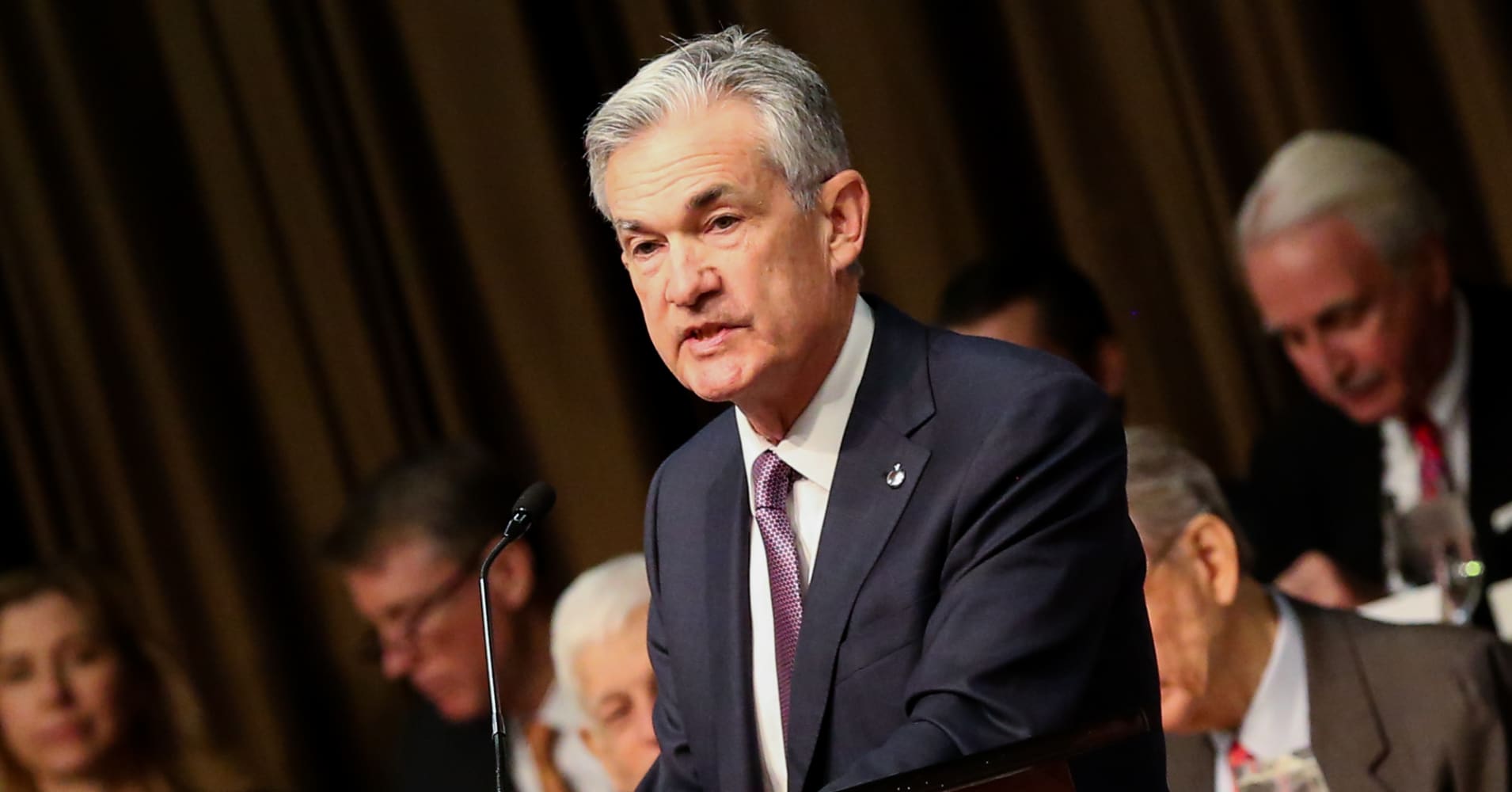
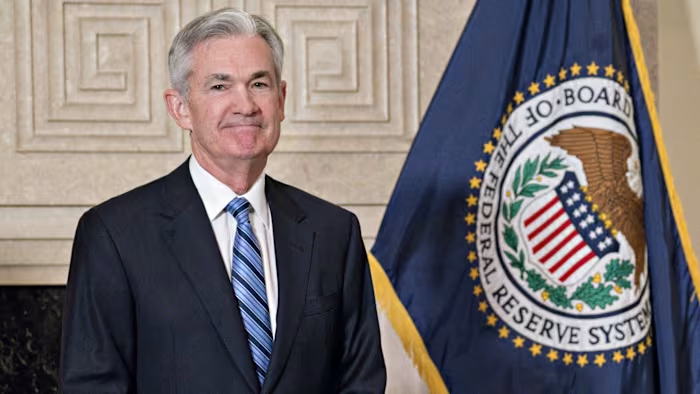
The April 28-29 FOMC meeting is Jerome Powell's second-to-last as chair. The Senate is moving toward confirming Kevin Warsh as his replacement following the Department of Justice's decision to drop its investigation into Powell, clearing the procedural path for the transition. Warsh has historically aligned with a more inflation-sensitive monetary framework than the current leadership, which means the incoming chair would inherit a benchmark rate, a balance sheet, and an economic conjuncture that offer no comfortable policy path.
If Q1 GDP prints near 1.2 percent, the political pressure on Warsh to ease at his first meeting will be immediate and loud. If the oil price simultaneously keeps headline inflation above 3 percent through the second quarter, rate cuts become nearly impossible to justify on the Fed's own stated criteria. The Fed's dot-plot projections, last updated in March, call for one 25-basis-point cut in 2026 and another in 2027, but the timing of even that modest move depends on data that is currently pulling in opposite directions. A GDP print in the 1.5 to 2.0 percent range, splitting the difference between the Atlanta and Philadelphia Fed estimates, would likely be received as confirmation that the expansion is slowing but not collapsing, keeping the single-cut baseline intact and leaving the July meeting as the earliest plausible window.
What the April 30 GDP number will not do is resolve the central tension of 2026 monetary policy. It will, instead, define the terms of the debate for the remainder of the year, hand Kevin Warsh his first concrete data point before he has even taken the oath, and remind markets that the economic disruptions flowing from the Strait of Hormuz are not confined to oil prices or bank trading desks, but are working their way through quarterly growth statistics in ways that the full accounting has only begun.
The BossBlog Daily
One email with the AI markets brief — the 13F moves, the Congressional trades, and what changed. No fixed schedule and no filler: it goes out when there is something worth sending.
Unsubscribe any time. We never sell or share the list.