
Equinix, Cisco, and NVIDIA announced an expanded collaboration to deploy the Cisco Secure AI Factory with NVIDIA across Equinix's global data center footprint, a move that bundles networking, security, and accelerated computing into a single managed infrastructure stack for enterprise AI workloads. The partnership, disclosed on June 17, 2026, also includes Presidio, which has deployed a Programmable AI Technology Hub (P.A.T.H.) Lab at an Equinix facility, providing a real-world environment where enterprises can test and validate AI infrastructure before committing to full-scale deployment. The Secure AI Factory combines Cisco's networking and security portfolio with NVIDIA's accelerated computing platform, all hosted within Equinix's colocation facilities, effectively creating a turnkey AI data center product for companies that lack the capital or expertise to build their own. Equinix operates over 260 data centers across 70 metros globally, making the partnership's geographic reach broader than any single hyperscaler's on-premises offering. This matters now because enterprise AI adoption has stalled at the proof-of-concept stage for most organizations, and the hyperscalers are capturing the lion's share of production AI workloads. A bundled, pre-validated infrastructure offering from three of the most trusted names in enterprise IT gives mainstream companies a credible on-ramp to deploying AI in their own controlled environments, with reduced integration risk and a single point of accountability.
How the Secure AI Factory bundles networking, compute, and security into one stack
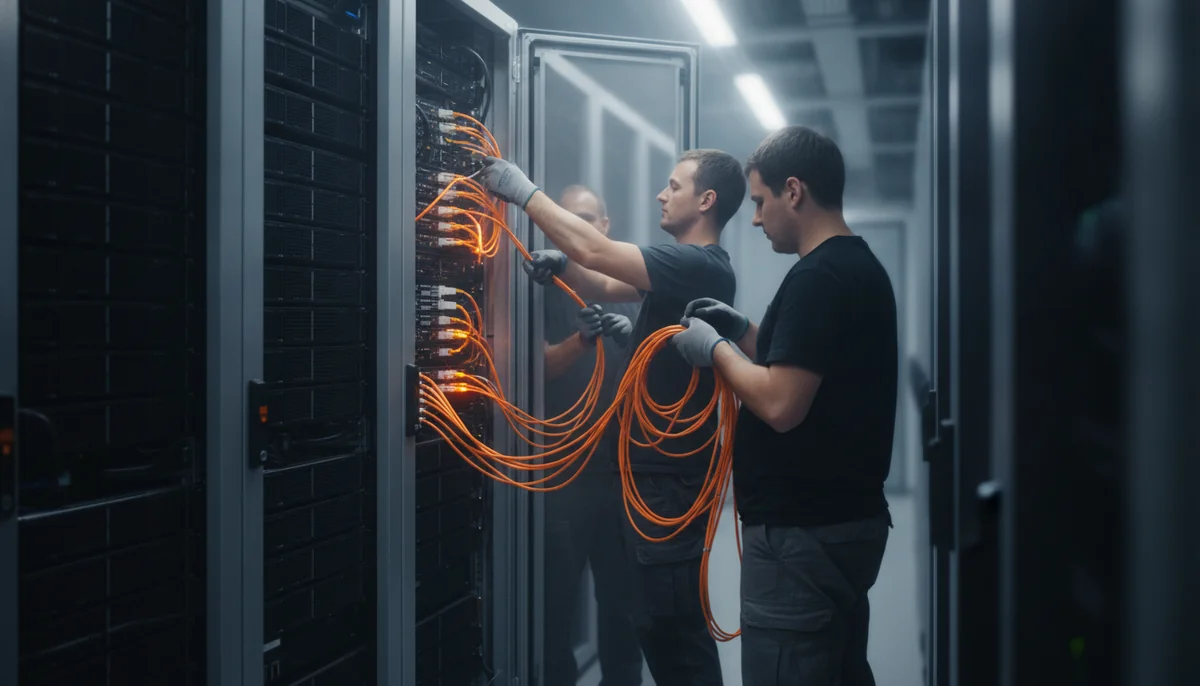
The Cisco Secure AI Factory with NVIDIA is not a single product but a validated reference architecture and managed service designed specifically for enterprise-grade AI workloads, integrating three layers: Cisco's Silicon One-powered switches and routers for high-bandwidth, low-latency networking; Cisco's security portfolio, including firewall and zero-trust segmentation, to protect AI data pipelines and model inference endpoints; and NVIDIA's Hopper and Blackwell-generation GPUs for training and inference acceleration. Equinix provides the physical colocation space, power, cooling, and cross-connects, while also managing the operational complexity of deploying and maintaining the infrastructure. The P.A.T.H. Lab, operated by Presidio, serves as a validation sandbox where enterprises can run their own AI workloads on the integrated stack, measure performance, and assess security postures before signing long-term contracts. This lab approach addresses a critical friction point: enterprise IT teams often struggle to evaluate AI infrastructure because they lack access to representative hardware configurations and production-like network topologies. By offering a pre-tested, pre-integrated stack with validated designs from Cisco and NVIDIA, the partnership reduces the integration risk that has historically plagued enterprise AI deployments. The bundled offering also simplifies procurement. Enterprises can purchase the entire stack through a single Equinix contract rather than negotiating separately with hardware vendors, network providers, and colocation operators. The P.A.T.H. Lab is equipped with the same GPU clusters and network fabric that enterprises will run in production, so performance benchmarks and security scans conducted in the lab translate directly to the deployed environment.
Revenue flows across Equinix, Cisco, NVIDIA, and Presidio
The financial structure of the Secure AI Factory partnership creates multiple revenue streams for each participant, but the biggest beneficiary is Equinix, which monetizes its real estate and interconnection fabric rather than just selling cabinets. Equinix charges for colocation space with higher power density. AI workloads require 30–50 kW per rack versus the 5–10 kW typical for traditional enterprise IT. Equinix also collects recurring revenue from cross-connects between the Cisco-NVIDIA compute clusters and enterprise customer cages. Cisco sells switches, routers, and security appliances at list price plus annual support contracts, with the Secure AI Factory design requiring at least two Nexus 9000-series switches and a pair of Firepower 9300 security appliances per deployment pod. NVIDIA generates revenue from GPU sales. Each pod scales from 8 to 256 H100 or B200 GPUs. NVIDIA also collects AI Enterprise software licenses at $4,500 per GPU per year. Presidio, as the systems integrator, charges for lab design, workload validation, and deployment services, typically billing at $300–$500 per hour for its engineers. For a typical mid-market enterprise deploying a 32-GPU pod, the total upfront cost runs approximately $1.2 million for hardware and colocation, with annual recurring costs of $250,000 for software licenses, support, and cross-connects. Equinix management expects the Secure AI Factory to drive incremental revenue of $50 million to $100 million in the first 12 months, primarily from power-dense colocation leases and interconnection fees.
Who gains and who loses in the enterprise AI infrastructure market
The Secure AI Factory partnership directly challenges Dell, HPE, and Lenovo, which have been selling their own AI-optimized server bundles but lack the colocation footprint and interconnection density that Equinix provides. Dell's AI Factory with NVIDIA, announced in 2024, sells servers and storage but requires customers to find their own data center space and manage networking separately. The Equinix-Cisco bundle eliminates those friction points. HPE's GreenLake for AI offers a consumption-based model but is limited to HPE's own ProLiant servers and Aruba networking, which have smaller installed bases in AI workloads than Cisco's Nexus switches. The partnership also pressures cloud providers like AWS and Azure, which have been the default destination for enterprise AI workloads. By offering a colocated, private infrastructure option with the same NVIDIA GPUs available in the cloud, Equinix gives enterprises a path to avoid cloud egress fees and data sovereignty concerns. Regulated industries, in particular, have long cited data residency requirements as a barrier to moving AI workloads to public cloud, and the Equinix model resolves that concern by keeping data physically within specific jurisdictions while still accessing enterprise-grade GPU compute. However, the biggest losers are smaller colocation providers like CyrusOne, QTS, and Digital Realty, which lack the integrated networking and security partnership that Equinix now offers. Without a comparable Cisco or NVIDIA-endorsed reference architecture, these providers are limited to selling raw colocation space and will struggle to compete for AI-driven deals where enterprises prioritize a validated, integrated stack over price per kilowatt. For enterprises, the deal creates a clear triage: simple AI workloads go to the cloud, complex regulated workloads go to Equinix with Cisco and NVIDIA, and everything else stays on-premises with Dell or HPE. Presidio also wins by positioning itself as the validation partner of record for enterprise AI deployments, potentially displacing smaller AI consultancies that lack the dedicated lab infrastructure and vendor-backed reference architectures to compete.
Downstream effects on hyperscaler capex, chip supply, and enterprise procurement
The Secure AI Factory's most significant second-order effect will be on hyperscaler capital expenditure plans. If enterprises shift even 10% of their AI workloads from public cloud to colocated private infrastructure, AWS, Azure, and Google Cloud would need to reduce their GPU procurement forecasts by approximately 15,000–20,000 H100 equivalents per quarter, freeing up supply for the remaining cloud customers and potentially easing the GPU shortage that has persisted since 2023. For NVIDIA, this is a net positive. The company sells GPUs regardless of where they are deployed, and the enterprise colocation channel opens a new customer segment that previously could not justify the minimum order quantities required by hyperscalers. Cisco benefits from increased switch and router sales in the enterprise data center segment, which has been flat for three years as workloads migrated to the cloud. The partnership also pressures Broadcom, which competes with Cisco in data center networking via its Tomahawk and Jericho switch ASICs, and Arista Networks, which has gained share in cloud data centers but has less presence in enterprise colocation. For enterprise procurement teams, the Secure AI Factory simplifies vendor evaluation. Rather than running separate RFPs for colocation, networking, compute, and security, they can issue a single request for proposal to Equinix. This procurement efficiency accelerates AI deployment timelines by 6–12 months for regulated industries like financial services, healthcare, and defense, where data sovereignty and security compliance have been major barriers to AI adoption.
What the partnership signals about the future of enterprise AI deployment models
The Equinix-Cisco-NVIDIA deal marks a structural shift in how enterprise AI infrastructure will be built and consumed. For the past two years, the industry narrative has been that AI workloads will inevitably flow to the hyperscale cloud. This partnership challenges that assumption by creating a credible third path: colocated private infrastructure with cloud-like consumption models. The involvement of Cisco, which has historically been the networking backbone of enterprise data centers, signals that the enterprise networking giant sees AI as a catalyst to reverse the decade-long trend of workload migration to the cloud. NVIDIA's participation validates that the GPU maker views enterprise colocation as a growth vector distinct from both hyperscale cloud and on-premises server sales. The P.A.T.H. Lab model, where a systems integrator provides a testing sandbox before deployment, suggests that enterprise AI adoption will follow the same pattern as previous enterprise technology waves. Mainframes, client-server, and cloud all required proof-of-concept labs and reference architectures to de-risk adoption. This partnership also signals that the market for AI infrastructure is bifurcating: hyperscalers will continue to dominate training of frontier models and large-scale inference, while enterprise colocation will capture the long tail of fine-tuning, retrieval-augmented generation, and regulated inference workloads. For Cisco specifically, the Secure AI Factory is also a revenue recovery story. The company's switch and router revenue has been under pressure as enterprises reduced data center footprints during the cloud migration era, and a wave of enterprise AI build-outs represents the most significant on-premises networking spending opportunity in a decade. The deal positions Equinix as the neutral ground where enterprises can deploy AI without committing to a single cloud provider's ecosystem, preserving optionality as the AI platform wars between OpenAI, Anthropic, Google, and open-source models continue to evolve. That neutrality, combined with physical control over data and the ability to swap GPU vendors as the market matures, is increasingly the value proposition that enterprise CIOs are willing to pay a premium for.
The BossBlog Daily
One email with the AI markets brief — the 13F moves, the Congressional trades, and what changed. No fixed schedule and no filler: it goes out when there is something worth sending.
Unsubscribe any time. We never sell or share the list.