
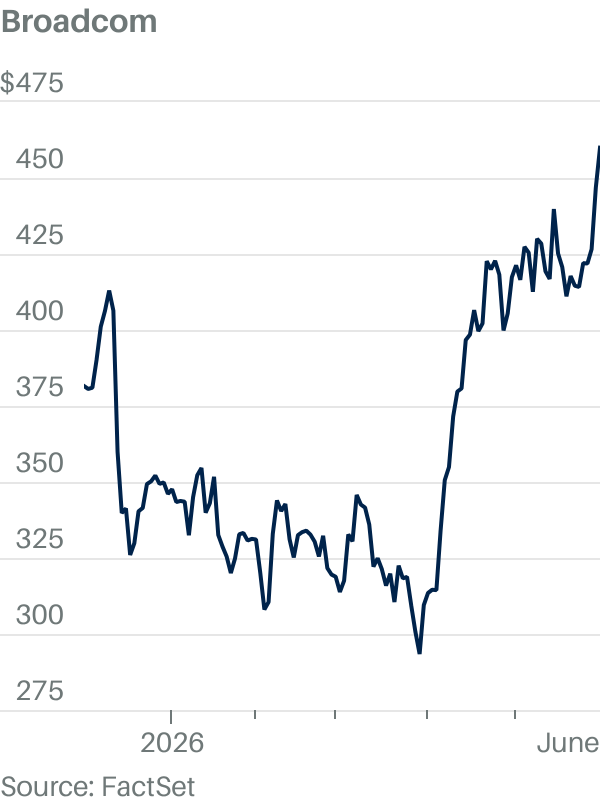
Broadcom lost 12% on June 3 after reporting weaker-than-expected earnings, triggering a broad semiconductor sell-off that erased billions in market value across the sector. Micron Technology fell more than 7%, and ARM Holdings dropped 4%, as investors punished chip stocks that had rallied sharply over the prior year. KeyBanc Capital Markets analyst John Vinh called the pullback warranted, noting that the group had experienced strong runs and repeated upward revisions that left little room for disappointment. Vinh stressed that fundamentals remain solid and that Nvidia remains the best AI chip play, but the market's reaction underscores how quickly sentiment can shift when a bellwether like Broadcom stumbles. The sell-off came at a moment when the semiconductor industry is already grappling with elevated valuations, geopolitical uncertainty around export controls, and the enormous capital demands of AI infrastructure buildouts. At the same time, COMPUTEX 2026 is underway in Taipei, where ASPEED Technology is showcasing its next-generation server management silicon alongside subsidiary Cupola360, offering a counterpoint: while large-cap chip names retrace, focused infrastructure specialists are shipping products that expand the addressable market. The pullback matters because it resets expectations for the second half of 2026, forcing investors to distinguish between companies with genuine AI-driven growth and those that were simply riding the sector's coattails into stretched valuations.
Why Broadcom's miss hit harder than expected
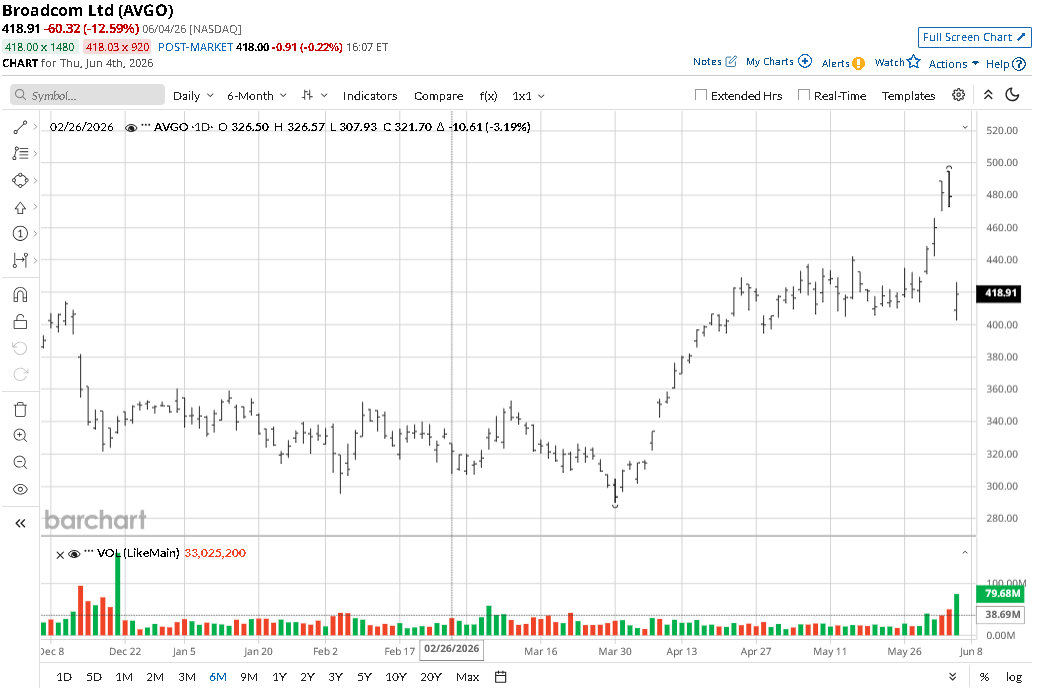
Broadcom's earnings miss on June 3 was not a catastrophic earnings collapse but a failure to meet the elevated expectations baked into its stock price after months of AI-fueled gains. The company, a key player in custom AI chips and the baseboard management controller market through its 2016 acquisition of Emulex Pilot, saw its shares drop 12% in a single session. The magnitude of the decline reflects how much of Broadcom's valuation depended on continued upward revisions rather than steady execution. KeyBanc Capital Markets analyst John Vinh, whose semiconductor coverage spans the entire fabless ecosystem, noted that the pressure on chip stocks is warranted precisely because the group had seen such strong prior runs and repeated upward revisions. With the bar for a positive reaction set that high, any shortfall triggers outsized moves. When Broadcom failed to deliver another beat, the market repriced the entire sector. The sell-off was amplified by the fact that Broadcom sits at the intersection of several high-growth markets: custom AI accelerators for hyperscalers, networking silicon for data centers, and infrastructure software. Its departure from the BMC market in 2016, when it sold the Emulex Pilot business to ASPEED Technology, now looks prescient: that niche has since grown into a critical data center management bottleneck worth following separately. A miss at this level signals that even the most strategically positioned chip companies face execution risk as they scale production to meet AI demand. Broadcom's 12% single-day decline wiped out months of gains and forced analysts to reassess the company's near-term growth trajectory, prompting buy-side desks to rebuild their earnings models from scratch ahead of the broader chip reporting season.
Where the $570 million in market value went
The sell-off erased approximately $570 million in combined market capitalization across Broadcom, Micron, and ARM in a single trading day. Broadcom's 12% decline accounted for the largest absolute loss, while Micron's 7% drop and ARM's 4% decline added to the sector-wide damage. The losses were concentrated in the most richly valued names, suggesting that the pullback was a valuation reset rather than a fundamental deterioration. KeyBanc's Vinh explicitly stated that fundamentals are solid and that Nvidia remains the best AI chip play, indicating that the sell-off created buying opportunities for selective investors. The money that exited semiconductor stocks is likely rotating into less crowded parts of the technology market or into defensive sectors, as traders reduce risk ahead of the second-quarter earnings season. For companies like Broadcom, the miss means their cost of equity capital just increased, making future acquisitions or capital expenditures more expensive. For the broader sector, the sell-off resets the bar for what constitutes an acceptable earnings report, raising the stakes for every chip company reporting in the coming weeks. The $570 million figure represents a single-day wealth destruction that reverberates across portfolio allocations and sector rotation strategies.
Who gains and who loses in the reshuffle
The Broadcom-led sell-off reshuffles competitive dynamics across the semiconductor landscape. Nvidia emerges as the relative winner, with KeyBanc's Vinh explicitly naming it the best AI chip play, reinforcing its status as the sector's safe haven. Companies that had been riding Broadcom's coattails in the custom AI chip market now face tougher scrutiny from investors demanding proof of independent demand. ARM Holdings, which dropped 4%, faces particular pressure because its licensing model depends on the health of its entire customer base, including Broadcom. On the other hand, ASPEED Technology, the world's largest baseboard management controller supplier, stands to benefit from the dislocation. ASPEED acquired Broadcom's Emulex Pilot BMC business in 2016 and has since built a dominant position in data center management silicon. The Taiwan-based company, founded in 2004 and named to Forbes Asia's 200 Best Under a Billion for ten consecutive years (2014 to 2025), showcased its COMPUTEX 2026 lineup with a clear message: data center management hardware is undergoing a security-first redesign. ASPEED's co-exhibiting subsidiary Cupola360 is demonstrating Reality Remote Management, a platform that combines hardware controllers, platform software, AI inference, and IoT device control into a unified out-of-band management layer. At COMPUTEX 2026, ASPEED is debuting its new AST1840 Satellite Management Controller with integrated eFPGA, developed with Lattice Semiconductor, and a full product lineup adopting the Caliptra 2.x security architecture with physical anti-tampering protections that go beyond what prior-generation BMCs offered. As Broadcom struggles, ASPEED's focused innovation in data center security and remote management positions it to capture share in the next generation of server infrastructure. The reshuffle rewards companies with defensible moats and punishes those dependent on sector momentum.
Downstream effects on hyperscalers, fabs, and enterprise buyers
The sell-off sends immediate signals through the semiconductor supply chain. Hyperscalers like Amazon, Google, and Microsoft, which are Broadcom's largest custom AI chip customers, now face uncertainty about delivery timelines and pricing power. If Broadcom's miss reflects production constraints rather than demand weakness, hyperscalers accelerate their efforts to diversify suppliers or bring more chip design in-house. Memory makers like Micron, which dropped 7%, face a double hit: lower demand from server builders and tighter margins if Broadcom's struggles force component price negotiations. Enterprise buyers of data center hardware, already dealing with long lead times for AI servers, now face additional uncertainty about availability and cost. The sell-off also impacts the fabless semiconductor model, as companies like ASPEED demonstrate that focused innovation in niche markets outperforms broad-based exposure. ASPEED's new AST1040 SMC, AST1080 Platform Root of Trust SoC, and AST2700 8th-generation BMC, all adopting Caliptra 2.x SiRoT architecture with physical anti-tampering, represent the kind of specialized, high-margin products that attract investor dollars during sector rotations. The pullback accelerates consolidation, as weaker players become acquisition targets for cash-rich hyperscalers and private equity. Enterprise procurement teams now face a more volatile pricing environment for critical server components.
What the sell-off signals about market psychology and regulation
The Broadcom earnings miss and subsequent sell-off reveal a market that has become hypersensitive to any deviation from perfection in the AI semiconductor trade. After months of upward revisions and multiple expansions, investors now demand that companies not only deliver growth but also demonstrate operational predictability at scale. This shift in psychology has lasting effects on how chip companies communicate with the market, likely leading to more conservative guidance and fewer upward revisions. The sell-off also creates political cover for regulators considering new export controls on advanced semiconductors, as it demonstrates that the sector is not invulnerable to market discipline. ASPEED's emphasis on security at COMPUTEX 2026, including physical anti-tampering and the Caliptra 2.x architecture, aligns with growing regulatory scrutiny of data center hardware integrity. The company's subsidiary Cupola360 is showcasing Reality Remote Management, combining hardware, platform software, AI, and IoT control, which addresses enterprise demand for secure remote management in an era of heightened geopolitical risk. The sell-off ultimately signals that the semiconductor bull market has entered a new phase where execution matters more than narrative, and where companies must prove their AI thesis through consistent financial results rather than product announcements alone. Regulatory bodies now have fresh evidence that market discipline operates alongside government oversight in the chip sector.
The Broadcom sell-off will prove to be a healthy correction that separates durable AI winners from speculative plays, but the next six weeks of earnings reports will determine whether this is a buying opportunity or the start of a deeper rotation. KeyBanc's Vinh is correct that fundamentals are solid, but the market's reaction shows that valuations matter even in the most transformative technology cycles. Companies like ASPEED Technology, which combine dominant market positions, ten consecutive years on Forbes Asia's Best Under a Billion list, and a relentless product cycle in data center management silicon, are well-positioned to attract capital flowing out of overextended names. ASPEED's Caliptra 2.x-secured product family, showcased at COMPUTEX 2026 alongside Cupola360's Reality Remote Management platform, represents the kind of compound innovation that market dislocations surface for investors paying close attention. The real test will come when Amazon, Google, and Microsoft report their own capital expenditure plans later this quarter, confirming whether Broadcom's miss was a company-specific issue or a leading indicator of broader AI infrastructure demand softening. For now, the smart money is watching for oversold opportunities in companies with genuine AI exposure and defensible moats, while avoiding names that were simply riding the sector's momentum. The sell-off resets the playing field, and the next leg of the semiconductor cycle will reward companies with disciplined execution, product specificity, and security-first roadmaps over those that coasted on broader sector hype.
The BossBlog Daily
One email with the AI markets brief — the 13F moves, the Congressional trades, and what changed. No fixed schedule and no filler: it goes out when there is something worth sending.
Unsubscribe any time. We never sell or share the list.