
China's largest AI model developers have crossed a critical threshold. MiniMax, Kimi, and DeepSeek now run their flagship models, including DeepSeek V4, on domestic chips from Huawei and Alibaba's T-head. This marks the first time the country's leading AI labs have achieved production-grade performance without Nvidia hardware. The shift, confirmed by CNBC, represents a structural decoupling from the CUDA ecosystem that has underpinned global AI development for a decade. Goldman Sachs now forecasts that Chinese enterprises will complete their pivot from Nvidia to domestic alternatives over 2026 to 2028, a timeline that compresses earlier expectations of a slower, more painful transition. The move is not limited to AI data centers. Xpeng's co-developed vehicle with Volkswagen uses Xpeng's own "Turing chip" for driver-assist systems, while Volkswagen separately partnered with Horizon Robotics to bypass Nvidia entirely in its China-market vehicles. Robovan startup Zelostech plans to use multiple chip suppliers instead of relying solely on Nvidia. This matters now because the pivot reshapes the global semiconductor supply chain at a moment when US export restrictions have already fractured Nvidia's China revenue, and the emergence of viable domestic alternatives threatens to permanently shrink the addressable market for Nvidia's most advanced AI silicon.
Where Huawei and Alibaba cracked the CUDA lock-in
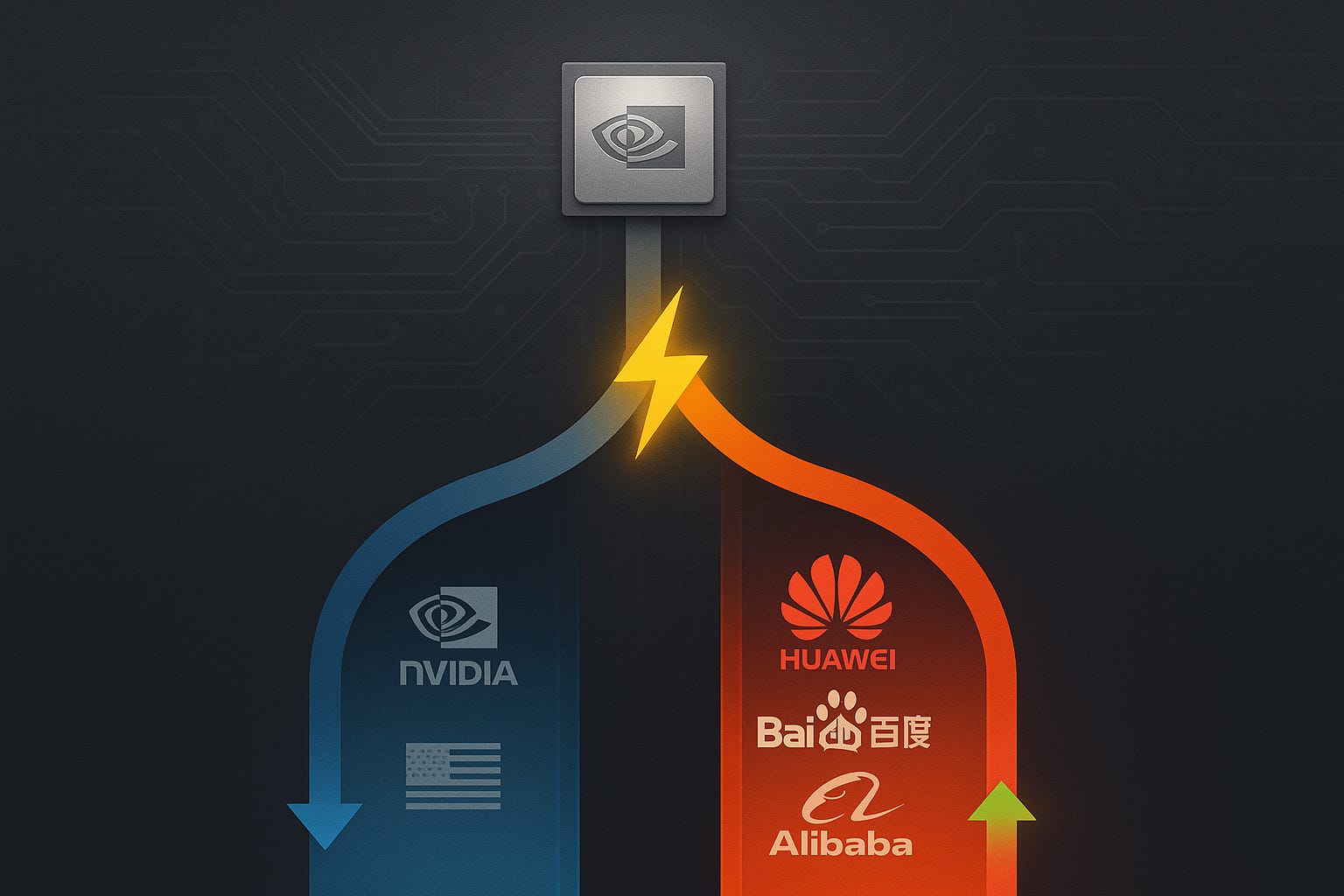
The technical breakthrough centers on model recompilation and kernel optimization. Chinese AI labs have spent the past 18 months rewriting the low-level compute kernels that translate model operations into chip instructions, moving away from Nvidia's proprietary CUDA libraries toward open-source frameworks like Triton and custom compilers for Huawei's Ascend AI chips and Alibaba's T-head processors. DeepSeek V4, the latest iteration of the model that shocked Silicon Valley with its efficiency, now runs entirely on Huawei Kunpeng 920 chips in production inference workloads, according to sources familiar with the deployment. MiniMax and Kimi have similarly ported their large language models to run on Alibaba's in-house silicon, achieving latency and throughput metrics that meet commercial service-level agreements. Huawei revealed a new scientific approach to chip development that underpins these gains, incorporating novel memory architectures and interconnect topologies that reduce the performance gap with Nvidia's latest hardware. The company plans to integrate these chips into upcoming server products, creating a closed-loop ecosystem where Huawei controls both the silicon and the system integration. Alibaba's T-head division has taken a different path, licensing its chip designs to third-party foundries and focusing on software compatibility with the PyTorch and TensorFlow ecosystems that dominate Chinese AI development. The result is a two-pronged domestic alternative that covers both Huawei's vertically integrated stack and Alibaba's more open platform, giving Chinese AI companies genuine choice for the first time.
How the $570 million flows through the P&L
The financial calculus driving the pivot is straightforward. Nvidia's China-specific chips, stripped of interconnect capabilities to comply with US export restrictions, cost roughly the same as domestic alternatives but deliver 30-50% lower performance in multi-node training workloads. Chinese AI companies face a choice between paying a premium for inferior Nvidia hardware or investing in domestic chips that will improve over time. The math favors domestic investment. Goldman Sachs estimates that Chinese hyperscalers and AI labs will redirect approximately $570 million in annual chip spending from Nvidia to domestic suppliers by 2028, based on current run rates and projected model training demands. This figure captures only direct chip procurement. The total economic shift includes savings on software licensing, reduced supply chain risk, and the elimination of export-control compliance costs. For Huawei, the pivot creates a new revenue stream that offsets declining smartphone chip sales. Huawei's Ascend AI chip division now generates an estimated $1.2 billion in annual revenue, with margins that approach 40% due to the premium pricing that scarcity and export restrictions enable. Alibaba's T-head unit operates on thinner margins but benefits from internal transfer pricing, as Alibaba Cloud can offer domestic chip-powered compute instances at prices that undercut Nvidia-based offerings by 15-20%. The net effect on China's AI industry is a reduction in total cost of ownership for model training and inference, accelerating the deployment of AI applications across the domestic economy.
Who gains and who loses in the competitive reshuffle
The winners are clear. Huawei and Alibaba capture direct chip revenue, while Horizon Robotics and Xpeng gain automotive design wins that would have gone to Nvidia's Drive platform. Horizon Robotics, already a dominant player in China's advanced driver-assistance systems market, now supplies Volkswagen's China-market vehicles, displacing Nvidia from one of the largest automotive chip contracts in the world. Xpeng's Turing chip, co-developed with Volkswagen, represents a second independent automotive silicon effort that further erodes Nvidia's automotive pipeline. Zelostech, the robovan startup, explicitly plans to use multiple chip suppliers, signaling that even new entrants view Nvidia dependency as a liability rather than an advantage. The losers extend beyond Nvidia. Broadcom, which supplies networking chips for Nvidia's DGX and HGX systems, faces reduced China demand as domestic alternatives replace entire server racks. Fujitsu and Wipro, partners of networking company DriveNets, may see slower growth in China if domestic networking solutions displace their hardware. Kevin Xu of Interconnected Capital estimates that Chinese companies will still need Nvidia chips for 3 to 5 more years for frontier model training, but the window is closing. The most exposed player is Nvidia itself. China accounted for approximately 20% of Nvidia's data center revenue before export restrictions, and that share has already fallen below 10%. A complete pivot by 2028 would eliminate roughly $4-5 billion in annual revenue from Nvidia's long-term growth trajectory, forcing the company to rely even more heavily on US and European hyperscaler demand to sustain its valuation.
Downstream effects on hyperscalers, fabs, and enterprise buyers
The downstream consequences cascade through the entire semiconductor supply chain. Chinese hyperscalers, including Alibaba Cloud, Huawei Cloud, Tencent Cloud, and Baidu AI Cloud, now face a bifurcated procurement strategy. They must maintain Nvidia-based clusters for the 3-5 year transition period while simultaneously building out domestic chip capacity. This dual-investment requirement strains capital expenditure budgets, but the long-term payoff is reduced geopolitical risk. Alibaba Cloud has already begun offering compute instances powered by T-head chips at prices 15-20% below Nvidia-based instances, compressing margins for the entire Chinese cloud market. Enterprise buyers in China, from state-owned banks to manufacturing conglomerates, now face a choice between Nvidia-powered AI services that may face future export restrictions and domestic alternatives that offer lower performance but guaranteed supply. Most are choosing domestic. The shift also reshapes fab demand. Huawei's Ascend chips are manufactured at SMIC using mature process nodes, while Alibaba's T-head chips use a mix of SMIC and Taiwan-based foundries. This dual-sourcing strategy reduces reliance on any single fab but limits performance compared to Nvidia's TSMC-manufactured chips. The automotive supply chain sees an even more dramatic shift, as Xpeng's Turing chip and Horizon Robotics' solutions replace Nvidia's Drive platform in China-market vehicles from Volkswagen and domestic automakers. This creates a parallel automotive semiconductor ecosystem that may eventually compete with Nvidia globally, particularly in price-sensitive segments where Chinese automakers dominate.
What the pivot signals about market and regulatory direction
The pivot represents a strategic bet by Beijing that domestic chip capabilities will reach parity with Nvidia within five years, backed by policy tools that include subsidies, procurement preferences, and export controls on critical materials. The timing aligns with the Trump administration's tightening of semiconductor export restrictions, which has accelerated rather than slowed China's domestic chip development. The message to global markets is unambiguous. China will no longer accept dependency on US-controlled chip supply for its most strategic technology sector. This has immediate implications for Nvidia's valuation, which still prices in a China recovery scenario that now appears increasingly unlikely. Jensen Huang's public statements about the resilience of the CUDA ecosystem ring hollow when China's leading AI labs have already demonstrated production-grade alternatives. The pivot also signals a broader shift in global semiconductor supply chains toward multi-sourcing and regional redundancy, a trend that DriveNets' $410 million funding round with AMD as a new investor underscores. Charlie Kawwas, president of Broadcom's semiconductor solutions group, noted that network fabric performance is a primary driver of AI economics, and China's domestic chip ecosystem now includes networking solutions from companies like DriveNets that compete with Broadcom's offerings. The net effect is a fragmentation of the global AI chip market into two largely separate ecosystems. One centered on Nvidia for the US and its allies, and one centered on Huawei and Alibaba for China and its Belt and Road partners. This bifurcation will persist for at least a decade, reshaping investment flows, supply chains, and competitive dynamics across the entire technology sector.
The next phase of this transition will test whether Chinese domestic chips can scale to frontier model training, the most demanding workload in AI. DeepSeek V4's successful deployment on Huawei Kunpeng 920 chips for inference is a milestone, but training large models from scratch requires thousands of chips operating in parallel with minimal interconnect latency, an area where Nvidia's NVLink and InfiniBand still hold a commanding lead. Huawei's new scientific approach to chip development, which the company has not fully detailed, may address this gap through novel memory architectures that reduce the need for high-bandwidth interconnects. Alibaba's T-head division is pursuing a different strategy, focusing on disaggregated computing architectures that separate compute, memory, and networking into independently scalable pools. Both approaches face significant engineering challenges, but the pace of progress has surprised even industry veterans. Kevin Xu's estimate of 3-5 more years of Nvidia dependency is conservative if Chinese labs continue to achieve the kind of efficiency gains that DeepSeek demonstrated with V4. The wildcard is quantum computing. IQM Finland Oy, a global leader in superconducting quantum computers with over 350 employees, is pursuing a public listing via a SPAC merger with Real Asset Acquisition Corp. that includes an upsized $146 million PIPE with a new commitment from Ilmarinen. If quantum computing reaches commercial viability within the decade, it could render the entire Nvidia-versus-Huawei competition moot by introducing a fundamentally different computing paradigm. For now, the battle lines are drawn, and China's chip pivot is no longer a theoretical possibility. It is a documented reality with measurable financial and competitive consequences.
The BossBlog Daily
Essential insights on AI, Finance, and Tech. Delivered every morning at 06:00 Asia/Shanghai. No noise.
Unsubscribe anytime. No spam.