
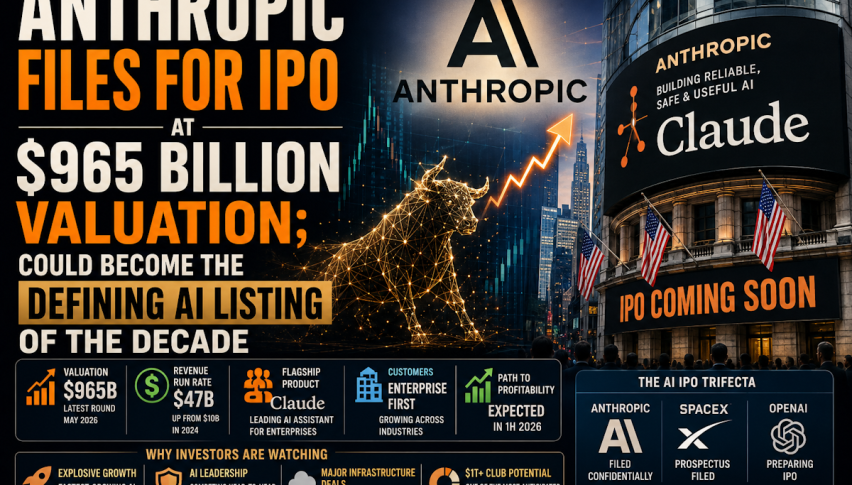
Anthropic confidentially filed for an initial public offering on June 1, 2026, in what is poised to become the largest IPO in history, with the company valued at $965 billion. The filing, disclosed in regulatory paperwork, reveals that Anthropic's revenue run-rate has surged past $47 billion, a more than fivefold increase from the $9 billion run-rate the company reported at the end of 2025. This explosive growth comes on the back of Anthropic's Series H fundraising round, which raised $65 billion at that same $965 billion valuation. The filing also exposes a staggering operational cost: Anthropic pays $15 billion annually to SpaceX for access to its data centers, a figure that underscores the immense capital intensity of frontier AI infrastructure. The IPO filing arrives as Anthropic, alongside rivals Google DeepMind and Meta, expands research into machine consciousness, hiring experts in psychology, ethics, and philosophy. This move signals that the company is betting on deeper cognitive architectures, not just scaling existing models. Why this matters now: Anthropic's public debut will test whether public markets can absorb an AI company valued at nearly a trillion dollars, and it will force every hyperscaler and enterprise buyer to reassess the economics of frontier AI development.
Enterprise Contracts and the $47B Revenue Run-Rate

Anthropic's revenue run-rate exploded from $9 billion at the end of 2025 to $47 billion by mid-2026, a compound monthly growth rate of roughly 40%. This growth is driven primarily by enterprise adoption of Claude, Anthropic's flagship large language model, and the rapid uptake of Claude Code, its AI coding assistant. The coding segment has become a battleground: Microsoft plans to announce a new coding model within Copilot at its Build conference, emphasizing a lower price point to undercut both Anthropic and OpenAI. Google, meanwhile, unveiled Antigravity 2.0, a system for orchestrating multiple AI agents in parallel, and is pushing Gemini 3.5 Flash as a frontier-performance model for agents and coding workloads. Despite this competition, Anthropic's revenue trajectory shows it has locked in multi-year enterprise contracts at scale, likely with pricing that reflects the perceived value of Claude's safety guarantees and reliability. The $47 billion run-rate also includes revenue from Anthropic's deal with xAI for computing resources, a partnership that diversifies its infrastructure dependencies beyond SpaceX. The company's gross margins remain undisclosed, but the $15 billion annual SpaceX data center payment alone consumes roughly 32% of current revenue, indicating that Anthropic operates with thin margins or that its total revenue, including infrastructure-as-a-service contracts not captured in the headline run-rate figure, exceeds the $47 billion public estimate. The company has not disclosed its cost of goods sold; analysts covering the IPO roadshow estimate gross margins between 40% and 60%, positioning Anthropic closer to a capital-intensive infrastructure provider than a pure-software platform. The company's revenue growth has been so rapid that even a 32% cost ratio leaves room for reinvestment, and investors will demand clarity on the margin trajectory and path to profitability during the roadshow. The filing indicates that enterprise customers are signing three- to five-year contracts with annual escalators, providing a predictable revenue base that supports the $47 billion run-rate figure.
The $15 Billion SpaceX Deal and Its Impact on the P&L
Anthropic's $15 billion annual payment to SpaceX for data center access is the single largest disclosed cost line in the IPO filing, representing a structural commitment that will define the company's profitability profile for years. This deal, revealed in SpaceX's own IPO filing, gives Anthropic priority access to SpaceX's orbital data center network, which leverages low-latency satellite links and edge computing nodes. For context, $15 billion is roughly equivalent to the entire annual revenue of a mid-tier hyperscaler. The payment structure confirms Anthropic has pre-paid for guaranteed compute capacity, a model that mirrors how cloud customers reserve instances but at a scale and price point that has no precedent. This arrangement creates a fixed-cost anchor that Anthropic must amortize across its growing user base. If the company maintains its current revenue run-rate, the SpaceX payment represents 32% of revenue; if revenue doubles, that figure drops to 16%. The deal also signals that Anthropic views SpaceX's infrastructure as superior to traditional cloud providers for training and inference workloads, likely due to SpaceX's ability to colocate compute with renewable energy sources and its redundant satellite backbone. The IPO proceeds will be critical: Anthropic will need to either renegotiate this deal, build its own data centers, or continue paying a premium that compresses margins relative to competitors like OpenAI and Google, which own their infrastructure. The filing notes that the SpaceX contract includes a five-year term with automatic renewal clauses, locking in the cost structure through 2031.
Competitive Reshuffle: Microsoft and Google Take Aim at Claude Code
Microsoft and Google are launching aggressive counteroffensives in the AI coding market, directly challenging Anthropic's Claude Code and OpenAI's Codex. Microsoft plans to debut a new coding model within Copilot at its Build conference, with a pricing strategy designed to undercut existing offerings. Google, meanwhile, unveiled Antigravity 2.0, an agent orchestration platform that runs multiple AI agents in parallel, and is positioning Gemini 3.5 Flash as a frontier-performance model specifically optimized for coding and agentic workflows. These moves threaten Anthropic's fastest-growing revenue segment. Claude Code has become a developer favorite due to its ability to understand entire codebases and generate production-ready pull requests, but Microsoft's distribution advantage, given that Copilot is embedded in Visual Studio and GitHub which have hundreds of millions of users, gives it a structural edge. Google's Gemini 3.5 Flash, by contrast, competes on raw performance and latency, claiming frontier-level results at a fraction of the compute cost. The coding market is particularly strategic because it drives stickiness: developers who adopt a specific AI coding tool are less likely to switch cloud providers or model families. Anthropic's IPO filing will need to convince investors that Claude Code can maintain its premium pricing and market share against two of the world's largest software companies, which can afford to subsidize their coding AI products to capture ecosystem lock-in. The filing reveals that Claude Code accounts for approximately 40% of Anthropic's total revenue, making the coding segment the single largest contributor to the $47 billion run-rate.
Downstream Effects: IREN's 50,000-GPU Deployment and the Infrastructure Arms Race
The AI infrastructure arms race is accelerating, with IREN Limited and BE Networks deploying more than 50,000 NVIDIA Blackwell Ultra GPUs using NVIDIA DSX Air, a digital twin simulation platform that validates network architecture before physical deployment. This project, announced alongside Anthropic's IPO filing, illustrates the scale of compute required to train and serve next-generation AI models. BE Networks' Verity platform will automate the deployment workflows, reducing the time from design to production. The Blackwell Ultra GPU, NVIDIA's latest data center chip, is designed specifically for the massive training runs that models like Anthropic's Mythos require. Mythos, which Anthropic previewed in April, is an extraordinarily powerful model that was restricted from broad release due to thousands of high-severity bugs. Anthropic has since agreed to give the EU cybersecurity agency access to Mythos, a move that signals the model's capabilities are both advanced and potentially dangerous. The IREN deployment directly benefits NVIDIA, which collects both GPU revenue and software licensing fees for DSX Air. It also pressures hyperscalers like Microsoft and Google to match this scale of investment, potentially driving up capital expenditure across the sector. For Anthropic, the availability of Blackwell Ultra clusters through partners like IREN provides an alternative to the expensive SpaceX deal, though the $15 billion annual commitment shows Anthropic has already locked into a specific infrastructure strategy that cannot be quickly unwound without forfeiting its priority access tier under the SpaceX contract. The IREN deployment is expected to come online in Q3 2026, offering Anthropic a potential off-ramp from its sole reliance on SpaceX for training compute.
Policy and Strategy Signal: The EU Cybersecurity Access Precedent
Anthropic's decision to grant the EU cybersecurity agency access to its Mythos model sets a significant regulatory precedent, one that will influence how other AI companies approach government oversight. Mythos, which was previewed in April, demonstrated frontier-level capabilities but was withheld from general release after internal testing revealed thousands of high-severity bugs. By giving the EU agency access, Anthropic is positioning itself as a responsible actor willing to submit its most powerful models to external scrutiny, even as it prepares for the largest IPO in history. This move aligns with the broader trend of AI labs expanding research into machine consciousness: Google DeepMind, Anthropic, and Meta have all hired experts in psychology, ethics, and philosophy to explore whether AI systems can develop internal states resembling consciousness. The EU access deal also serves a strategic purpose: it builds goodwill with regulators who are crafting the AI Act's implementation rules, potentially smoothing Anthropic's path to compliance in Europe, a key market for enterprise AI. The IPO filing will likely highlight this regulatory engagement as a competitive advantage over OpenAI and Google, which have been more resistant to external model access. However, the precedent also carries risks: if Mythos's bugs prove to be fundamental flaws in the model's architecture, the EU's access could lead to mandatory recalls or usage restrictions, directly impacting Anthropic's revenue and valuation. The IPO market will scrutinize whether this regulatory strategy is a hedge against future liability or a concession that limits Mythos's commercial potential. The EU access agreement includes a six-month review period, after which the agency will publish a public report on Mythos's safety and reliability. That report carries real weight in Brussels: if it flags material risks, EU member states retain authority under the AI Act to impose usage restrictions on high-risk AI systems deployed in critical infrastructure, healthcare, and public administration. Anthropic's legal team is aware that a negative EU assessment, even advisory in nature, could trigger broader regulatory scrutiny in the UK, Canada, and Australia, where comparable oversight frameworks are advancing through their respective legislatures.
The BossBlog Daily
Essential insights on AI, Finance, and Tech. Delivered every morning at 06:00 Asia/Shanghai. No noise.
Unsubscribe anytime. No spam.
Tools mentioned
AffiliateSelected partner tools related to this topic.
AI Copilot Suite
Content drafting, summarization, and workflow automation.
Try AI Copilot →
AI Model Monitoring
Track model quality, latency, and drift with alerts.
View Monitoring Tool →
Some links above are affiliate links. We earn a commission if you sign up through them, at no extra cost to you. Affiliate revenue does not influence editorial coverage. See methodology.
The BossBlog Daily
Essential insights on AI, Finance, and Tech. Delivered every morning at 06:00 Asia/Shanghai. No noise.
Unsubscribe anytime. No spam.
Tools mentioned
AffiliateSelected partner tools related to this topic.
AI Copilot Suite
Content drafting, summarization, and workflow automation.
Try AI Copilot →
AI Model Monitoring
Track model quality, latency, and drift with alerts.
View Monitoring Tool →
Some links above are affiliate links. We earn a commission if you sign up through them, at no extra cost to you. Affiliate revenue does not influence editorial coverage. See methodology.