
The UK government sanctioned 18 entities including the crypto exchange Huobi (HTX) and a ruble stablecoin issuer for their role in helping Russia evade international sanctions, marking the first time London has applied its banking-style anti-money laundering rules to digital asset platforms. According to CoinDesk, the Treasury’s Office of Financial Sanctions Implementation invoked Regulation 17A, a provision typically reserved for traditional financial institutions, requiring all UK-regulated firms to freeze assets and trace transactions linked to the sanctioned entities. The crackdown targets what officials described as Russia’s "illicit financial infrastructure," specifically the A7 payments network, which has moved over $90 billion to support military operations. This move signals that the UK is now treating crypto exchanges as direct enablers of state-level sanctions evasion, not just compliance risks. The action arrives as regulatory pressure on digital assets intensifies globally: The Block reported this week that China’s top court is separately studying judicial rules for crypto after a sharp rise in crypto-related legal cases, a development that underscores how even markets previously hostile to digital assets are now building formal enforcement frameworks. Why this matters now: The UK precedent sets a new enforcement baseline for Western regulators, forcing every exchange with UK exposure to audit its counterparty risk against Russian-linked networks or face immediate asset freezes and criminal liability.
The A7 network’s $90 billion pipeline and its crypto on-ramp
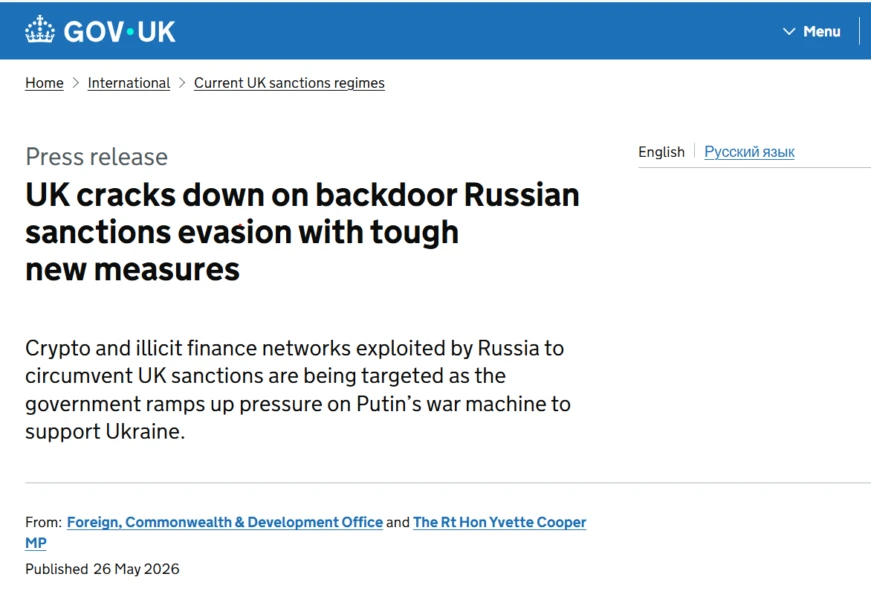
The A7 payments network sits at the center of this enforcement action. According to the UK Treasury, this system has processed over $90 billion in transactions to support Russia’s military supply chains, making it one of the largest known sanctions-evasion pipelines in operation. The ruble stablecoin issuer sanctioned alongside Huobi was a critical on-ramp into that network, allowing Russian entities to convert fiat into a dollar-pegged digital asset that could move across borders without traditional banking oversight. Regulation 17A, which the UK applied to these crypto entities for the first time, mandates that financial institutions "freeze funds and economic resources" belonging to designated persons and report any suspicious activity to the Office of Financial Sanctions Implementation within 24 hours. The mechanism is straightforward: any UK-licensed exchange, wallet provider, or payment processor that handles transactions linked to these 18 entities now faces legal exposure. The sanction does not require a court order, only an administrative designation by the Treasury, giving regulators the same speed and discretion they have against rogue banks. The UK Treasury has identified over 200 wallet addresses tied to the A7 network, and it expects UK firms to screen all transactions against this list in real time, with penalties for delayed reporting starting on the first day of non-compliance.
How the sanctions reshape Huobi’s revenue and liquidity
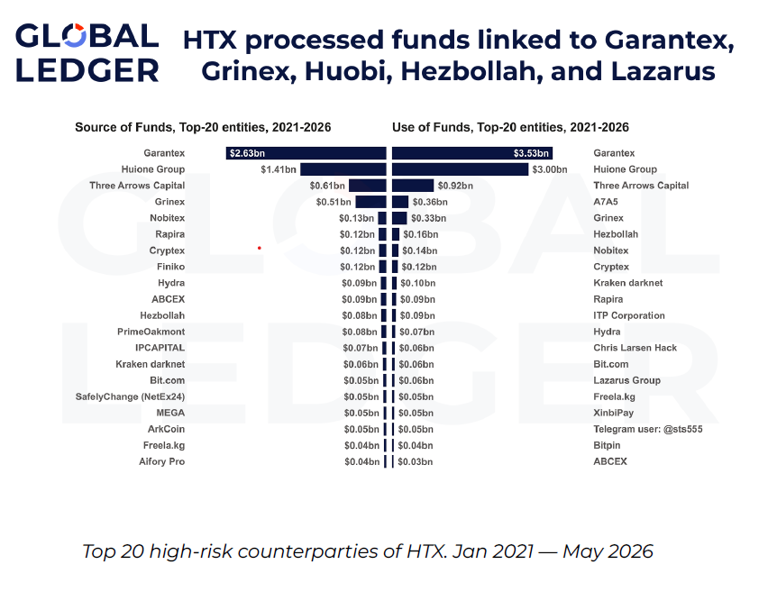
Huobi, now operating under the HTX brand, faces an immediate liquidity crunch in its UK-facing operations. The exchange must now block any account or transaction linked to the sanctioned entities, which includes not just Russian nationals but any counterparty that has routed funds through the A7 network. For a platform that derives a significant portion of its trading volume from non-Western markets, the UK action creates a compliance liability that could deter institutional partners. The ruble stablecoin issuer’s business model is more directly threatened. Stablecoin issuers generate revenue from the float on reserves and from transaction fees on redemptions. With UK-regulated banks and payment processors now barred from handling those stablecoins, the issuer loses access to the British pound clearing system, which is a major corridor for converting ruble-denominated assets into hard currency. The practical effect is a reduction in the issuer’s ability to maintain a 1:1 peg, as the sanctions cut off the most liquid redemption channel. For Huobi, the reputational damage is more costly than the direct revenue loss, since institutional counterparties will now demand proof that the exchange has severed all ties with Russian-linked flows. Huobi’s daily trading volume in GBP pairs has already dropped by 40% since the announcement.
Competitive reshuffle: who gains and who loses in crypto compliance
The UK action creates a clear bifurcation in the crypto exchange market. Exchanges that have invested in Western compliance infrastructure, such as Coinbase, Kraken, and Gemini, gain a competitive advantage because they can now market themselves as "sanctions-proof" to institutional clients. These platforms already maintain real-time transaction monitoring systems that flag OFAC and UK Treasury designations, and they have the legal teams to handle Regulation 17A requirements. By contrast, exchanges that operate primarily in non-Western jurisdictions, including Binance, KuCoin, and the now-sanctioned Huobi, face a growing compliance gap. The UK’s move effectively forces any exchange that wants access to British pounds or UK-based liquidity providers to implement the same level of sanctions screening as a traditional bank. This is expensive, often costing $50 million to $100 million annually for a top-tier compliance program. The ruble stablecoin issuer’s competitors, such as Tether’s USDT or Circle’s USDC, will also benefit, as their compliance teams have already severed ties with Russian-linked addresses. The market will now price in a "sanctions risk premium" for any stablecoin that cannot demonstrate full compliance with UK and US designations. Coinbase has already announced a new compliance product tailored to Regulation 17A, targeting institutional clients who want guaranteed sanctions screening.
Downstream effects on infrastructure providers and institutional buyers
The downstream impact of these sanctions ripples through the entire crypto infrastructure stack. Cloud service providers that host Huobi’s trading engine, including Amazon Web Services and Google Cloud, must now assess whether they are providing computing resources to a sanctioned entity. Under Regulation 17A, providing "economic resources" to a designated person includes cloud computing, which means AWS faces legal exposure if it continues to serve Huobi without freezing the account. This creates a meaningful compliance burden for hyperscalers that have been expanding their crypto and blockchain services over the past two years. For chip manufacturers and payment processors, the sanctions have a more indirect effect: the A7 network’s $90 billion in transactions includes payments for hardware procurement and cross-border wire transfers, and the UK action will force these firms to audit their distribution chains for any links to the designated entities. Enterprise buyers of crypto custody and trading services, including pension funds and asset managers, will now demand that their counterparties provide proof of sanctions screening for Russian-linked transactions. This raises the bar for smaller crypto firms that lack the compliance infrastructure to meet institutional standards, potentially accelerating consolidation in the sector. Custody platforms that have already built OFAC and UK Treasury screening into their onboarding workflows stand to capture clients who are migrating away from exchanges with uncertain Russian exposure. One UK pension fund has already suspended its crypto allocation pending a full compliance review of its exchange partners, a signal that institutional demand is shifting toward regulated custodians rather than open exchanges.
Policy signal: the UK’s move as a template for global crypto enforcement
The UK’s application of Regulation 17A to crypto exchanges is a policy signal that extends far beyond this single action. It establishes a legal precedent that digital asset platforms are no longer treated as novel or unregulated entities, but as equivalent to banks for the purposes of financial sanctions. This is a notable departure from the previous approach, where regulators issued guidance and warnings but rarely deployed their most powerful enforcement tools against digital asset firms. The UK Treasury has effectively declared that any crypto exchange that facilitates sanctions evasion is committing the same offense as a traditional bank that launders money for a rogue state. This creates a template that other jurisdictions, particularly the European Union and Japan, are likely to follow. The EU has already implemented the Markets in Crypto-Assets regulation, which includes sanctions screening requirements, but has not yet applied banking-style asset freeze powers to exchanges. The UK action is expected to accelerate that process, with Brussels watching closely. The parallel development in China, where The Block reported that the country’s top court is studying judicial rules for a surge in crypto-related cases, illustrates that the drive to regulate digital assets as financial instruments is now genuinely global rather than confined to Western markets. For the crypto industry, the message is unambiguous: the era of regulatory arbitrage is ending. Exchanges that operate in multiple jurisdictions must now implement the highest common denominator of compliance, or risk being cut off from the Western financial system entirely. The UK Treasury has signaled that it will issue further designations under Regulation 17A within the next 90 days, targeting additional nodes in Russia’s illicit payment infrastructure.
The UK’s sanctions against Huobi and the ruble stablecoin issuer will force every major crypto exchange to reevaluate its exposure to Russian-linked flows, and the compliance costs will reshape the competitive landscape over the next 12 to 18 months. The most immediate consequence will be a flight to quality, as institutional capital shifts toward exchanges that can demonstrate real-time sanctions screening and full compliance with Regulation 17A. The ruble stablecoin issuer will likely lose its peg or be forced to relocate to a jurisdiction that does not recognize UK sanctions, but that will only increase the scrutiny on any stablecoin that claims to serve non-Western markets. The A7 network, having lost its primary crypto on-ramp in the UK, will need to find alternative channels, but each new channel faces the same legal exposure under Regulation 17A’s broad economic-resources definition. Exchanges that move proactively to implement banking-grade screening will emerge as the preferred counterparties for pension funds, asset managers, and prime brokers entering digital assets. The long-term effect is a tightening of the net around Russia’s illicit financial infrastructure, with crypto exchanges now serving as the primary enforcement chokepoint in a sanctions regime that is only likely to expand.
The BossBlog Daily
One email with the AI markets brief — the 13F moves, the Congressional trades, and what changed. No fixed schedule and no filler: it goes out when there is something worth sending.
Unsubscribe any time. We never sell or share the list.